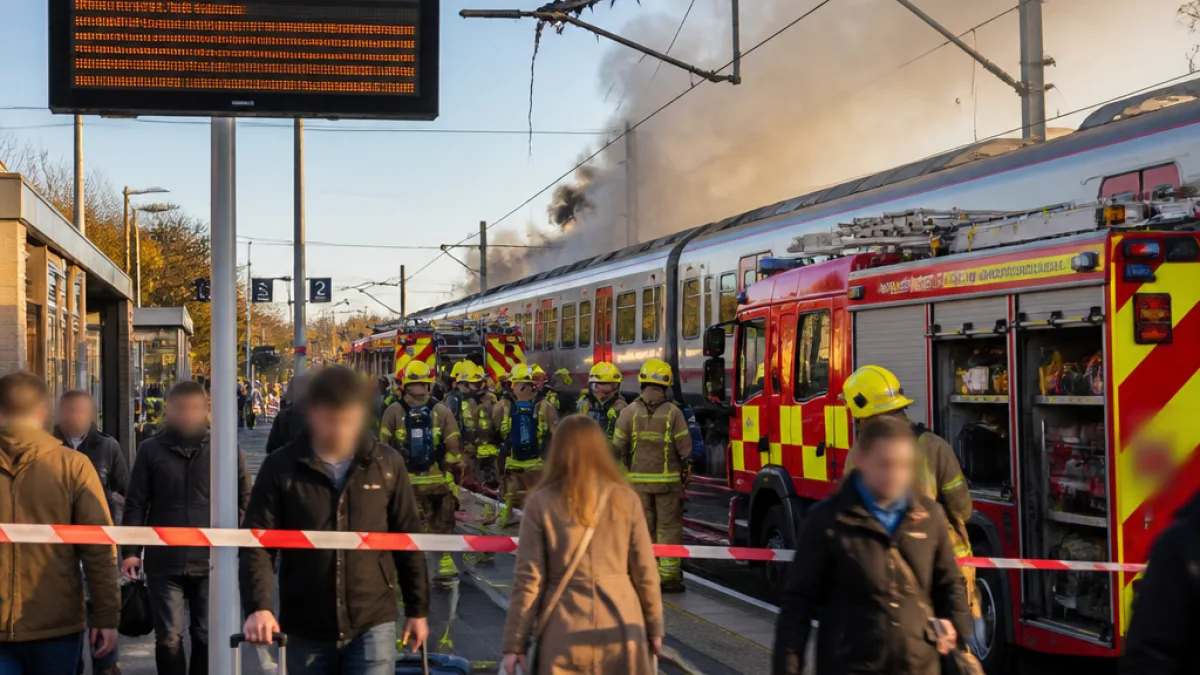
West London rail services linking Paddington with Heathrow and Reading entered a fifth day of disruption on Wednesday after overhead electrical cables were damaged by fire, leaving routes on a restricted timetable and prompting an evacuation of almost 400 passengers.
What happened
Fire crews were called to the scene after overhead lines caught fire, rendering the electrified section unusable. The London Fire Brigade deployed six fire engines and around 40 firefighters to attend the incident. National Rail has said it cannot operate the full electric timetable through the affected section until repair work is complete because of pressures on the electrical distribution network.
Passengers evacuated and services altered
Almost 400 people had to be escorted from a train that lost power after the cables went up in flames. Operators have run a reduced service pattern to limit demand on the damaged power infrastructure.
- Elizabeth line: operating at a reduced frequency of twice an hour to Heathrow Terminal 4, Heathrow Terminal 5, Maidenhead and Reading; some trains additionally call at Acton Main Line, Hanwell, Iver, Langley and Taplow.
- Great Western Railway (GWR): running a curtailed timetable, stopping at Slough, Maidenhead and Twyford.
- Heathrow Express: services operating less frequently than normal.
- Intercity services: largely unaffected as many can switch to diesel traction and run through the affected section.
Cause and official responses
GWR said on its website that the fire was caused by deliberate tampering with railway equipment.
“due to vandalism of railway equipment”
Transport for London (TfL) has warned passengers to allow extra time for journeys and to check before travelling, noting that train times and frequencies may differ from the usual timetable. National Rail has cautioned that the full electric timetable cannot be reinstated until repairs have reduced the load on the distribution system sufficiently.
Practical impact for travellers
The disruption affects local commuters, airport passengers and those using long-distance services that interchange at Paddington. Passengers heading to Heathrow should expect fewer Elizabeth line and Heathrow Express options, and plan additional time for connections. Intercity passengers are less likely to see cancellations but may face altered paths or longer journey times if connecting through the area.
| Operator | Current status |
|---|---|
| Elizabeth line | Twice-hourly services to T4, T5, Maidenhead, Reading; selected intermediate stops |
| GWR | Reduced timetable; stopping at Slough, Maidenhead, Twyford |
| Heathrow Express | Less frequent services |
| Intercity | Largely running using diesel where possible |
How long will disruption last?
Rail operators have advised that the limited service pattern is expected to remain in place until at least the end of Wednesday while engineers complete repairs and test the electric distribution. Passengers have been told to consult operator websites and real-time travel updates before setting out.
Voices from the line
At smaller stations west of Paddington, regular commuters told me the disruption has been disruptive and stressful. One passenger waiting at Slough described long queues for replacement buses and said: “It’s taken twice as long as usual to get to work. There’s not much information at times, people are confused.” Another traveller bound for Heathrow said they were relieved intercity services could still operate but worried about missing flights if replacement links ran late.
With the capital’s western corridor a vital artery for both daily commuters and international travellers, the remaining days of repair work will be closely watched. Operators and emergency services continue to prioritise safety while attempting to restore normal services as quickly as possible.