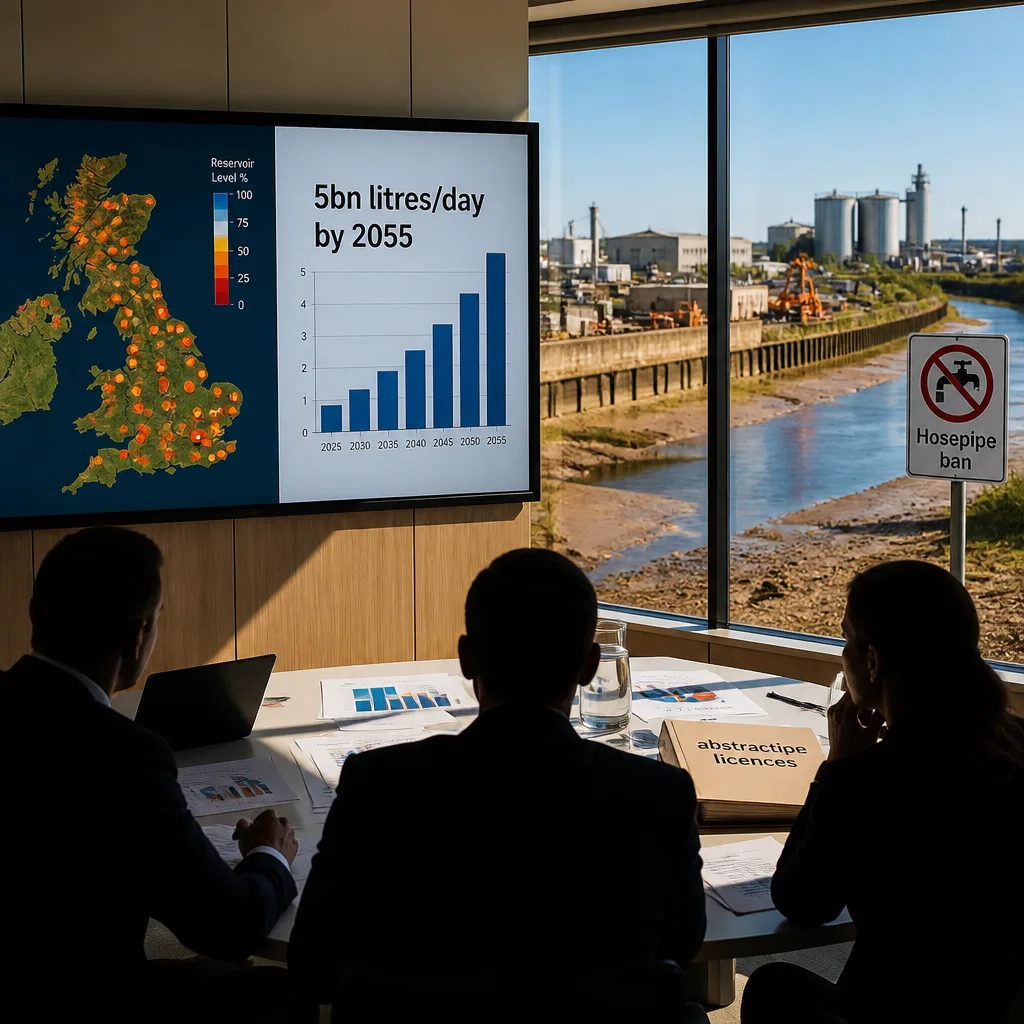
Ministers are in talks over proposals to increase water charges for businesses and industrial users as the Environment Agency (EA) warns the UK faces chronic supply shortages unless urgent action is taken.
Human stakes and scale
The discussion comes after what the EA describes as the UK's hottest summer on record this year and a period in which around 26 million people in Britain have been subject to water restrictions, primarily through hosepipe bans imposed during drought. The agency has warned that climate change, population growth and a range of environmental pressures have significantly reduced available water supplies.
The EA has set out a long-term picture in which public water supplies could be short by 5 billion litres a day by 2055 unless the government and water companies act.
How the shortfall would be addressed
The agency expects the response to split between management measures and new infrastructure: 60% of the gap is expected to be addressed by water companies managing demand and reducing leaks, with the remaining 40% to be met by building new water infrastructure and transfer schemes.
| Issue | Estimate / Detail |
|---|---|
| Predicted public shortfall by 2055 | 5bn litres a day |
| Share to be managed by demand reduction/leak control | 60% |
| Share to be met by new infrastructure | 40% |
| People subject to restrictions this summer | ~26 million |
Charging industry for the value of water
The EA has suggested the value of water to industry is not currently reflected in abstraction licensing. Under the present system, firms applying for an abstraction licence pay for the administrative cost of producing the licence, but not for the resource itself.
“If someone wants an abstraction licence from the EA, what they pay for is the cost of producing the licence. They don’t pay anything towards the value of that water. It’s the beginning of a conversation, but ministers have asked us to look at the value of water and how our abstraction licensing system works.”
The EA director of water, Helen Wakeham, has framed higher charges for commercial water use as part of the toolkit to reduce pressure on public supplies. Ministers have asked the agency to examine the value of water and the structure of abstraction licences.
Business use and emerging demands
Recent reporting by The Guardian found that many industrial users — from oil refineries to chemical plants and paper mills — face no formal requirements to reduce consumption, and that businesses in England alone use about 2.6 billion litres a day. Compounding demands are the UK’s growing data centre sector, which the EA notes is expected to double in capacity to 6.3 GW by 2030. The International Energy Agency is cited as finding that data centres consume more than 560 billion litres a year, largely through cooling systems that lose water to evaporation and require steady replenishment.
- Current industrial demand: ~2.6bn litres a day in England (business use).
- Forecast infrastructure need: combination of demand management and new supply schemes.
- Government spending: the private water sector has committed £104bn over the next five years to address shortages.
The proposals under discussion could change the incentives for heavy industrial water users, making licences reflect the scarcity value of the resource rather than only administrative costs. Officials say it is an initial conversation rather than a decided policy, but ministers have asked the EA to produce analysis of how the licensing system could work differently.
Raising charges for industry would mark a significant shift in water policy and could prompt legal and commercial challenges from sectors that rely on large volumes of water. It would also force firms to weigh investments in water-efficiency technologies or alternative cooling systems against higher running costs.
As the UK moves from crisis response to long-term planning, the balance between demand management, infrastructure spending and potential market signals such as higher charges for bulk users will determine whether the country can close the projected multi-billion-litre gap before it affects everyday supplies.