
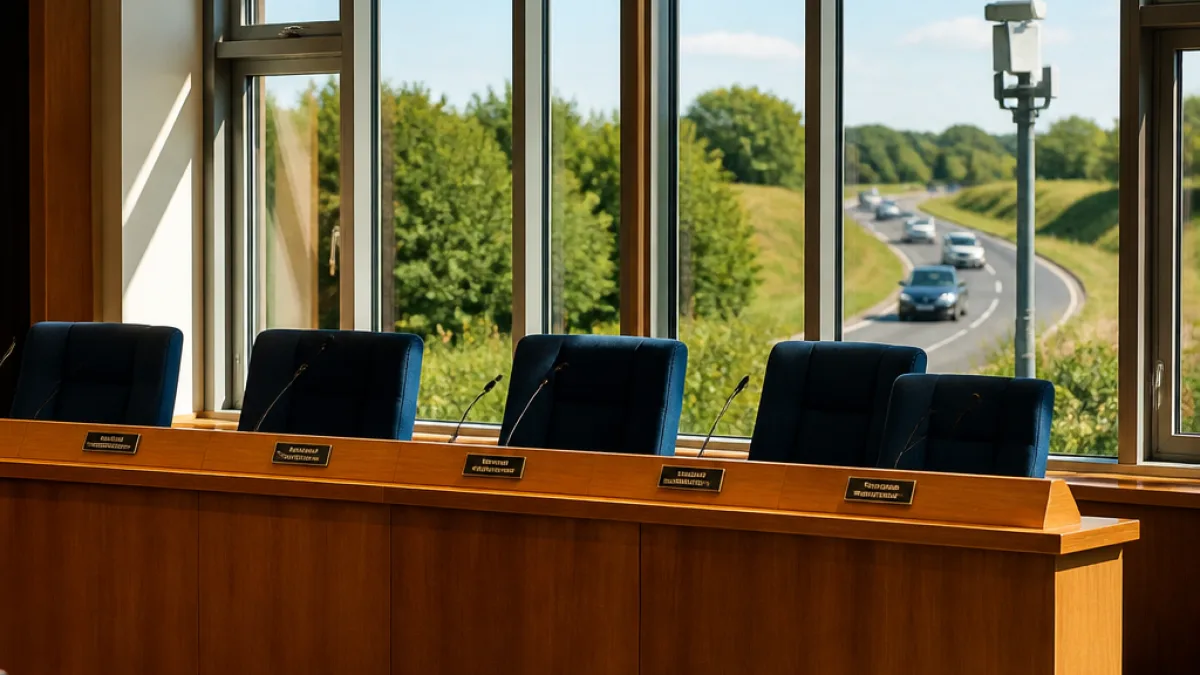
The Livingston Parish Council is considering an ordinance that would prevent privately owned Flock automated licence-plate readers (ALPRs) from operating on roads owned or maintained by the parish, a narrowly drawn measure aimed at limiting surveillance of motorists in parish rights-of-way.
What the proposal would do
Introduced last week and supported by Council Member Ryan Chavers, the ordinance would prohibit privately owned Flock cameras and similar ALPR systems from being installed in, or using, parish-controlled rights-of-way. It would not amount to a blanket ban on Flock equipment across the parish: the restriction would apply only to cameras sited on roads owned or maintained by the parish.
- The ordinance targets privately owned ALPRs located in parish rights-of-way.
- Cameras on state roads and in private parking lots would not be covered by the proposed rule.
- Homeowners’ association installations at neighbourhood entrances are among those most likely to be affected.
According to DeFlock, a grassroots group that uses crowdsourced data to catalogue ALPR deployments, there are nearly 40 Flock cameras across the parish. However, the majority of those are on state-maintained roads or within private business car parks and would therefore remain outside the scope of the proposed restriction.
Technology and concern
Flock’s systems are a more advanced iteration of traditional licence-plate readers. Beyond capturing a vehicle’s registration, ALPRs such as those made by Flock Safety can catalogue a number of vehicle attributes using artificial intelligence — including make, model, colour and certain distinguishing marks — and store that information in searchable databases.
| Attribute | Typical ALPR capability |
|---|---|
| Licence plate number | Captured and stored |
| Vehicle make/model/colour | AI-derived descriptors |
| Other identifying marks | Dents, roof racks, bumper stickers noted |
Flock Safety, founded in 2017, is the dominant ALPR provider in the United States and says it operates more than 80,000 cameras across 49 states. Municipalities have adopted the technology in many jurisdictions citing public-safety benefits, while opponents express concerns about privacy, scope of surveillance and data retention.
“You're not going to use our parish rights-of-way to surveil people,”
Those were the words of Council Member Ryan Chavers as he outlined the motivation behind the ordinance. He told colleagues he had acted after receiving a complaint from a constituent and said he had researched the issue before drafting the measure, describing it as a narrowly tailored response to that concern.
Where this leaves parish residents
If approved, the ordinance would restrict one avenue by which private entities — including homeowners’ associations — can position ALPRs to capture traffic on parish roads. It would not, however, affect devices on state highways or privately owned land such as business car parks. That distinction leaves much of the existing Flock footprint in the parish untouched.
The proposal illustrates a common local-government dilemma: balancing community safety tools that rely on vehicle-tracking technology against residents’ expectations of privacy on public thoroughfares. The council has yet to take a final vote and further deliberation can be expected as members weigh legal, technical and community implications of the measure.
DeFlock’s crowdsourced inventory and Flock Safety’s national footprint frame a wider debate playing out in jurisdictions across the United States about who may deploy automated surveillance devices in public space and under what rules.













