
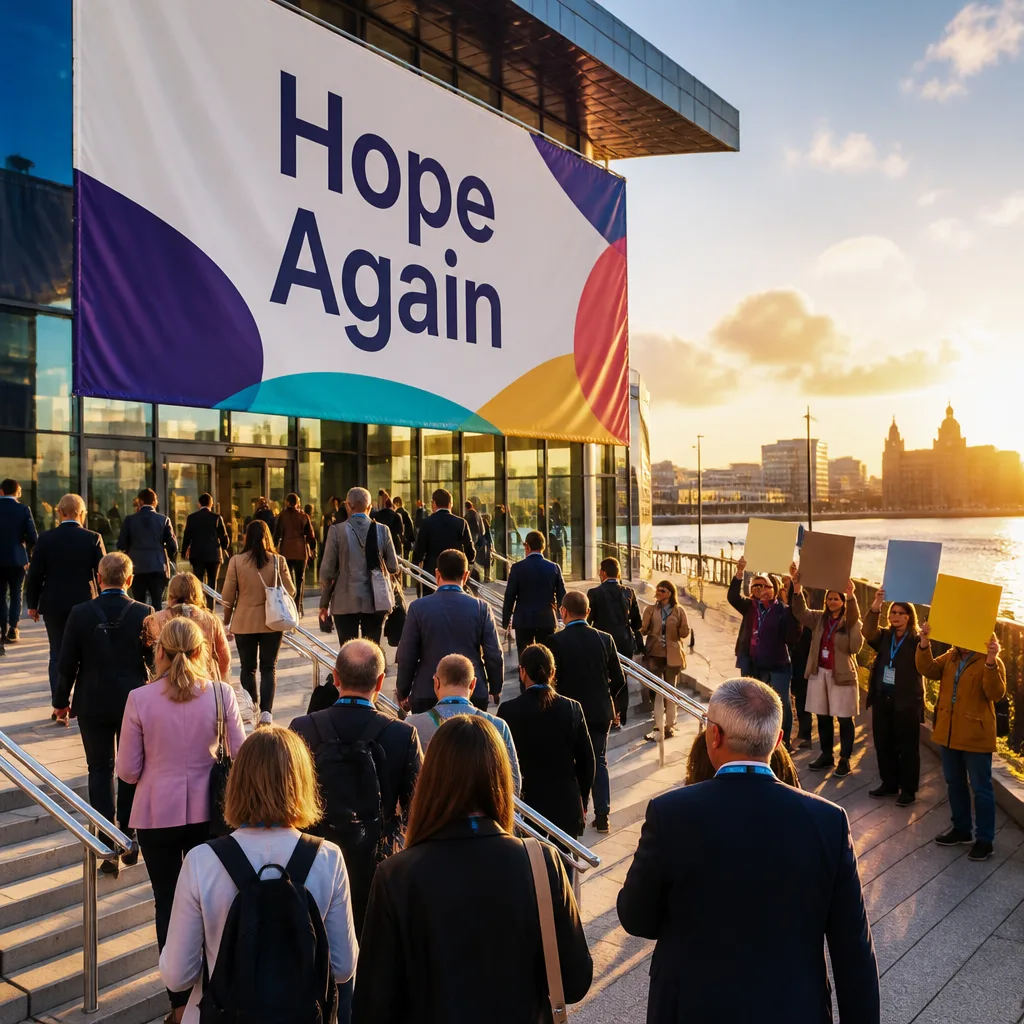
Labour arrived in Liverpool this week with a new slogan and an old instinct. The party’s conference branding, "Hope Again", places emphasis on reclaiming a past political standing even as commentators warn that the era of simple two-party dominance is over.
Back to what voters recall
The observation comes from a column by Guardian writer John Harris, who noted that the conference strapline appears to tap into Labour’s institutional nostalgia. He contrasted "Hope Again" with last year’s “Renew Britain”, arguing the current phrase is both more succinct and more explicitly backward-looking.
Harris linked the choice of language to a broader political tendency; the slogan’s use of the word "again" suggests a belief that Labour can return to a commanding share of the vote, comparable to its post-war peaks. He pointed to historical high-water marks in Labour support: 48.8% of the vote in 1951 and a near-equivalent performance for Harold Wilson in 1966, arguing these seasons of political dominance inform current thinking inside the party.
| Year | Context | Vote share |
|---|---|---|
| 1951 | Post-war Labour high | 48.8% |
| 1966 | Harold Wilson’s near-peak | Comparable to 1951 (column reference) |
Political fragmentation and its beneficiaries
Harris warned that the comfortable assumption of a two-party system is no longer realistic. He argued that a more fragmented model of British politics is likely to persist, and that Reform UK will continue to benefit from that reality unless Labour and other parties adapt their approach to cooperation.
That warning sits alongside other signs of strain in the political landscape. Harris pointed to local activism in Norfolk, where the town of Barnham is reportedly preparing a symbolic independence-style referendum in protest at proposals to house asylum seekers locally. He also noted the continuing presence of Reform UK despite what he characterised as its "current troubles".
"Hope Again"
Harris drew comparisons to other effective political slogans. He placed Labour’s new tagline alongside modern campaigning classics such as "Take back control" and "Make America Great Again", observing that the word “again” in each case evokes a return to a better-seen past.
Leadership, messaging and expectations
The columnist referenced comments made by Andy Burnham at the start of his leadership, in which he spoke of voters responding to "the promised return of the Labour they once knew". Harris suggested that such pronouncements reflect a persistent belief within Labour that it should command the progressive electorate in the way it once did.
He also invoked a broader geopolitical backdrop, noting that Britain’s new Labour prime minister had recently held cordial talks with a US president whose politics Harris described as having brought "a modern de facto fascism to his homeland" and who he said sought to export that model to Europe. That assessment is presented in the column as part of Harris’s wider commentary on the tenor of contemporary politics.
Implications for Labour and the wider system
- Messaging risk: Leaning on nostalgia may reassure core supporters but risks appearing backward-looking to voters seeking new solutions.
- Electoral fragmentation: A divided political field benefits insurgent parties such as Reform UK unless mainstream parties coordinate strategically.
- Local tensions: Protests like the Barnham referendum signal how national issues such as asylum policy can provoke local disruption and feed national debate.
The column concludes by urging Labour to recognise the limits of nostalgia in a changed political environment. Whether the party will recalibrate its strategy away from a desire to reclaim a past high-water mark or continue to lean on familiar themes will be a deciding factor in its ability to navigate a fragmented and unpredictable political era.












