
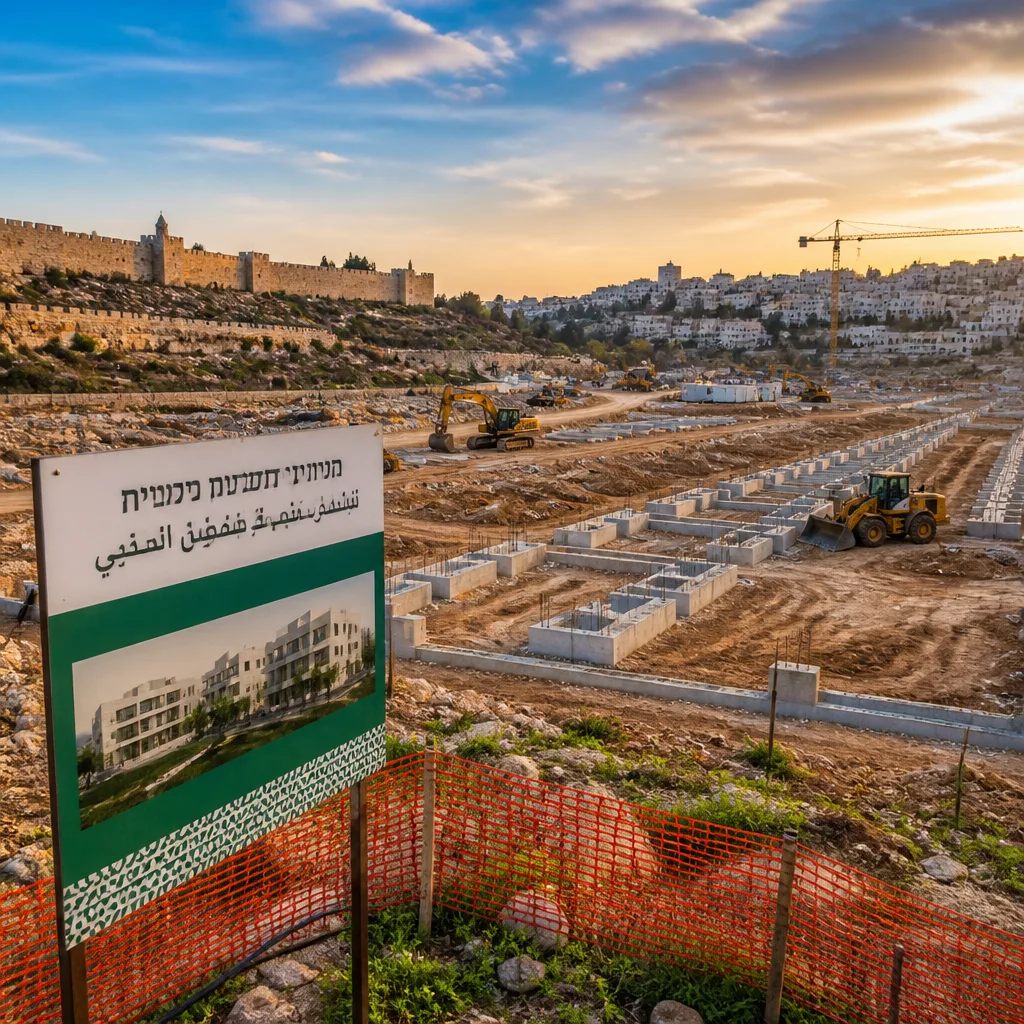
Israel has put out a tender for 1,234 housing units in the E1 area of the occupied West Bank, a controversial step critics say will further entrench settlements and make the creation of a contiguous Palestinian state markedly more difficult.
Move comes despite legal challenges and international concern
The Israeli housing ministry’s tender covers part of a larger project of 3,401 housing units approved by the government last August and spans roughly 12 sq km between East Jerusalem and the settlement of Maale Adumim. The tender, which is for a portion of the development, sets a bidding deadline of 19 October — just days before Israel’s general election on 27 October — a timing opponents say will complicate any attempt by a future government to reverse steps already taken.
Plans for E1 have been challenged in Israeli courts by Bedouin Palestinians who live in the area, together with Israeli peace groups. Nevertheless, the housing ministry proceeded to publish the tender this week.
Why E1 matters
Opponents and many diplomats warn that settlements in E1 would sever the West Bank geographically, cutting the north of the territory off from the south. That fragmentation, they argue, would make a contiguous Palestinian territory — a key element in most two-state proposals — practically impossible.
"the idea of a Palestinian state was 'being erased'"
The phrase was used by Finance Minister Bezalel Smotrich when the E1 plans were unveiled, underlining how the approval of new housing in the area has become a symbol of a broader political shift.
Scale and context
Settlements have expanded for decades. Since Israel occupied the West Bank and East Jerusalem in the 1967 Middle East war, around 160 settlements have been built, housing about 700,000 Jewish settlers. Some 3.3 million Palestinians live in the West Bank alongside them.
Expansion of settlement construction has accelerated since Prime Minister Benjamin Netanyahu returned to power in late 2022 at the head of a right-wing, pro-settler coalition. The pace of approvals also rose following the Gaza war triggered by Hamas’s attack on Israel on 7 October 2023, which reshaped domestic politics in Israel.
| Item | Figure |
|---|---|
| Total units approved (August) | 3,401 |
| Units in current tender | 1,234 |
| Area covered | 12 sq km |
| Settlements built since 1967 | ~160 |
| Jewish settlers | ~700,000 |
| Palestinians in West Bank | ~3.3 million |
Diplomatic fallout and implications for the UK
The tender has drawn sharp international criticism. Western governments have repeatedly stated that settlement expansion undermines prospects for peace and violates international law. The timing of the tender, immediately ahead of Israel’s election, heightens tensions: once tenders are issued and contracts signed, reversing construction becomes politically and legally more complex.
For the UK, the development will add to diplomatic pressure: ministers and officials must weigh responses that range from formal condemnation and raising the matter in international fora, to possible targeted measures. British policy has long supported a negotiated two-state solution; moves perceived as closing that path are likely to prompt public statements and diplomatic engagement.
- Human impact: Critics say E1 risks cutting the West Bank and undermining Palestinians’ ability to build a contiguous territory.
- Political timing: The tender’s deadline falls eight days before Israel’s general election, complicating reversal efforts.
- Wider trend: Settlement expansion has accelerated under the current Israeli government and since the 2023 Gaza war.
The publication of the tender makes concrete an already divisive policy choice and will test the response of international partners, including the UK, as well as the capacity of Israeli courts and future political authorities to alter a course that many say will have long-lasting consequences for Israeli-Palestinian relations.















