
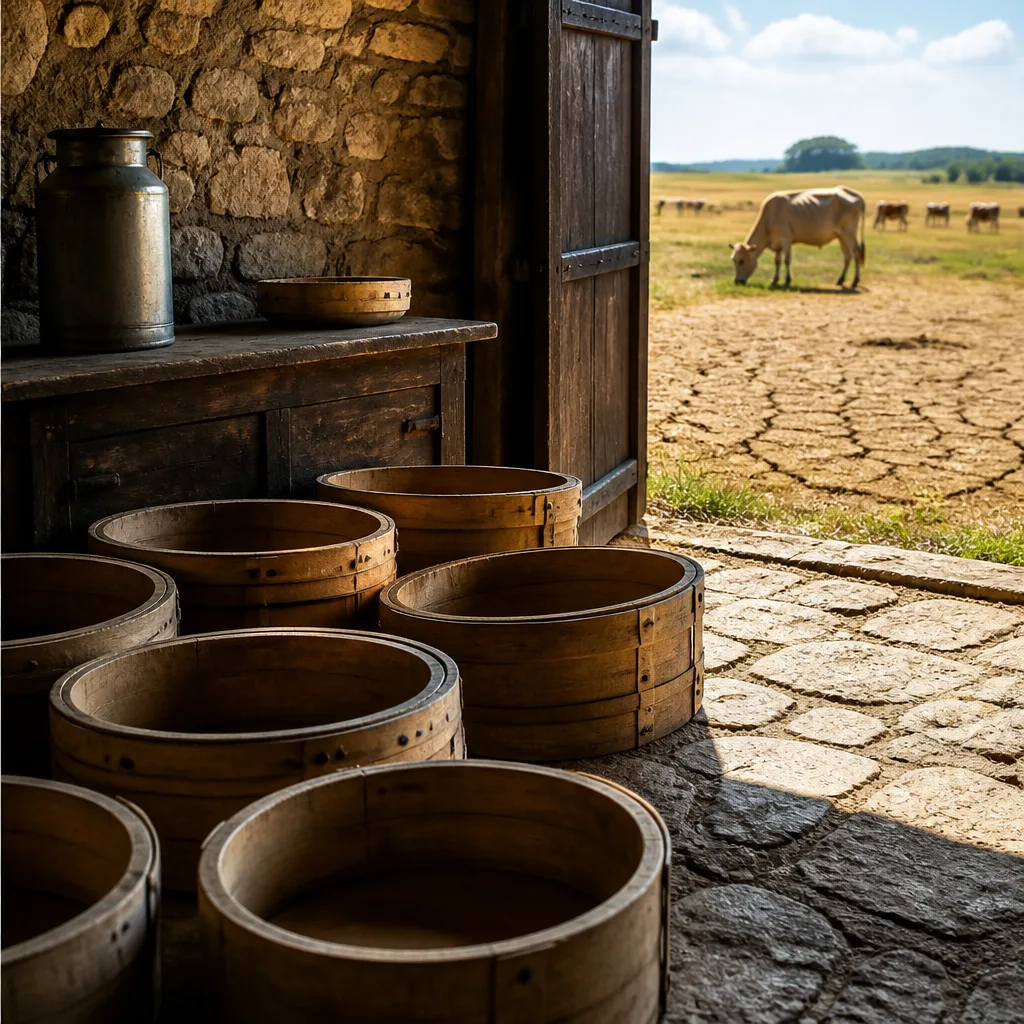
Historic heat waves and prolonged drought this summer have hit France’s pastoral landscapes and are putting some of the country’s best-known cheeses at risk. Farmers report parched pastures, stressed dairy herds and a growing need to buy supplementary feed — a combination that has curtailed milk supplies and forced many artisanal producers to pause production.
Production curtailed as cows suffer heat stress
Producers of Salers — a semi-hard, raw cow’s milk cheese made in the volcanic uplands of Cantal — were particularly affected: more than three-quarters of the region’s 80 Salers producers halted activity this summer after repeated heat waves and drought conditions. The interruption comes as France recorded an unusually extreme July, named the hottest month since records began in 1900 and the third driest on record by the national weather service.
Dairy farmers who traditionally let cows graze outdoors through the summer say the rhythm has broken. Pastures that would normally be lush and nutrient-dense have turned yellow and sparse, reducing the quality and quantity of milk. Farmers following strict AOP (Appellation d’origine protégée) rules cannot change milk sourcing or production locations, meaning they have limited flexibility when local feed and grazing fail.
“Before, we used to have a problem with the grass every 15-20 years. Now, it’s about every other year. And it’s getting worse.”
The comment comes from Laurent Lours, a dairy farmer and cheesemaker with 35 years’ experience, who described an unprecedented run of extreme weather for 2026, noting the impact on herd health, milk yields and calf survival. Farmers reported lower milk output and fewer or weakened calves — both immediate problems for small-scale cheesemakers who rely on regular supplies of raw milk to meet AOP specifications.
Why the AOP system matters — and complicates responses
The AOP label guarantees that every stage of a product’s creation takes place within a strictly defined area. It exists to protect regional specialities and the link between flavour and local environment — often called terroir. France has 47 cheeses carrying the AOP designation. But when local pastures fail, producers bound by these rules cannot simply source milk from farther afield without losing the label, reducing their options in a crisis.
That rigidity is part of what makes the problem both cultural and practical. On the one hand, consumers buy AOP cheeses for their distinct regional character; on the other, producers face a stark choice: accept interruptions to production, buy extra feed (adding cost) or suspend cheesemaking until conditions improve.
- Scale of impact: More than three-quarters of Salers producers suspended production this summer.
- Historic weather: July 2026 recorded as the hottest month since 1900 and the third driest on record in France.
- Regulatory constraint: AOP rules limit the ability to source milk from other areas, constraining emergency responses.
| Metric | Value |
|---|---|
| Number of Salers producers | 80 |
| Proportion halted | Over 75% |
| AOP cheeses in France | 47 |
| Typical grazing altitude for Salers cows | 800–1,500 metres |
The impacts already extend beyond immediate production pauses. When milk volumes fall or milk quality changes because of altered pasture composition, the sensory profile of cheeses — the very attribute consumers prize — can shift. For cheeses whose identity is rooted in the local flora eaten by grazing cows, changes to pasture species and quantity may alter aromas, textures and flavours season to season.
For now, many affected cheesemakers are managing by buying additional feed, but that carries costs and does not preserve the terroir-linked qualities AOP status is designed to protect. Farmers warn that what used to be an intermittent challenge has become more frequent: where grass failures occurred every 15–20 years in the past, they say the interval has shortened to roughly every other year.
As climate extremes become more common across Europe, the strain on traditional, place-based food systems is likely to increase. For consumers who care about provenance and taste, that raises difficult questions: how to support artisanal producers through climate shocks, whether regulatory frameworks need adapting for resilience, and how to balance heritage protections with practical survival in an era of unprecedented weather.














