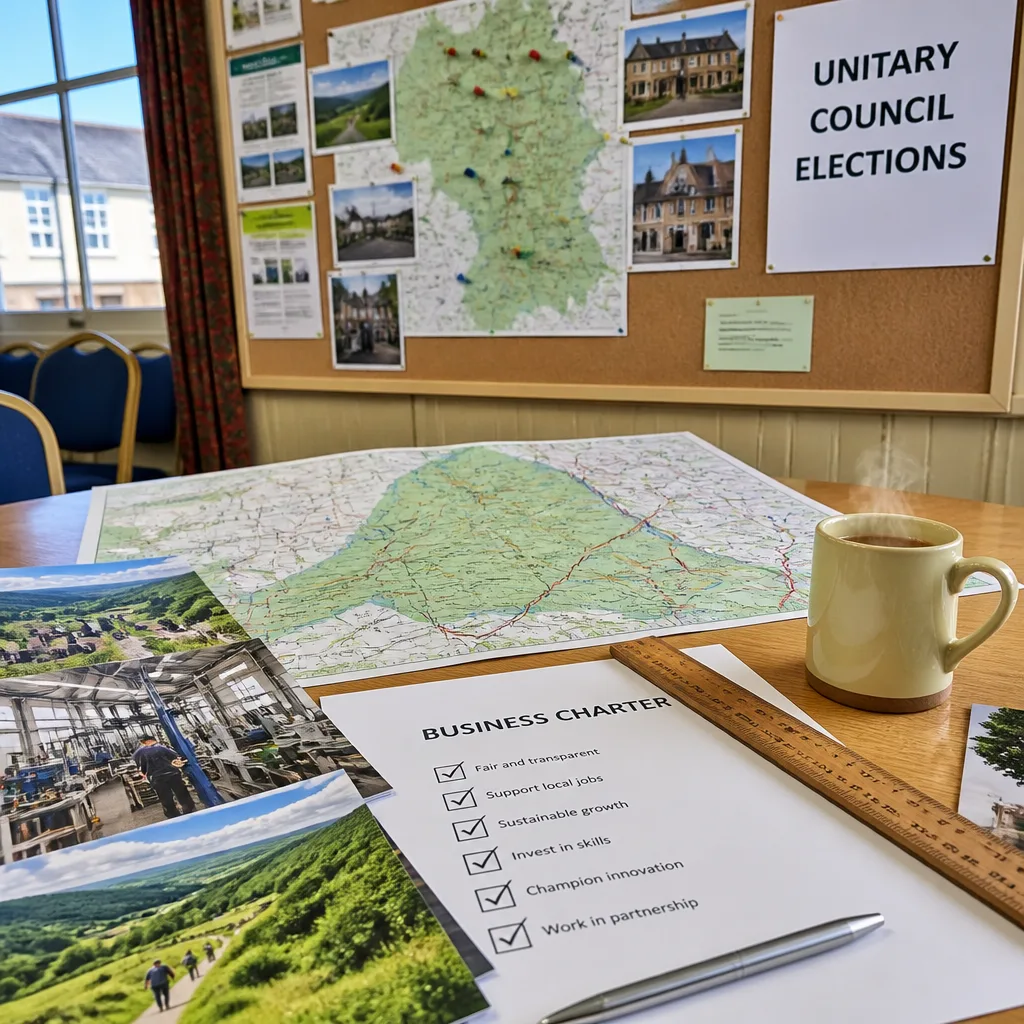
The Forest Economic Partnership (FEP) has pledged to draw up a Forest Business Charter to be placed before candidates for the new Gloucestershire unitary council ahead of local elections next May. The group says the charter will set clear, measurable commitments that the new authority will be asked to adopt and against which its performance will be publicly reported.
Making growth measurable
The FEP plans to develop the charter in consultation with firms across the district, including sessions in each of the Forest’s four market towns this autumn. Every candidate standing for a Forest ward will be asked to set out their position on the charter, the partnership said.
“Now the unitary is decided our job is to make sure the Forest of Dean is not simply part of the conversation, but shaping it,” said Nicola Bird, Chair of the Forest Economic Partnership.
The partnership is explicit that it will judge success not by structures of governance but by practical outcomes: whether young people have greater opportunities, whether local businesses can grow with confidence, whether manufacturers can recruit the skilled workforce they need, and whether investment reaches every part of Gloucestershire rather than only established growth corridors.
How the Forest’s economy stacks up
The FEP supplied a compact set of statistics to underline the district’s economic profile. The Forest comprises around 3,800 businesses, of which more than 90% are micro firms employing fewer than 10 people. Manufacturing is identified as the area’s largest industrial employer, while the visitor economy generated over £400 million from more than 5.8 million visits in 2023.
But the partnership also highlights regional weaknesses: average wages in the Forest are roughly 11% below the England average, and the proportion of residents with no formal qualifications is about 50% higher than the national rate — a phrase the FEP described as “roughly half as high again as the national rate”.
| Indicator | Forest of Dean | Context |
|---|---|---|
| Number of businesses | ~3,800 | Over 90% micro firms |
| Visitor economy (2023) | £400m+ | From 5.8m+ visits |
| Average wages | 11% below England average | Local earnings lag national level |
| No formal qualifications | ~1.5× national rate | Skills gap highlighted by FEP |
What the charter must deliver — and how it will be measured
The FEP says it will use the charter as a tool to turn political promises into measurable outcomes. It named specific tests of success: improved opportunities for young people in towns such as Cinderford, confidence among businesses in places like Mitcheldean to expand, and the ability of Coleford manufacturers to recruit adequately skilled staff.
- Local consultation: town sessions this autumn in each of the four market towns.
- Accountability: candidates asked to declare their stance on the charter before the May elections.
- Performance reporting: the FEP will publicly report progress against the charter’s commitments.
The proposition taps into a familiar national tension: outside major growth corridors, places risk being outcompeted for investment and skills. For business leaders, a charter that binds political actors to measurable commitments can be a useful lever — if it is grounded in plausible delivery mechanisms and resources.
Yet the facts the FEP cites also underline the scale of the challenge. With the vast majority of firms small and wages lagging, policy levers will need to focus on workforce skills, productivity support for micro and small enterprises, and targeted investment that reaches smaller towns rather than concentrating in already buoyant urban hubs.
The partnership’s pitch to “keep the Forest in the conversation” is straightforward. The harder questions will follow: how will the charter be turned into funded programmes, what central or county resources will be redirected, and crucially, how will outcomes for wages and jobs be monitored and enforced once the new council is in place?
For voters and businesses in the Forest of Dean, the coming months will test whether a locally crafted charter can translate political promises into better-paid jobs, improved skills and investment that reaches every postcode.