
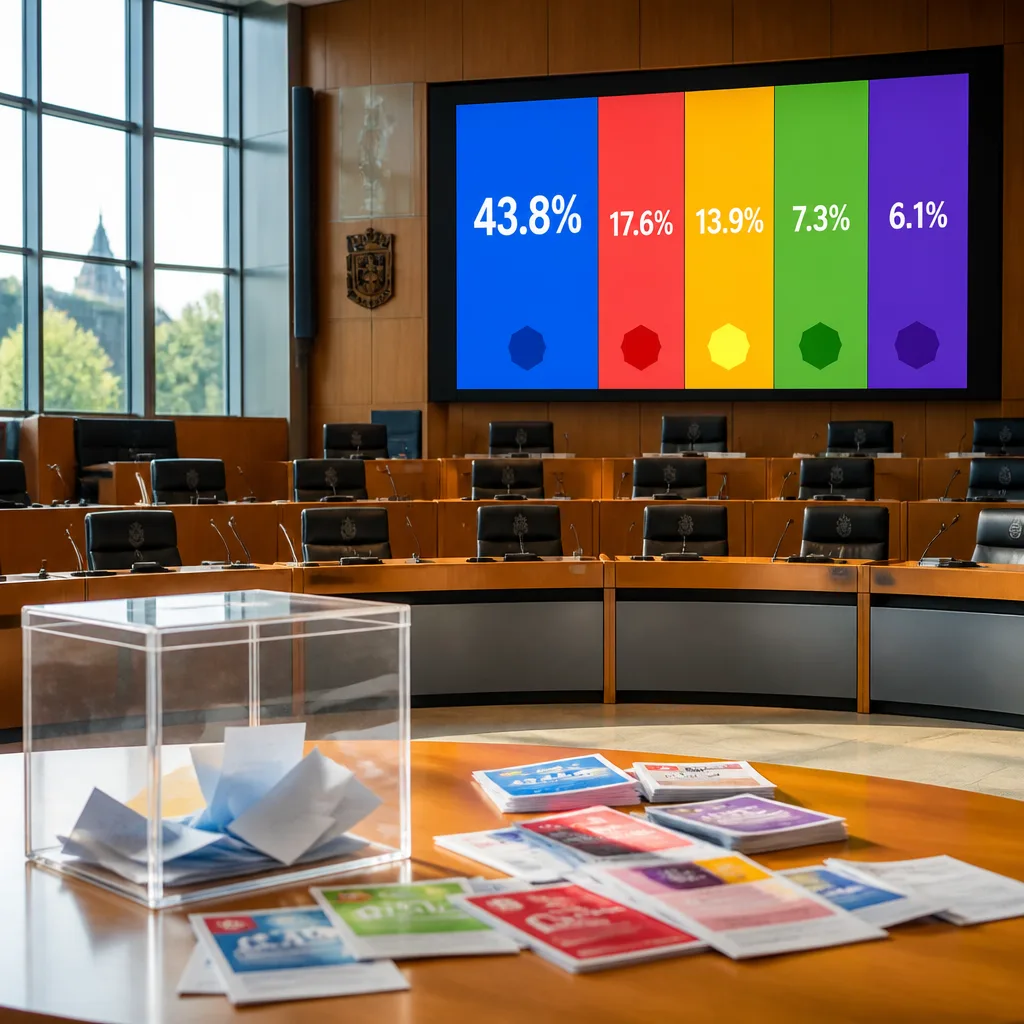
The far-right Alternative für Deutschland (AfD) secured a decisive victory in Sunday’s state election in Saxony-Anhalt, according to preliminary official results, but looks set to fall short of an outright majority in the 83-member regional parliament.
Result and immediate arithmetic
Early figures published on Monday show the AfD obtained 43.8% of the vote, more than double its share from the last contest five years ago. Despite the surge, the party is projected to be approximately three seats short of the threshold required to govern alone.
The Christian Democratic Union (CDU), the party of Chancellor Friedrich Merz, recorded just 17.2%, losing roughly half of its previous support and taking 15 seats under the preliminary count. The result represents a major setback for the federal coalition in which the CDU is a principal partner.
Coalition prospects and the political firewall
It remains unclear whether the AfD can translate its plurality into executive power. Mainstream parties at regional and national level have long practised a deliberate refusal to enter coalitions with the AfD — a so-called "political firewall" intended to limit the party’s influence. Those parties have indicated they will not join an AfD-led administration in Saxony-Anhalt.
After exit polls, the AfD’s lead candidate in Saxony-Anhalt, Ulrich Siegmund, said the party would not take part in what he described as "games" such as forming a minority government, but that it would reach out to other political forces. He was quoted as saying the AfD would extend a hand to those willing to pursue what he called better policies.
“We extend a hand to all democratic forces that wish to pursue better policies,”
Policy stances and international reaction
The AfD’s platform includes an anti-immigration stance and scepticism towards the EU. The party has also faced repeated accusations of favouring warmer ties with Moscow and calling for an end to military support for Kyiv — positions that have fuelled concern among mainstream German parties and abroad.
The result prompted sharp comment from neighbouring Poland. On the X platform, Prime Minister Donald Tusk wrote that "in Poland, only idiots or traitors can be happy about the AfD’s triumph in Germany."
What the numbers show
Preliminary official figures provide a clear picture of the shift in voter preference within Saxony-Anhalt.
| Party | Preliminary vote share | Notes |
|---|---|---|
| AfD | 43.8% | More than double its share five years earlier |
| CDU | 17.2% | Lost roughly half of prior support; 15 seats projected |
Consequences and next steps
The immediate consequence is a politics of arithmetic and exclusion. With the AfD short of a majority, the formation of a government will depend on whether other parties are prepared to tolerate its presence in executive office — something that, to date, mainstream groups have ruled out.
Key questions now are how the CDU and other parties respond to the scale of the AfD advance, and whether national leaders will adapt strategy to contain any wider momentum for the far right. The outcome also intensifies debate about Germany’s position on defence and foreign policy, given the AfD’s stances on Russia and Ukraine.
- AfD took a commanding plurality with 43.8% of the vote.
- Party falls an estimated three seats short of an overall majority in the 83-seat Landtag.
- Mainstream parties, including the CDU, have ruled out coalition cooperation with the AfD.
Final, certified results and detailed seat allocations will be published by electoral authorities in the coming days. For now, the Saxony-Anhalt outcome poses a testing moment for Germany’s political centre as it navigates the implications of a strengthened far-right presence in a regional parliament.












