
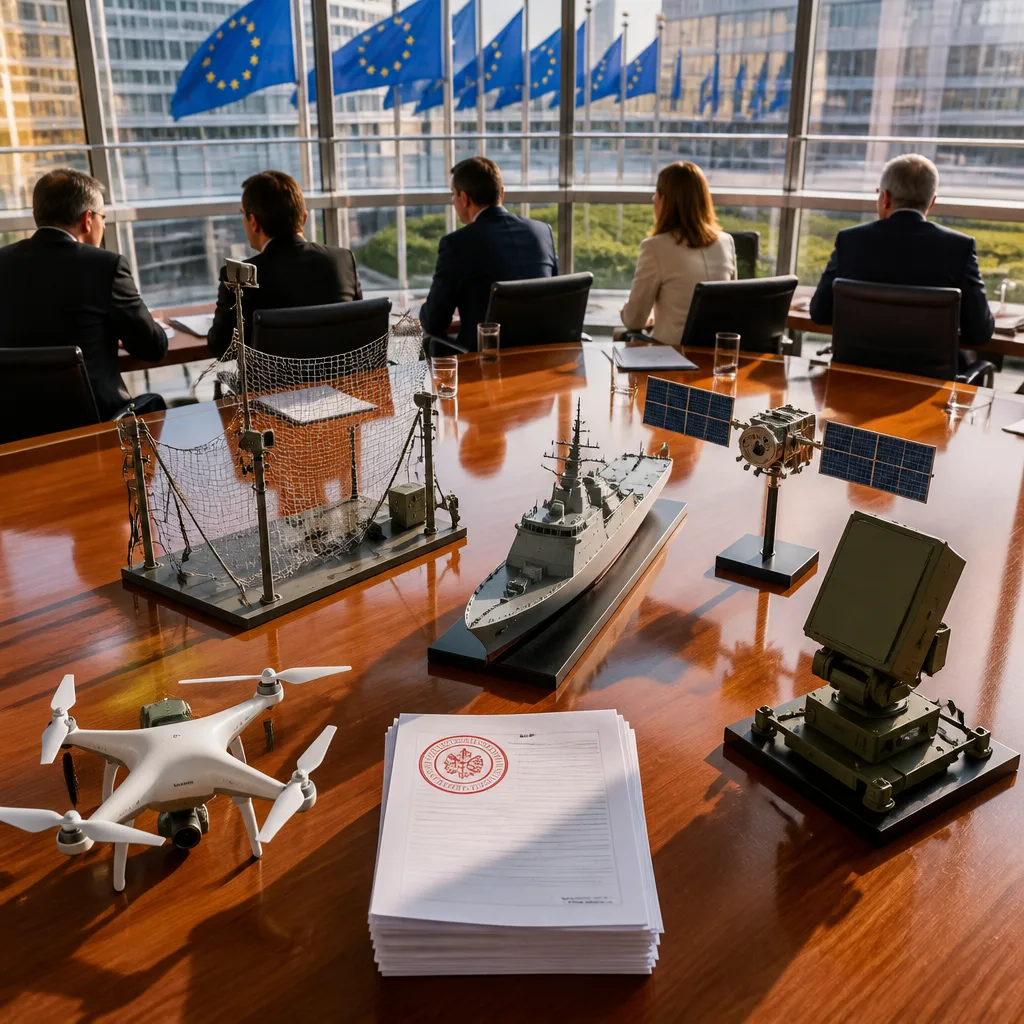
The European Council has approved five pan‑European defence projects designed to bolster military capabilities and deepen industrial collaboration across EU member states, marking a significant move by Brussels to extract greater economic value from public investment in science and technology.
What was approved
The projects were selected by the European Commission and are to be funded under the European Defence Industry Programme, receiving the label "European Defence Projects of Common Interest". They cover a range of capabilities, including drones and counter‑drone systems, maritime defence, space capabilities, missile early warning and security along Europe’s eastern borders.
| Label | Project focus (as described) |
|---|---|
| Project 1 | Drone and counter‑drone initiative |
| Project 2 | Defence of the sea / maritime programme |
| Project 3 | Improvement of European defence capabilities in space |
| Project 4 | Missile early warning system |
| Project 5 | Investment in security along eastern borders |
How this fits into Brussels’ wider agenda
These approvals sit alongside a string of innovation policy moves aimed at strengthening the link between research and commercialisation. Brussels is debating ways to capture more economic benefit from publicly funded research — not just in defence but across civilian research and innovation (R&I).
Recent items in the EU research policy discussion include a recommendation from the INPACT! work group to move the European Research Council’s Proof of Concept grants into the European Innovation Council, and high‑profile appearances by EU Research Commissioner Ekatarina Zaharieva at the Bits & Pretzels start‑up festival in Munich. Zaharieva’s visit highlighted themes such as the EU Startup and Scaleup Strategy, EU Inc., the Scaleup Europe Fund and the European Innovation Act.
What it means for industry, jobs and wages
Approving collaborative defence projects is intended to deliver pooled procurement and coordinated industrial planning — in effect trying to create larger, more predictable markets for defence suppliers. For businesses this can mean steadier orderbooks and higher barriers to entry, which can translate into investment in skills and facilities.
But there are trade‑offs. Larger projects and cross‑border programmes can favour established prime contractors and major defence groups over smaller suppliers unless explicit measures are taken to widen participation. For workers, the route from research to production matters: where projects include explicit plans for supply‑chain development and regional investment, they can underpin sustainable job creation and potential upward pressure on specialised wages; without them, gains may be captured mainly by incumbents.
For the civilian research economy, discussions about reallocating Proof of Concept grants to the EIC are aimed at improving commercial pathways for university‑based innovations. In practice, that could speed up the translation of early‑stage research into ventures that hire staff and generate taxable activity. Yet shifting grant management can also introduce delays or discontinuities if not handled with transitional clarity — a point policy‑makers will need to manage to protect researcher careers and spin‑out formation.
Policy risks and political context
Defence projects carry geopolitical signalling as well as industrial purpose. Investment in missile warning and border security projects reflects continued concern about strategic threats to Europe’s eastern flank. For firms, that geopolitical imperative can bring rapid funding — but it also risks distorting wider research priorities if defence funding crowds out civilian sectors where broader productivity gains might arise.
Brussels’ push to make R&I investments more economically productive is a welcome recognition that public science should generate jobs and growth. The practical test will be in programme design: how contracts are awarded, how small and medium enterprises are included, and how technology transfer from labs to market is supported. Absent careful implementation, the benefits for wages, jobs and regional economies could be uneven.
- Five defence projects approved under the European Defence Industry Programme.
- Broader EU innovation agenda includes moves on Proof of Concept grants and start‑up/scale‑up initiatives.
- Outcomes for jobs and wages will depend on supply‑chain inclusion and transitions from research to commercial production.
Policymakers and industry now face the task of turning labelled projects and strategic statements into concrete procurement, contracts and routes to market — the point at which public R&I spending actually shows up in pay packets, factory floors and new companies.














