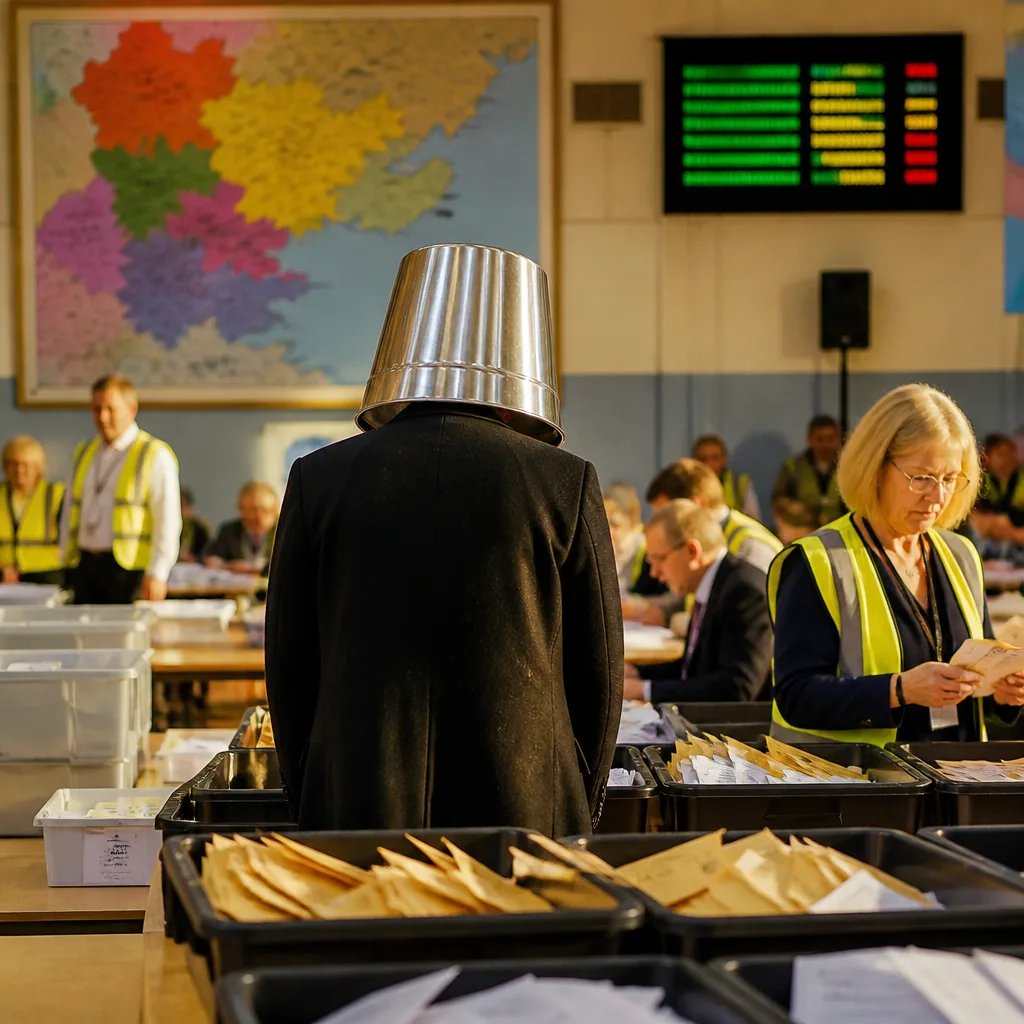
Counting has started in the Clacton by-election, and Count Binface — the satirical candidate who wears a silver bin on his head — is poised to record his highest share of the vote to date, according to reports.
The election was triggered when Reform UK leader Nigel Farage resigned his seat and promptly re-contested it, a move that prompted the Conservative, Labour and Liberal Democrat parties to announce they would not stand candidates, a boycott that has reshaped an unusually high-profile local contest.
Who is inside the bin?
The man who stands as Count Binface is the comedian Jon Harvey, an Oxford graduate who has worked as a writer on television satirical programmes including The Thick of It and Have I Got News For You. Harvey first appeared as a bin-headed candidate in 2017 under the name Lord Buckethead, when he challenged then-prime minister Theresa May in Maidenhead.
That initial outing produced 249 votes and viral attention that took the character onto international television. The appearance also spawned a legal dispute with another person using the Lord Buckethead persona; Harvey described it at the time as “an unpleasant battle on the planet Copyright”.
Electoral record
Harvey switched to the Count Binface persona for the 2019 general election, when he stood against then-prime minister Boris Johnson. That campaign returned 69 votes. Media coverage of the character has emphasised its satirical intent and the theatricality of campaigning while wearing a bin.
| Year | Character | Opponent (noted) | Votes |
|---|---|---|---|
| 2017 | Lord Buckethead | Theresa May | 249 |
| 2019 | Count Binface | Boris Johnson | 69 |
Media reports note that Harvey, under his various guises, has stood against “no fewer than three prime ministers and one soon-to-be prime minister” in his multiple electoral runs, although local and national coverage focuses on the Maidenhead and Uxbridge contests as the best-documented examples.
Why this contest matters
The Clacton by-election is notable for its political context as much as for the candidates. Farage’s resignation and immediate re-entry into the contest prompted the principal UK parties to step aside. That has left a smaller field and amplified both Reform UK’s profile in the seat and the visibility of smaller or novelty candidacies.
The presence of Count Binface has been much photographed and widely reported. Campaigning of this kind sits in a long British tradition of political satire and spoof candidacies that aim to lampoon mainstream politics while drawing attention to issues or personalities.
Observers say the shape of the field means unusual vote shares are possible, and that a well-known novelty candidate can attract greater support when the established parties withdraw. That dynamic is the principal reason commentators expect Harvey to exceed his previous results.
What to watch
- Final vote totals as declared at the count centre on the Essex coast.
- How the absence of Conservative, Labour and Liberal Democrat candidates affects turnout and vote distribution.
- Whether the result alters perceptions of Reform UK’s local strength or of the role novelty candidates play in high-profile by-elections.
“an unpleasant battle on the planet Copyright”
The outcome will be read in multiple ways: as a measure of Reform UK’s local appeal, as a comment on party strategy when a high-profile figure re-contests a seat, and as a fresh data point in the continuing British practice of satirical candidacy. Counting is under way and the official totals will determine whether Count Binface has indeed achieved his best ever performance.
All claims in this report are drawn from contemporary coverage of the campaign and the candidate’s own published record.