
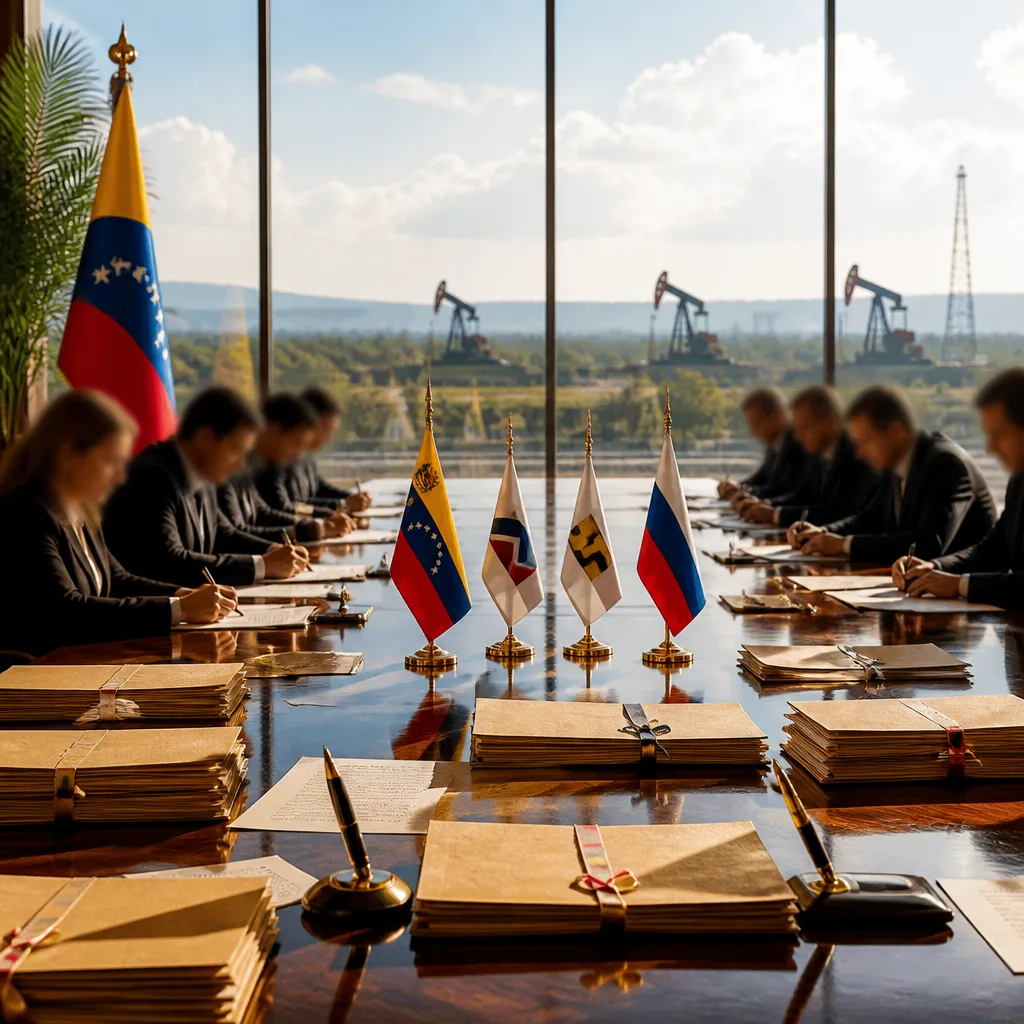
Chevron and Italy’s Eni have signed multibillion-dollar contracts in Caracas to expand Venezuelan oil production, while US energy firm GE Vernova will help repair the country’s electricity grid, officials said.
Deals promise fast output growth amid geopolitical debate
The agreements were signed at a ceremony in Venezuela’s capital overseen by interim President Delcy Rodríguez and US Energy Secretary Chris Wright. Most of the new contracts are expansions of projects that had been under negotiation with Venezuela’s Oil Ministry and state oil company PDVSA, following an oil reform approved in January.
US officials framed the deals as pivotal to a rapid economic transformation. Wright said the arrangements with Chevron, Eni and GE Vernova were "critical in starting this ball rolling of peace, opportunity, and prosperity" and that the administration wanted to move at what he described as "Trump-speed" to deliver swift change.
"We are trying to work at what I call Trump-speed. [US] President [Donald] Trump didn’t want a nudge or a slow drift in a positive direction," Wright said. "He wanted to see as fast as possible transformation in Venezuela."
Chevron — the United States’ second-largest oil company and its leading private producer in Venezuela — said its deal involves developing two additional oilfields in the Orinoco Belt, a move it has valued at $7bn. The company projects that output from the project will more than double within five years.
What the contracts mean for production, jobs and prices
The Chevron investment targets some of Venezuela’s heaviest crude reserves in the Orinoco Basin. If the company achieves the announced doubling of output from the two fields over five years, that could increase global supply from Venezuela and exert downward pressure on regional benchmark prices, all else equal. For UK and global markets, more Venezuelan heavy crude could ease refinery feedstock tightness, particularly for units configured to process lower-quality crudes.
Domestically in Venezuela, the deals signal potential job creation both on-site at oilfields and in associated services — drilling, logistics, maintenance and local supply chains — though precise employment numbers were not disclosed. Any sustainable increase in production will, however, depend on years of technical work and investment to restore ageing facilities and pipelines.
Eni’s agreement grants the company exclusive rights to explore the giant Junin 5 oilfield. GE Vernova’s role is explicitly aimed at repairing a "battered" electricity grid — a critical prerequisite for reliable oilfield operations and broader industrial activity.
| Company | Role | Key figure / note |
|---|---|---|
| Chevron | Develop two additional Orinoco Belt fields | $7bn deal; output to more than double in five years |
| Eni | Exclusive exploration rights | Junin 5 oilfield — giant field rights |
| GE Vernova | Electricity grid repairs | Support to restore power infrastructure |
Questions of sovereignty and wider US-Venezuela arrangements
The ceremony took place against the backdrop of a separate Caracas–Washington agreement that grants US access to 17 Venezuelan oilfields, reportedly representing about a fifth of the country’s reserves. That larger framework has prompted debate about sovereignty and control over hydrocarbon assets.
Venezuela’s government says it retains sovereignty over its resources, while US officials portray the deals as pathways to investment and stability. Observers should be cautious in taking corporate and diplomatic statements at face value: moving from contract signatures to sustained production is technically challenging and politically sensitive, particularly in a country with long-run underinvestment and complex governance questions.
- Short term: Contracts could accelerate repairs and field development, creating construction and service jobs.
- Medium term: Increased output may ease regional crude tightness and modestly affect prices for heavy grades.
- Long term: Success depends on security, institutional capacity, and consistent investment beyond headline deals.
The deals mark a significant shift in Venezuela’s engagement with major international energy firms. For markets, consumers and workers, the critical issue will be whether contractual promises translate into reliable barrels and stable employment rather than rhetoric at a high-profile signing.














