An individual widely reported to be the alleged leader of an Irish organised crime gang was flown from Dubai to Ireland on Sunday evening and is expected to be taken straight to the Special Criminal Court in Dublin to face charges relating to directing an organised crime group.
Extradition and court procedures
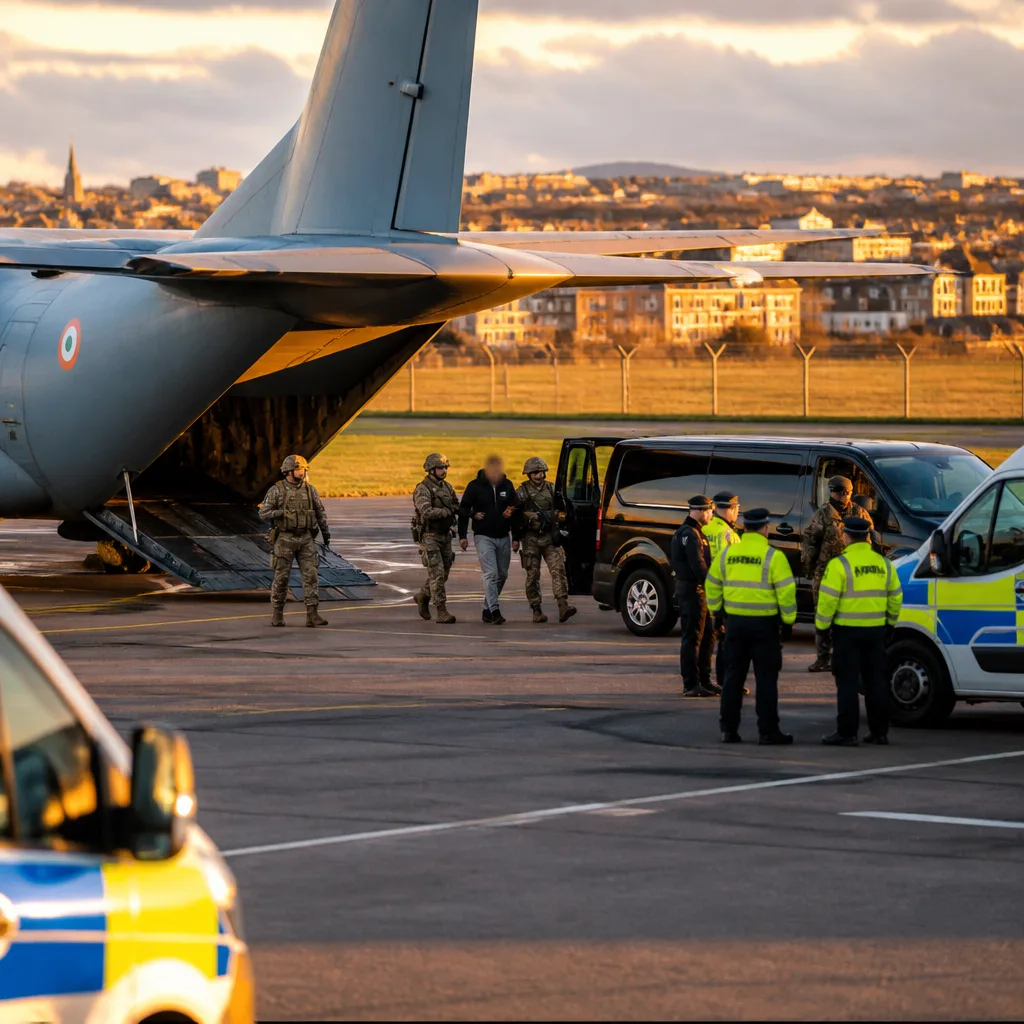
Air traffic tracking data showed an Irish Air Corps aircraft landing at a military airfield on the outskirts of Dublin after courts in the United Arab Emirates declined to block the extradition. Irish broadcasters have identified the man as 49-year-old Daniel Kinahan. He is reported to be due to appear before the Special Criminal Court and will then be held at Portlaoise Prison, a high-security facility roughly 145 kilometres south-west of the capital.
The Special Criminal Court deals with cases involving organised crime and terrorism, and those matters where juries are considered unsuitable for ensuring the effective administration of justice. Cases are heard by a panel of three judges without a jury.
Security operation and transfers
Irish media report that a substantial security operation has been put in place to manage the movement and court attendance of the suspect. Sources indicate that armed police, elements of the Irish Defence Forces and prison service personnel are involved. The prison service has recently acquired an armoured escort vehicle intended for the transfer of high-risk prisoners, including those accused of terrorism and organised crime offences.
- Arrival: Irish Air Corps plane landed at military airport near Dublin.
- Legal step: Appearance expected at the Special Criminal Court.
- Detention: Held at Portlaoise Prison following court procedures.
Allegations and international co-operation
Authorities in Ireland, with assistance from law enforcement in Britain, Spain and the United States, have pursued members of the group for more than ten years. Investigations allege the gang smuggled substantial quantities of drugs into Europe and engaged in money laundering and firearms trafficking. Media reporting and official statements have connected the organisation to a series of violent incidents.
"Since February 2016, the (Kinahan Organized Crime Group) has been involved in a gang war with another group in Ireland and Spain, resulting in numerous murders, including of two innocent bystanders,"
The quotation above, contained in a US Treasury Department statement when it imposed sanctions in 2022, was cited by Irish outlets when describing the international concern about the group's activities.
Context and implications
The extradition underlines the cross-border nature of modern organised crime investigations and the level of international co-operation required to pursue alleged criminal networks. If charged formally, the accused will face proceedings in a court specifically designed to hear cases where ordinary trials are judged inadequate for security or fairness reasons.
There are wider public safety and judicial considerations. The reported rivalry between the faction led by the accused and a rival group has been described as a gang war by some authorities, with law enforcement warning over the years about the risk of serious violence spilling into public spaces.
While the move to extradite follows legal processes in the UAE, courts are yet to determine guilt or establish criminal liability in open proceedings. The defendant will have the opportunity to respond to the allegations in the Irish legal system.
| Item | Detail |
|---|---|
| Arrival point | Military airport near Dublin |
| Expected court | Special Criminal Court, Dublin |
| Detention facility | Portlaoise Prison |
Law enforcement agencies in Ireland and abroad will continue to work on related investigations while the matter progresses through the Irish courts. Reporting restrictions and the sensitive security arrangements surrounding the case mean further details may be limited until formal hearings take place.