
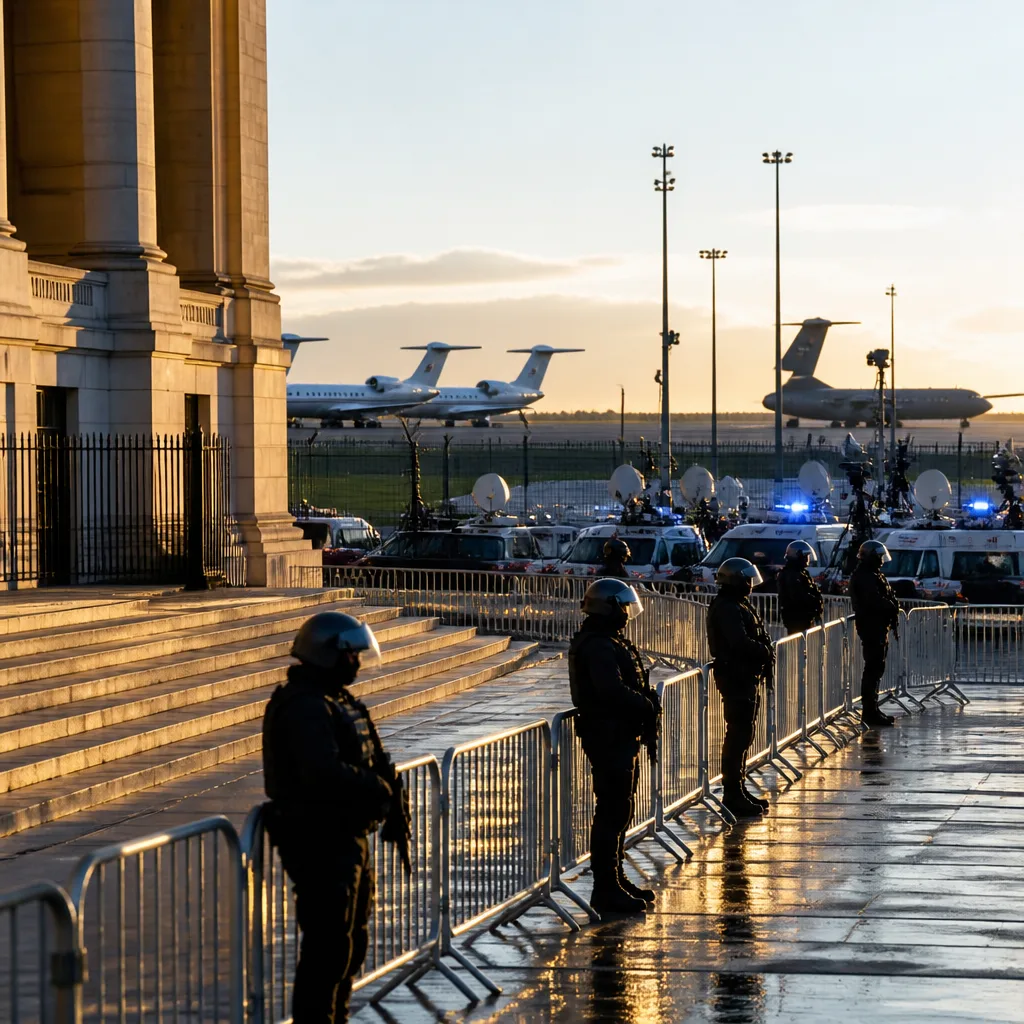
Armed police deployed at the entrances to the Special Criminal Court in Dublin as the aircraft carrying Daniel Kinahan approached the city, marking the culmination of a complex set of investigations and international arrangements that led to his return to Ireland.
Immediate court appearance and charges
Kinahan was brought to the court shortly after the government aircraft that had left the United Arab Emirates touched down at a military airfield roughly nine miles (14km) from the city. The doors of the court opened about half an hour after landing and the accused was in the dock for approximately 13 minutes. He was charged with a single offence of directing the activities of a criminal organisation during the period from October 2015 to April 2017. At this stage of the legal process he did not enter a plea.
Security, media and public interest
The arrival drew significant media attention: journalists tracked the flight, reported the sound of sirens and filled the courtroom along with detectives, prosecutors and members of the public. The presence of armed officers at court entrances and the use of a government jet to transport the suspect underline the sensitivity and seriousness of the operation.
- Aircraft used: Irish government jet, normally for ministerial transport, departed the UAE with Kinahan aboard.
- Landing site: Military airfield approximately 14km from Dublin.
- Court session: Defendant present in the dock for about 13 minutes.
Allegations and the accused's position
Law enforcement agencies in Europe and North America have long identified Kinahan as a principal figure in what they call the Kinahan Organised Crime Group, a network investigators say expanded from street-level drug dealing in Dublin during the 1980s into an international criminal enterprise linked to drug trafficking, money laundering and murder.
Representatives for Kinahan have previously rejected the characterisation of him as a crime boss. In earlier statements his lawyers said the claims were without foundation and that he had no criminal record or convictions.
"The allegations he is a crime boss are false and have no evidential basis,"
The court proceedings at this stage relate to the charge of directing a criminal organisation in a defined period; the accused remains entitled to the presumption of innocence until proven guilty in a court of law.
Investigative and international context
Senior investigators have described the group’s international reach. Roy McComb, the former deputy director of the UK’s National Crime Agency, told BBC Radio 4’s Today programme that the organisation’s expansion was driven by its "ambition and drive," and that it had forged links with networks in South America, Eastern Europe, Pakistan and Afghanistan, involved in larger-scale drug distribution.
| Item | Detail |
|---|---|
| Charge | Directing activities of a criminal organisation (Oct 2015–Apr 2017) |
| Transport | Irish government jet departed UAE with Kinahan aboard |
| Landing | Military airfield ~9 miles (14km) from Dublin |
Officials in multiple jurisdictions have for years pursued inquiries into the group's activities. The case highlights the role of international police co-operation and, in this instance, diplomatic arrangements that permitted transfer of an individual from the UAE to Ireland for prosecution.
Implications and next steps
The immediate legal step was the defendant’s appearance before the Special Criminal Court; further hearings and pre-trial procedures will follow in due course. The proceedings will be watched closely by law enforcement agencies in the UK, Ireland and beyond given the cross-border nature of the investigations linked to the group.
As the prosecution advances its case, courts will determine the admissibility of evidence and the route by which any charges proceed. Observers caution against drawing conclusions before a full trial, noting the continued operation of mutual legal assistance, extradition arrangements and international criminal investigations that underpin such complex cases.














