
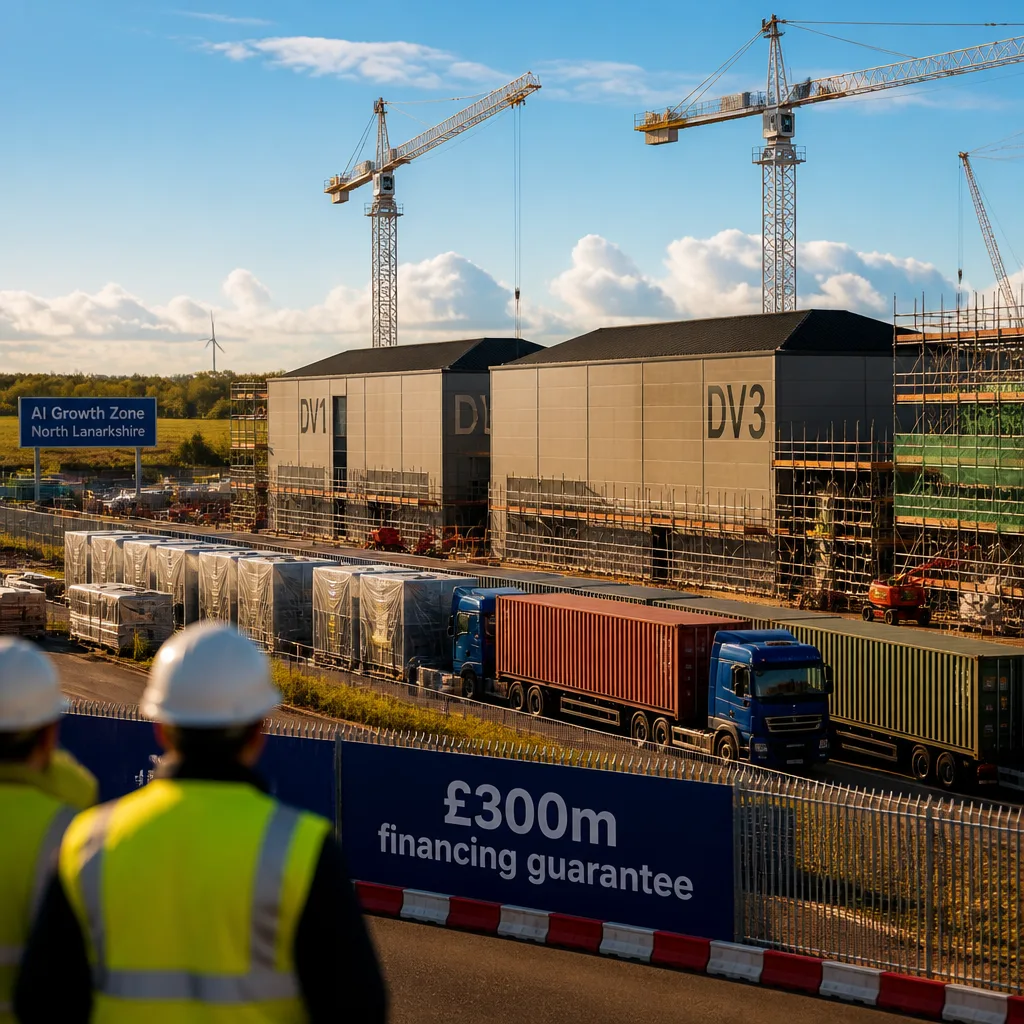
The UK’s push to secure domestic compute for artificial intelligence received a material boost as a consortium of lenders, supported by the National Wealth Fund, agreed a £300 million package to develop two data centres in North Lanarkshire’s designated AI Growth Zone.
What has been agreed
The funding will expand DataVita’s current data centre and underwrite construction of a second facility, labeled DV1 and DV3. Both sites will supply capacity to AI cloud firm CoreWeave under a 15‑year lease, marking a long-term commercial commitment of overseas cloud demand into Scottish infrastructure.
The financing rests on a National Wealth Fund guarantee for £252.5 million of lending provided by a syndicate including ING, ABN AMRO and Santander. The remainder of the £300 million package is supplied by the Scottish National Investment Bank (SNIB), while funding from Siemens Financial Services is noted as uncovered in the announcement.
| Element | Detail |
|---|---|
| Total finance package | £300 million |
| National Wealth Fund guarantee | £252.5 million of lending |
| Lead lenders | ING, ABN AMRO, Santander |
| Additional financier | Scottish National Investment Bank (SNIB) |
| Anchor tenant | CoreWeave (15-year lease) |
| Sites | DV1 and DV3 in North Lanarkshire AI Growth Zone |
| Jobs announced | About 100 roles |
Regional growth and the national compute agenda
The deal has been presented as the first deployment of National Wealth Fund support for domestic compute capacity, aligning with the Government’s Compute Roadmap and Scotland’s five‑year AI strategy. Officials have also tightened planning processes: the Scottish government recently required planning authorities to notify ministers of new data centre applications within seven days, reflecting rising scrutiny over the local impacts of large-scale facilities.
Dell Technologies will also relocate its Scottish team to Mercury House in Lanarkshire’s AI Innovation Park, signalling a clustering of corporate activity around the new campus and a potential lift to local supply chains.
Jobs, investment and the economics of onshore AI capacity
The announcement includes a projection of about 100 jobs at the two sites. That is a modest direct employment figure for a capital-intensive, high-power infrastructure project, but the broader economic case rests on how the campus affects regional contracts, construction activity and secondary services. For household incomes and local spending, the quality and pay of those roles will be decisive; the public statement does not detail wage levels or the split between construction and permanent operational posts.
Securing long-term leases with an AI cloud firm anchors demand, which lenders will see as reducing revenue risk. Yet it also means the UK must manage power, cooling and transmission needs while ensuring the price of onshore compute remains competitive versus international suppliers. For firms and taxpayers, the key question is whether domestic capacity reduces costs for UK-based AI developers and keeps critical data and compute onshore — and at what public cost.
“The UK needs its own AI capability, built here and run here, and we are grateful to the National Wealth Fund and our lenders for backing a project that is already delivering it,”
The comment came from Danny Quinn, managing director at DataVita, reflecting the strategic framing of the transaction: sovereign capability and local operation. Such rhetoric is familiar around major infrastructure deals and is accurate in signposting intent. However, the long-term public value will depend on how effectively the facilities are integrated with wider policy aims — including energy, labour market and competition considerations.
- Scale for now: Two data centres, DV1 and DV3, with a 15-year contracted tenant.
- Funding structure: £252.5m guarantee by the National Wealth Fund for syndicated lending, plus SNIB involvement.
- Local impact: Around 100 jobs and corporate relocation to an AI Innovation Park.
This transaction is an early test of how public financial instruments will be used to catalyse strategic digital infrastructure. For workers, firms and consumers the outcomes that matter will be sustained, well-paid roles, lower barriers to AI development for UK businesses and a competitive cost base for onshore compute — none of which are assured merely by the headline funding figures. The details on pricing, energy sourcing and long-term operational plans will determine whether the investment is primarily a regional jobs boost, a national strategic asset, or both.














