The government’s Soil Health Card (SHC) initiative, launched in 2015 to address widespread fertiliser overuse, has achieved large-scale coverage but falls short of producing broad changes in farmers’ fertiliser practices, a recent study reported.
Scale has not ensured behaviour change
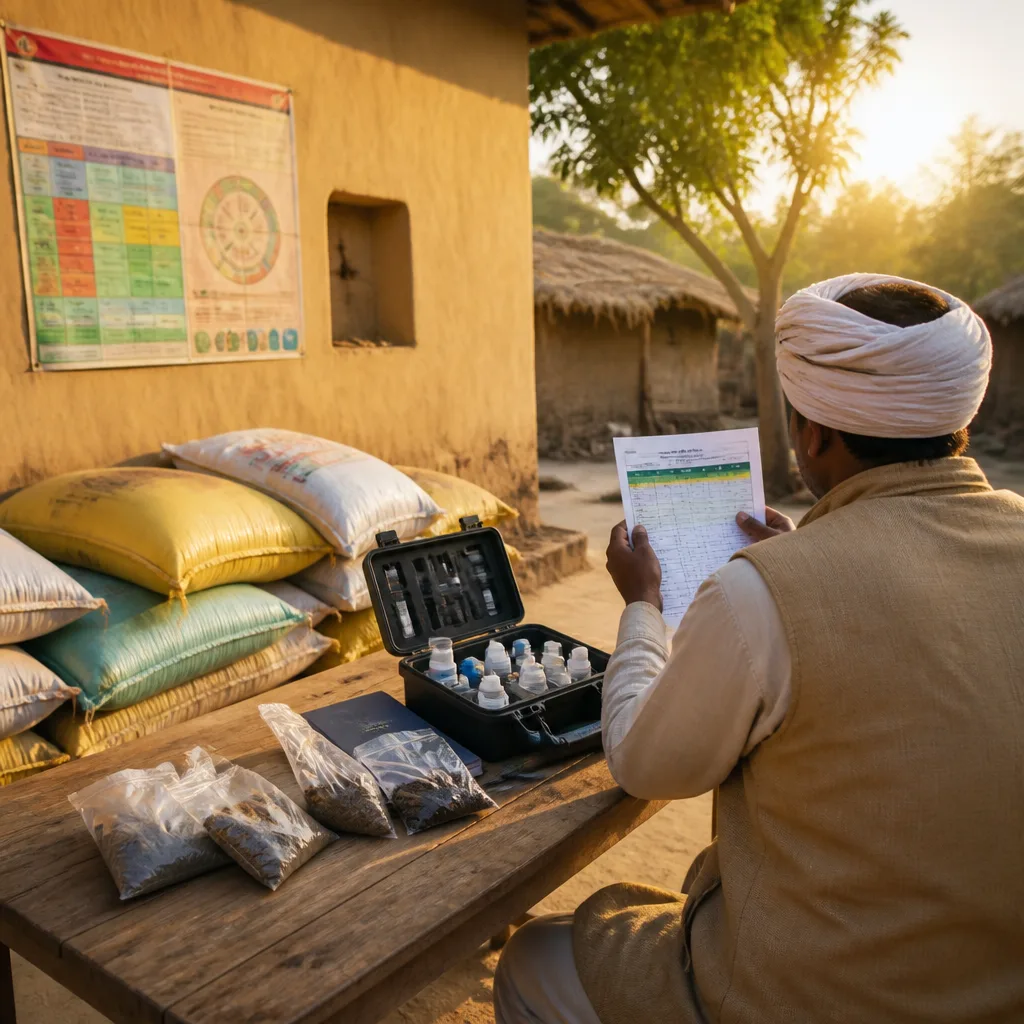
The SHC programme aims to provide every farmer with a soil test report every two years along with crop-specific recommendations at no cost. According to the study, the scheme has issued about 240 million soil health cards to farmers to date and targets roughly 120 million farmers nationwide. The study noted the programme cost approximately $200 million.
Despite this reach, researchers found that standardised, centralised soil measurements and the provision of information alone were insufficient to induce widespread uptake of the recommended fertiliser adjustments. The analysis highlighted that the nationalisation of soil testing has simplified soil health into a narrow set of standard indicators, which may limit the policy’s ability to capture local variability and farmer priorities.
Key limitations identified
The study identified several constraints that have limited the SHC’s effectiveness:
- Standardisation over localisation: Uniform measurements and recommendations can miss important local soil and cropping nuances.
- Information alone: Distribution of test reports did not reliably change fertiliser choices without stronger farmer engagement and advisory follow-up.
- Implementation gaps: Translating card recommendations into practice requires access to appropriate inputs, timely extension services and incentives that were not consistently present.
Researchers argued that while the SHC has created a valuable information infrastructure, its current design underestimates the social, economic and institutional barriers that influence farmer decision-making.
Implications for policy and practice
The study’s authors suggested that improving the SHC’s effectiveness will require incorporating more local input and strengthening farmer engagement. Specific areas for attention include:
- Devolving elements of soil testing and recommendation design to local agricultural institutions and extension workers;
- Combining soil test information with sustained advisory services, demonstrations and farmer-to-farmer learning;
- Aligning input availability and subsidy structures so recommended fertiliser mixes are affordable and accessible.
Policymakers face the challenge of maintaining the SHC’s national coverage while enhancing its responsiveness to diverse agro-ecological contexts. The study cautioned that without such recalibration, the programme may struggle to curb entrenched fertiliser dependence that dates back to the Green Revolution era.
| Indicator | Figure |
|---|---|
| Targeted farmers | 120 million |
| Soil Health Cards issued | 240 million |
| Programme cost (approx.) | $200 million |
Experts and policymakers who have worked on soil health contend that reducing nitrogen and urea overuse requires more than technical diagnostics. It also involves addressing entrenched subsidy regimes, improving market linkages for balanced nutrients and investing in local capacity for soil management.
For farmers and extension workers, the study underscores that soil test reports should be treated as one component of a broader advisory and service ecosystem. Farmers contemplating changes to fertiliser use are advised to consult qualified agricultural extension personnel or local agronomists before altering input regimes.
The study contributes to a growing conversation about how national programmes can balance the benefits of scale with the need for locally relevant, actionable guidance to achieve sustainable agricultural and environmental outcomes.