
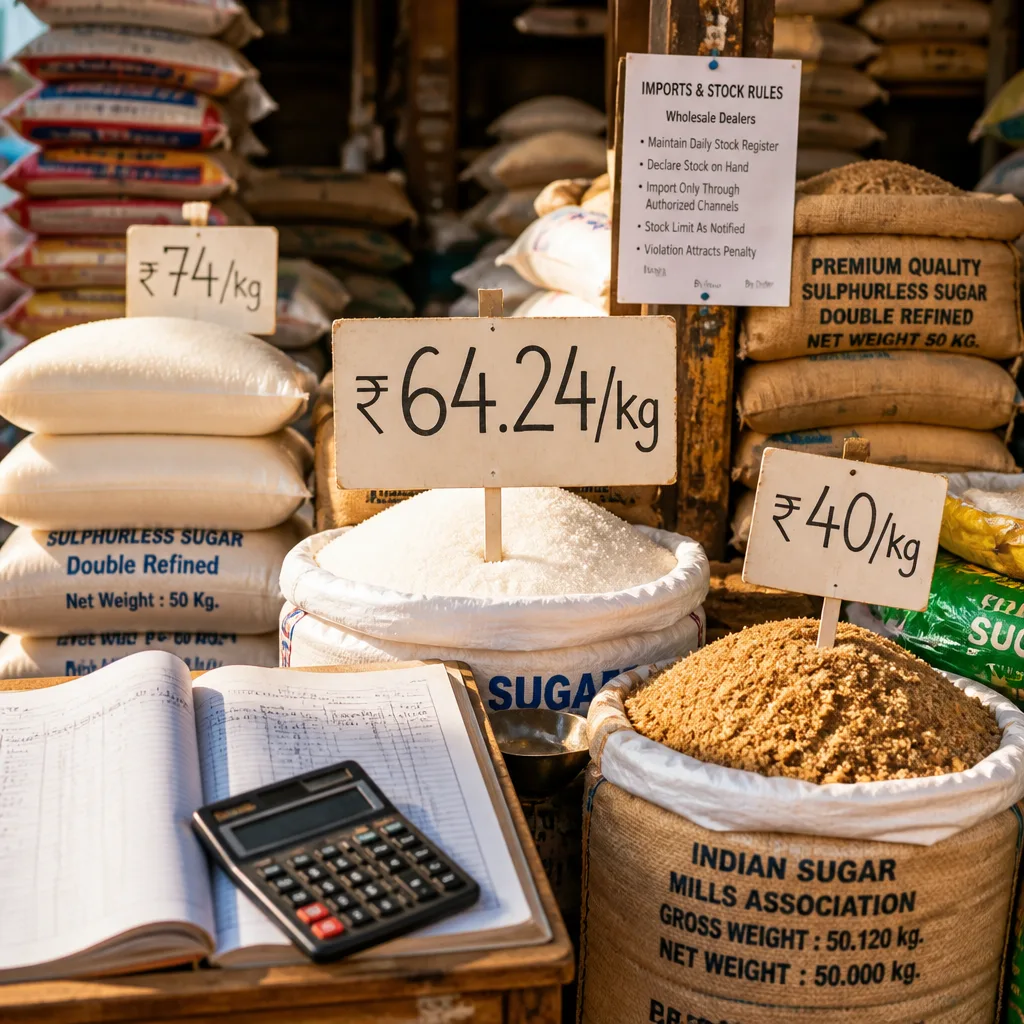
The all-India average retail price of sugar climbed to ₹64.24 per kg on Sunday, up 1.77 per cent from a week earlier, official data from the Consumer Affairs Ministry showed, signalling that domestic prices remain firm despite government measures intended to ease the rise.
Retail and wholesale move higher
Retail prices were about 30 per cent higher than a month ago and nearly 38.63 per cent above the same period last year. The data showed a maximum recorded retail price of ₹74 per kg and a minimum of ₹40 per kg as on August 30.
Wholesale sugar also stayed firm, with the all-India wholesale price at ₹59.73 per kg, reflecting a month-on-month rise of 31 per cent and a year-on-year increase of 38.63 per cent. A week earlier, the wholesale rate was ₹58.66 per kg.
City-level variation
Prices varied across metropolitan markets, underscoring regional spreads in distribution and retail margins. The Consumer Affairs Ministry reported the following city retail rates on Sunday:
- Delhi: ₹62 per kg
- Mumbai: ₹66 per kg
- Chennai: ₹63 per kg
- Ranchi: ₹68 per kg
| Measure | Price | Change |
|---|---|---|
| All-India retail (Aug 30) | ₹64.24/kg | +1.77% week-on-week; +30% month-on-month; +38.63% y-o-y |
| All-India wholesale | ₹59.73/kg | +31% month-on-month; +38.63% y-o-y |
Policy actions and industry reaction
The Centre has taken several steps to temper the price rise, including permitting duty-free imports of 10 lakh tonnes of raw sugar, tightening stockholding limits for bulk consumers and dealers, and earlier imposing an export ban. Despite these measures, industry participants and government officials point to persistent spreads between ex-mill, wholesale and retail prices.
Ex-mill rates have fallen by nearly 20 per cent following the import decision, but sources noted a typical gap of ₹2-3 per kg between ex-mill and wholesale prices, and about ₹7-8 per kg between ex-mill and retail prices, which helps sustain elevated consumer rates even as procurement cost indicators soften.
“The Centre has blamed mills for 'jacking up' prices,” the release said, noting that officials insist the country holds ample sugar stocks.
The government’s assertion on stocks comes against the backdrop of a downward revision in projected production for the 2025-26 marketing year (October–September) to 306 lakh tonnes, from earlier estimates of 343 lakh tonnes. Annual domestic demand is estimated at around 280–285 lakh tonnes, indicating a narrower surplus than previously expected.
What this means for consumers and businesses
- Consumers face higher grocery bills: a sustained retail price above ₹60 per kg means sugar will remain a visible contributor to food inflation in the near term.
- Food and beverage companies may pass on costs: manufacturers with thin margins could increase prices of packaged and processed goods where sugar is a primary input.
- Policy watch: the impact of the duty-free imports and tighter stock norms on the domestic price trajectory will be visible only over coming weeks as imported volumes arrive and inventory patterns adjust.
The combination of lower expected production, firm wholesale rates and the observed gaps between ex-mill and market prices suggests that, while policy levers can ease cost pressure at the origin, retail outcomes depend on distribution, dealer behaviour and time lags in supply adjustment.
For now, shoppers and businesses should expect sugar to remain a price-sensitive item in household budgets and input-cost calculations unless a meaningful correction in wholesale-to-retail margins occurs or imported supplies materially change market balances.