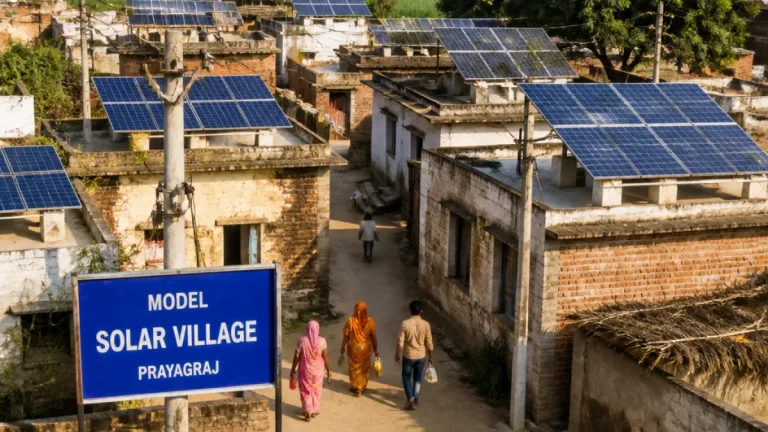
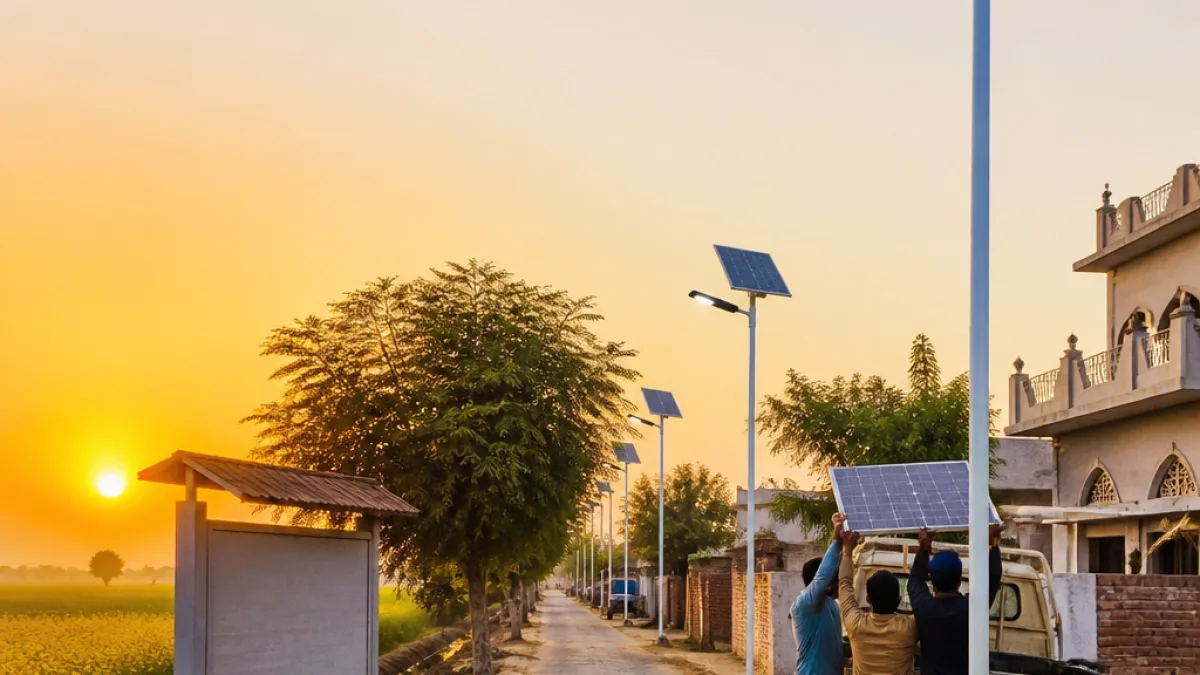
Chandigarh/Patiala: The Punjab government will install 3 lakh LED-based solar streetlights in villages across the state at a cost of ₹470 crore, New and Renewable Energy Sources Minister Aman Arora said on Wednesday. The move is intended to improve safety, connectivity and sustainability in rural areas by expanding clean-energy lighting.
Funding pattern revised to ease burden on panchayats
Under the new arrangement, the state will meet 70 per cent of the project cost while gram panchayats will contribute the remaining 30 per cent. The minister described this as a reversal of the earlier 30:70 funding pattern, which had placed a heavy financial burden on village bodies. The change, he said, was taken in view of limited financial resources available to panchayats and to ensure equal opportunity for all gram panchayats to participate.
The Punjab Energy Development Agency (PEDA) will act as the nodal agency for the scheme and will be responsible for overseeing installation as well as the repair and renewal of existing solar streetlight systems.
Rationale: safety, economic activity and clean energy
Aman Arora highlighted that about 62.51 per cent of Punjab's population — roughly 173.20 lakh people — lives in rural areas. He said poorly lit streets increase the risk of accidents and crime and limit social and economic activity after sunset. The scheme is designed to extend working hours in villages near economic hubs and support the rural economy while promoting renewable energy.
- Scope: 3 lakh LED-based solar streetlights in villages across Punjab.
- Cost: ₹470 crore total; state pays 70%, gram panchayats 30%.
- Implementation nodal agency: Punjab Energy Development Agency (PEDA).
- Maintenance: Support period extended from five to seven years.
Maintenance and sustainability measures
Responding to feedback from panchayats, the state has extended the maintenance support period from five years to seven years to ensure longer-term functioning of the systems. PEDA will not only oversee new installations but will also attend to repair and renewal of existing solar streetlight infrastructure.
| Item | Detail |
|---|---|
| Total lights | 3,00,000 |
| Project cost | ₹470 crore |
| State share | 70% |
| Panchayat share | 30% |
| Maintenance support | 7 years (extended from 5 years) |
Local implications for villages and farmers
Rural stakeholders often cite inadequate street lighting as a constraint on both safety and local commerce. Improved illumination can reduce the incidence of night-time accidents and petty crime according to the government rationale, while enabling small shops, cold-storage access and transport services to operate more safely after sunset. For agriculture-dependent communities, better lighting around village roads and market approaches may help farmers transport perishable produce to markets and work on post-harvest tasks during extended hours.
The decision to increase the state's share in project funding is likely to make the programme accessible to smaller panchayats with limited resources. However, actual rollout, allocation across blocks and the schedule for installations were not specified in the announcement and will determine how quickly benefits reach remote habitations.
What remains to be seen
Key implementation questions include prioritisation criteria for villages, tendering and procurement processes, quality-control norms for LED and solar equipment, and mechanisms to ensure timely maintenance beyond the seven-year support window. The role of PEDA as nodal agency sets a single coordination point, but its capacity to manage large-scale field deployment and long-term upkeep will be closely watched by panchayats and civil-society groups.
With a majority of Punjab's population resident in rural areas, the scheme, if implemented effectively, could be a notable step towards safer, greener and more economically active villages. The government has framed the plan as part of a broader effort to strengthen rural infrastructure while promoting clean energy solutions.
Further operational details, timelines and the schedule for fund disbursal were not provided in the announcement.