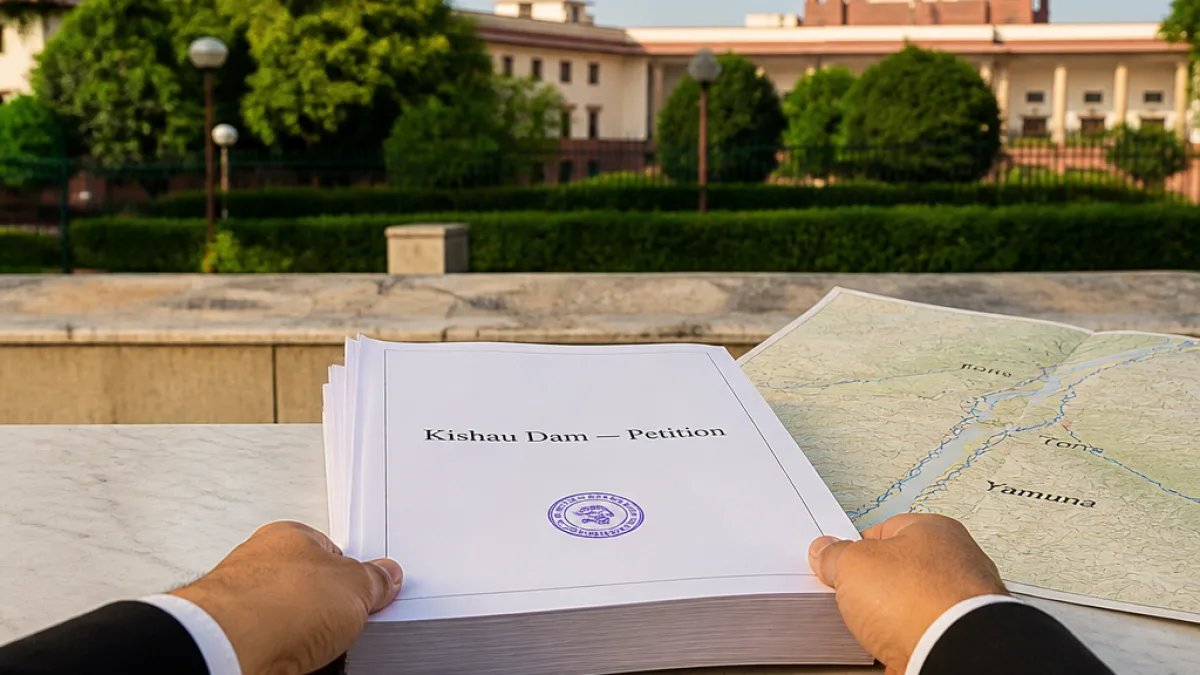
CHANDIGARH: The Punjab government has decided to file a plea in the Supreme Court challenging the Centre's move to go ahead with the Kishau Multipurpose Dam project on the Tons river without consulting the state, and to press for a share in Yamuna water allocations.
State to contest Centre's decision in apex court
Officials in the Punjab Water Resources Department said on Monday that the draft petition has already been vetted by a senior advocate who had formerly served as the Advocate General of Punjab. The office of the Advocate General has been asked to formally approve the plaint before it is filed in the Supreme Court, the sources added.
The proposed Rs 15,624 crore Kishau project, planned on the Tons river — a tributary of the Yamuna — has long been a contested proposal, and Punjab's legal team will argue that the Centre's decision to proceed without involving the state is unsustainable.
Punjab’s legal and technical position
Punjab's case, as explained by Water Resources Department officials, rests on historical and basin-based arguments. They note that the Yamuna, like the Ravi and Beas, formed part of the pre-1966 Punjab river system and that the state should be treated as a successor state entitled to a share of the river's waters.
- Punjab contends it was not a party to the May 12, 1994 Yamuna water-sharing Memorandum of Understanding.
- Officials argue the 1994 arrangement cannot be regarded as a final settlement because Punjab was excluded from the allocation process.
- The state refers to earlier technical reports and historical allocations to argue for recognition as a riparian or successor claimant.
An anonymous official in the Water Resources Department told reporters that Punjab has, since 1992, repeatedly sought inclusion in negotiations on Yamuna allocations. They pointed to the 1972 Irrigation Commission report, which — the department maintains — places parts of Punjab within the Yamuna basin.
Political and agricultural stakes
Water sharing is politically sensitive in Punjab, where agriculture remains the primary livelihood for large sections of the population. Officials and farmer organisations have in the past warned that any diminution of water available for irrigation could hit paddy and other kharif crops, affecting rural incomes and regional food security.
Punjab’s argument invokes precedents where successor states obtained allocations after reorganisation. The state notes that Haryana, though not strictly riparian for Ravi and Beas, receives water as a successor state — an analogy Punjab seeks to extend to the Yamuna question.
What Punjab will seek in court
While the exact reliefs to be sought in the Supreme Court petition will be finalised in the plaint, department officials indicated the state will challenge both the process by which the Kishau project was finalised and the exclusion of Punjab from Yamuna water-sharing arrangements.
| Item | Detail |
|---|---|
| Project | Kishau Multipurpose Dam on the Tons river |
| Estimated cost | ₹15,624 crore |
| Legal action | Plea to be filed in Supreme Court |
Government sources emphasised that the legal challenge is not only about rights to water but also about ensuring that the interests of farmers and downstream users are protected before large infrastructure projects proceed.
Experts and officials across the region have previously warned that unilateral decisions on river projects can inflame inter-state tensions and create long-term management problems. Punjab’s planned approach to the Supreme Court underscores the continued salience of river-sharing disputes in northern India.
The petition, once cleared by the Advocate General’s office, is expected to outline Punjab’s historical, technical and legal grounds for contesting both the Kishau project's approval process and the adequacy of existing arrangements governing Yamuna flows.
Further developments will be watched closely in Chandigarh, New Delhi and among downstream states, where water allocation decisions have direct implications for irrigation, hydro-power and urban supply planning.