LUHADIANA — Punjab Chief Minister Bhagwant Mann on Friday said he was not in favour of registering FIRs against farmers for stubble burning and asked the Centre to provide financial support to paddy growers who refrain from burning crop residue. His remarks came as the state prepares for the paddy harvesting season, with farmer unions pressing for incentives rather than penalties.
Centre urged to pay for residue management
Speaking after inaugurating a two-day Kisan Mela at Punjab Agricultural University in Ludhiana, Mann reiterated that farmers should receive monetary help to manage straw. He said he had told the Centre that farmers did not want to burn paddy stubble because the smoke affects them directly, and therefore needed support to adopt alternative methods.
“The Centre says Punjab has contributed 180 lakh metric tonnes of paddy to the central pool. But they do not consider how much of that stubble comes from the 180 lakh MT. They suggest registering FIRs,” he said.
Mann said stubble-burning problems were being used to "defame Punjab" and questioned why emissions from other states such as Haryana and Uttar Pradesh were not equally highlighted. He recalled that Pakistan's Punjab Chief Minister Maryam Nawaz had informed him she would write about smoke affecting Lahore, using it to underline that air pollution crosses borders.
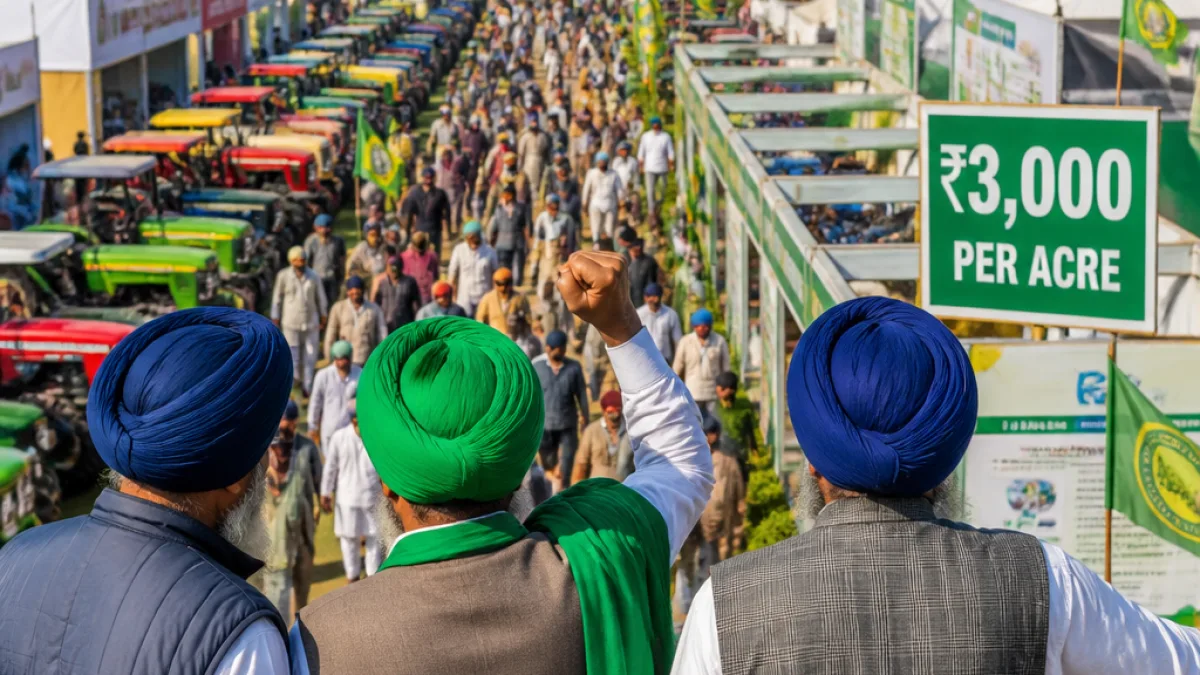
Farmers seek ₹3,000 per acre incentive
Farmers and unions in Punjab have been demanding a cash incentive of ₹3,000 per acre to manage paddy residue without resorting to burning. Mann's public appeal to the Centre came days before the state’s paddy harvest, which typically takes place during October and November, when farmers have a narrow window to clear fields and sow the rabi wheat crop.
- Key demand: ₹3,000 per acre to incentivise non-burning of stubble.
- State figure cited: 180 lakh metric tonnes of paddy contributed to the central pool.
- Timing: Harvest season and field clearance occur in October–November, prompting rapid residue disposal.
Punjab has repeatedly been at the centre of debate around post-harvest stubble burning, which environmental authorities and Delhi-NCR officials link to seasonal deterioration in air quality. Farmers, however, point to constrained time and the costs of alternative management methods as reasons for continuing to burn residue.
Political overtones ahead of polls
Leaders of farmer unions interpreted Mann's remarks through a political lens, given the approaching Assembly elections. Bharti Kisan Union (Ekta Ugrahan) general secretary Sukhdev Singh Kokrikalan said the government should first cancel FIRs already registered against farmers for stubble burning. BKU (Lakhowal) leader Harinder Singh Lakhowal also commented that farmers should be given support — remarks that framed the issue as both a governance and electoral matter.
Experts and activists have long urged a mix of short-term financial support and longer-term investment in machinery such as happy seeders, in-situ management tools, and supply chains for straw-based industries. While Mann did not detail a funding mechanism, his call places renewed pressure on the Centre to announce central assistance or a targeted subsidy for Punjab cultivators.
| Issue | Statement / Data |
|---|---|
| Paddy contribution (state to central pool) | 180 lakh metric tonnes (as cited by CM) |
| Farmer demand for residue management | ₹3,000 per acre |
| Key harvest months | October–November |
Practical pressure points
Farmers in Punjab work under considerable time pressure between paddy harvest and wheat sowing, which makes quick disposal of straw a priority. Mann highlighted this operational constraint while opposing criminal action against growers. Officials implementing anti-burning drives must balance enforcement with on-the-ground realities of small and marginal holdings, where access to machinery and labour can be limited.
By publicly opposing FIRs, the state government signals a softer enforcement posture and a preference for incentivisation. The Centre's response will be critical: a central scheme or special package could ease the transition for many farmers, whereas denial of funds may sharpen tensions between state and central authorities and feed political narratives in the run-up to elections.
As the paddy season approaches, the debate over punishment versus support is likely to intensify across Punjab and neighbouring states. Policymakers will face the challenge of curbing seasonal pollution while ensuring farmers have affordable, practical alternatives to stubble burning.
Gurpreet Kaur, WE NEWS Punjab Correspondent.