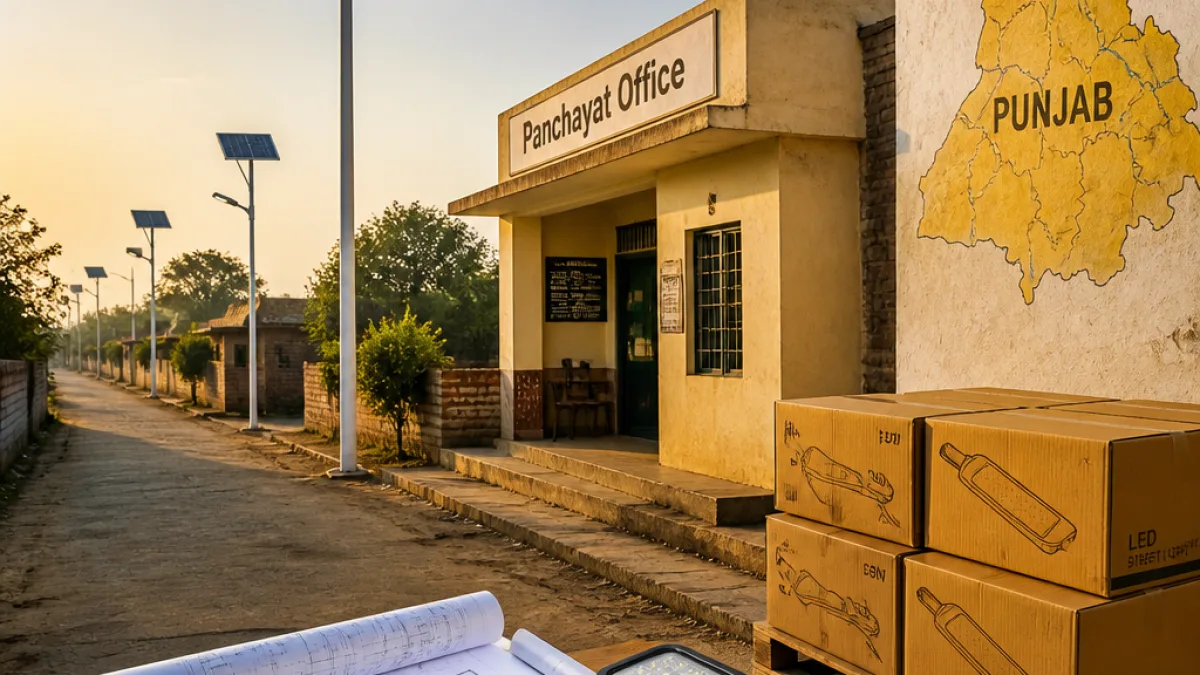
Chandigarh, Aug 12: The Punjab government has approved a state-wide programme to install 3 lakh LED-based solar streetlights in villages at an estimated cost of ₹470 crore, New and Renewable Energy Sources minister Aman Arora said on Wednesday. The scheme aims to boost rural safety, connectivity and clean-energy use in gram panchayats across the state.
Funding, implementation and maintenance
The Aam Aadmi Party-led administration will meet 70 per cent of the project cost, while the remaining 30 per cent will be borne by gram panchayats, a reversal of the earlier funding ratio. Officials said the change was made to ease the financial burden on village bodies and enable wider participation.
The Punjab Energy Development Agency (PEDA) has been designated as the nodal agency for implementation. It will supervise both the installation of new solar lighting and the comprehensive repair and renewal of existing systems in rural areas.
| Item | Detail |
|---|---|
| Total lights | 3 lakh LED-based solar streetlights |
| Estimated cost | ₹470 crore |
| State share | 70% |
| Panchayat share | 30% |
| Implementation agency | Punjab Energy Development Agency (PEDA) |
| Maintenance support | Extended from five years to seven years |
Why the push for rural lighting?
Minister Aman Arora framed the initiative as a move to improve safety and extend economic activity after sunset. He pointed to the large rural population in Punjab when outlining the need for the programme: about 62.51 per cent of the state's people live in rural areas, roughly 173.20 lakh residents.
"The initiative reflects the state government's intent to enhance safety, improve rural infrastructure and promote clean energy in gram panchayats," the minister said.
Dark streets are linked to a higher risk of accidents and crime, and limited illumination can curtail evening commercial and social life in villages. The state government said the new lights would also support villages located near economic hubs by enabling extended working hours and potentially increasing local economic output.
Practical aspects and local impact
Panchayats will have to contribute their share of the cost; however, the revised funding ratio is designed to reflect constrained resources at the village level and to provide equal opportunity for panchayats across districts to take part. The expanded maintenance support period—from five to seven years—was introduced after feedback from gram panchayats to help ensure long-term functionality.
By assigning PEDA to lead the rollout, the government is relying on an agency with an established mandate in renewable projects. PEDA's responsibilities will include procurement, quality control, overseeing contractors and coordinating maintenance schedules with local bodies.
- Target: 3 lakh LED solar streetlights to be installed across gram panchayats.
- Cost sharing: State 70%, gram panchayats 30% (revised from earlier 30:70).
- Maintenance: Support period extended to seven years.
The scheme aligns with broader efforts to increase adoption of decentralised renewable energy in rural India, reduce reliance on grid-supplied power for street lighting, and lower lifecycle costs through solar technology. For many villages, reliable public lighting can also yield intangible benefits such as improved perceptions of security and greater evening mobility for women, traders and students.
Officials have not yet provided a detailed rollout schedule or a district-wise allocation of lights. Implementation timelines, tendering processes and the mechanism for panchayat contributions are expected to be finalised by PEDA in the coming weeks.
As the state moves to operationalise the plan, local bodies and residents will be watching for clarity on how costs are to be collected at the village level, standards for equipment and assurance of long-term maintenance so that the intended safety and economic gains are realised.