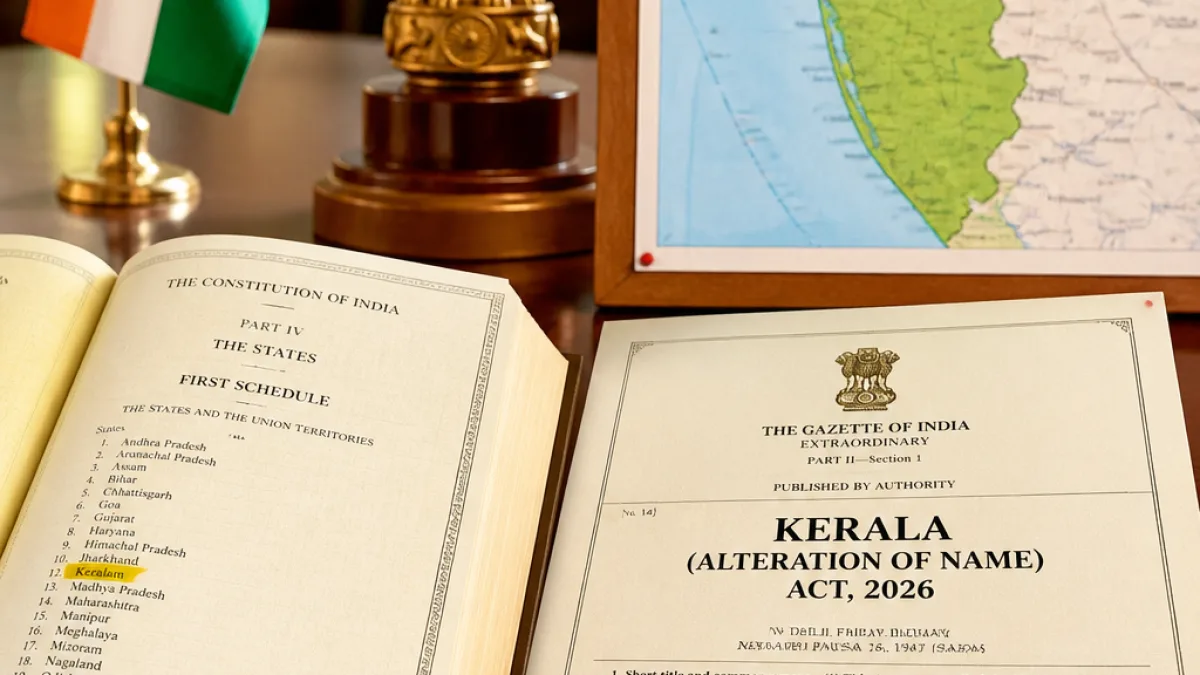
Thiruvananthapuram: President Droupadi Murmu has given assent to the Kerala (Alteration of Name) Bill, 2026, making it law and providing for the State of Kerala to be officially known as the State of Keralam. The legislation, passed by the Lok Sabha on August 11 and by the Rajya Sabha the following day, will require consequential amendments to the Constitution's First Schedule.
Parliamentary approval and state resolution
The Bill's passage through both Houses of Parliament followed a resolution adopted by the Kerala Legislative Assembly in 2024, which the state government forwarded to the Centre in June 2024 requesting an alteration of the state's name. The Ministry of Home Affairs, during Rajya Sabha proceedings, cited the Assembly resolution as the basis for the Centre introducing the Bill under Article 3 of the Constitution.
Speaking in the upper House, Minister of State for Home Affairs Nityanand Rai explained the purpose of the measure.
"The Bill provides that the State of Kerala will be known as the State of Keralam, and hence there is a proposal to rename the State of Kerala to Keralam."
Constitutional mechanics and immediate effects
The Bill provides for the alteration of the State's name in the First Schedule to the Constitution, alongside necessary consequential provisions. Once the formal notification process is completed, central and state agencies will be required to update official records, stationery, websites and legal documents to reflect the new name.
Under Article 3, Parliament is empowered to change the name of a state. The law-making process in this instance included a reference by the President to the Kerala legislature for its views; the Assembly subsequently adopted a unanimous resolution agreeing with the Bill, clearing the way for presidential assent.
Practical implications for administration and law
Officials and departments will need to coordinate nationwide updates to reflect the new nomenclature. Changes will affect:
- Central and state government letterheads, seals and official signage
- Legal instruments and court records referring to the state name
- Government websites, databases and public-facing documents
- Educational certificates and institutional charters where the state name appears
While the change is largely nominal, administrative timelines for updating records and issuing notifications will be crucial to prevent confusion in governance, law and service delivery.
Timeline of key events
| Date | Event |
|---|---|
| June 2024 | Kerala Assembly forwards resolution seeking name change to the Centre |
| 11 August 2026 | Lok Sabha passes the Kerala (Alteration of Name) Bill, 2026 |
| 12 August 2026 | Rajya Sabha passes the Bill |
| 17 August 2026 | President gives assent; Bill becomes law |
Political and public response
The parliamentary debates and the state Assembly's unanimous resolution indicate cross-institutional support for the change within formal channels. The Bill's proponents have described the move as aligning the state’s official name with local linguistic usage. The passage through Parliament and the President's assent formalise what supporters framed as a restoration of regional nomenclature.
At the same time, implementation will require careful coordination between the state government in Thiruvananthapuram and multiple departments of the Union Government. Ministries will need to issue instructions and timelines to ensure a smooth transition in records and public services.
What to expect next
Following presidential assent, the Central Government is expected to notify the change in the Gazette of India and issue directions to ministries and departments on updating central records. The Kerala government must similarly circulate orders to state departments, local bodies and public institutions to begin the process of replacing the state's name in official materials.
For citizens, services and legal processes will continue unchanged in substance; the principal effect is a change in nomenclature that will gradually appear in all formal documentation.
Administrative timelines, costs of replacing signage and stationery, and the sequence of updates across central and state databases will be matters to watch in the coming weeks as the new name is rolled out.
Reporting from Thiruvananthapuram.