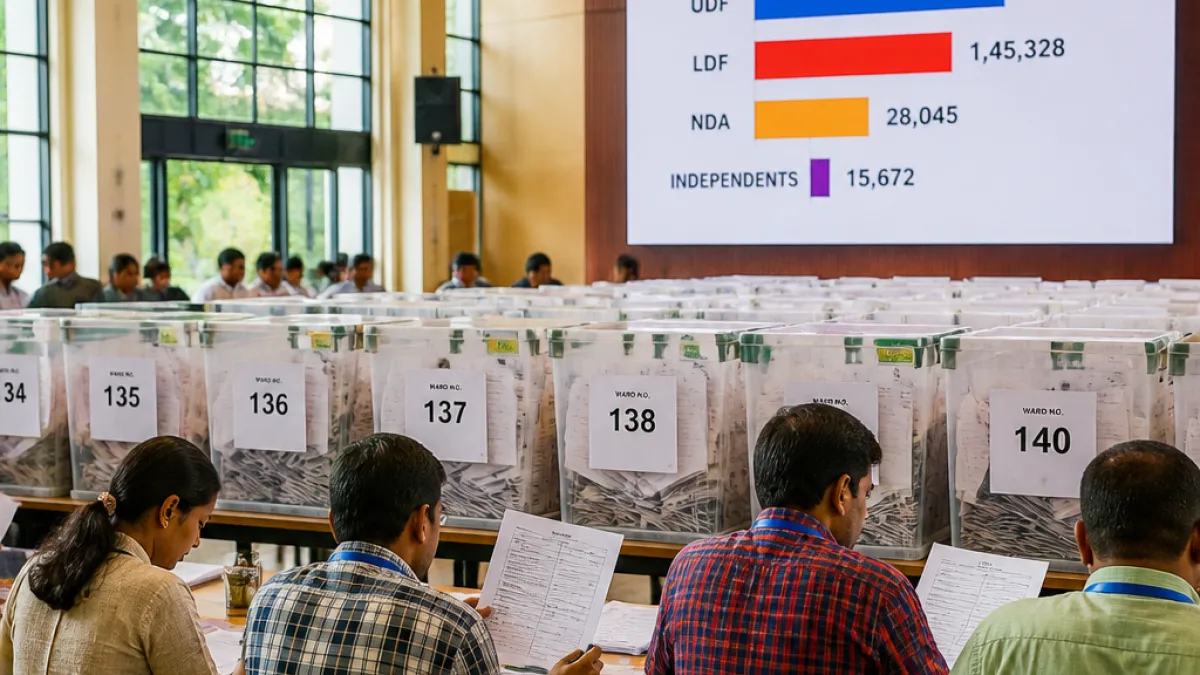
Thiruvananthapuram: The Congress-led United Democratic Front (UDF) suffered a setback in local body by-elections held on Monday, winning 18 of the 38 wards that went to the polls, according to State Election Commission figures. The CPI(M)-headed Left Democratic Front (LDF) captured 16 seats, the BJP-led National Democratic Alliance (NDA) won one, and three wards were taken by independent candidates.
District picture and key losses
The bypolls, held roughly four months after the VD Satheesan-led government assumed office in the state, produced mixed outcomes across districts. The UDF swept all wards in Pathanamthitta that were contested, but performed poorly in other areas.
- Ernakulam: UDF won 2 of 4 wards — a setback in a Congress stronghold.
- Kottayam: LDF won 2 of the 3 wards that went to poll.
- Palakkad: The Left front captured 4 of the 7 seats contested.
- Wayanad: UDF held the Pallikkal division of Mananthavady but with a much narrower margin than previously.
- Kozhikode: The Kuttichira ward was retained by UDF with a reduced majority.
Reports indicate the UDF lost around four sitting seats. Among these were two wards in the Chirayinkeezhu constituency — from where Congress MLA Ramya Haridas had won in the April Assembly polls.
Local issues and electoral dynamics
Observers and reports suggest localised factors affected outcomes in several wards. In Chirayinkeezhu, a recent physical altercation involving the MLA and some local Congress functionaries, followed by disciplinary action against a few party workers, was cited as having potentially undermined the party’s prospects in the area.
Beyond constituency-level incidents, the results were presented by analysts as an early barometer of public reaction to criticism mounted by the LDF against the new UDF administration. The Left has attacked the state government on a string of governance issues — power cuts, the foreign travel of ministers, alleged delays in flood relief assistance and shortages of medicines in government hospitals — focusing particular attention on Chief Minister V D Satheesan.
Turnout and voting margins
The overall turnout for the bypolls was recorded at 58.81 per cent. Kannur reported the highest participation at 84.55 per cent. In several wards where the UDF retained seats, the victory margins narrowed considerably compared with the previous election cycle — from margins of over a thousand votes earlier to just a few hundred this time, according to the returns.
| Outcome | Seats won |
|---|---|
| UDF (Congress-led) | 18 |
| LDF (CPI(M)-led) | 16 |
| NDA (BJP-led) | 1 |
| Independents | 3 |
Political implications
Though bypolls to a limited number of wards do not alter overall control of local bodies, they serve as an early test of the ruling coalition’s public standing. For the Satheesan government, now four months into its term, the results add pressure to respond to issues highlighted by the opposition and to shore up support at the grassroots.
For the LDF, gains in Kottayam and Palakkad and narrowed margins in traditional UDF territories will be presented as validation of the front’s aggressive scrutiny of the state administration. The BJP’s single win indicates limited inroads at this stage in the particular set of contests.
What to watch next
Political observers say attention will shift to how the UDF addresses governance criticism — in particular on public utilities, health supply chains and the timeliness of disaster relief payments — and whether the party moves to resolve internal organisational frictions in constituencies such as Chirayinkeezhu. Local bodies’ next affairs may also indicate whether the reduced margins translate into further erosion or are localised aberrations.
State Election Commission returns and the distribution of ward-level numbers will be examined closely by all parties in the coming days as they prepare for the next round of civic contests and reorganise campaign strategies.
Thomas Varghese is the Kerala correspondent reporting on state politics and civic governance.