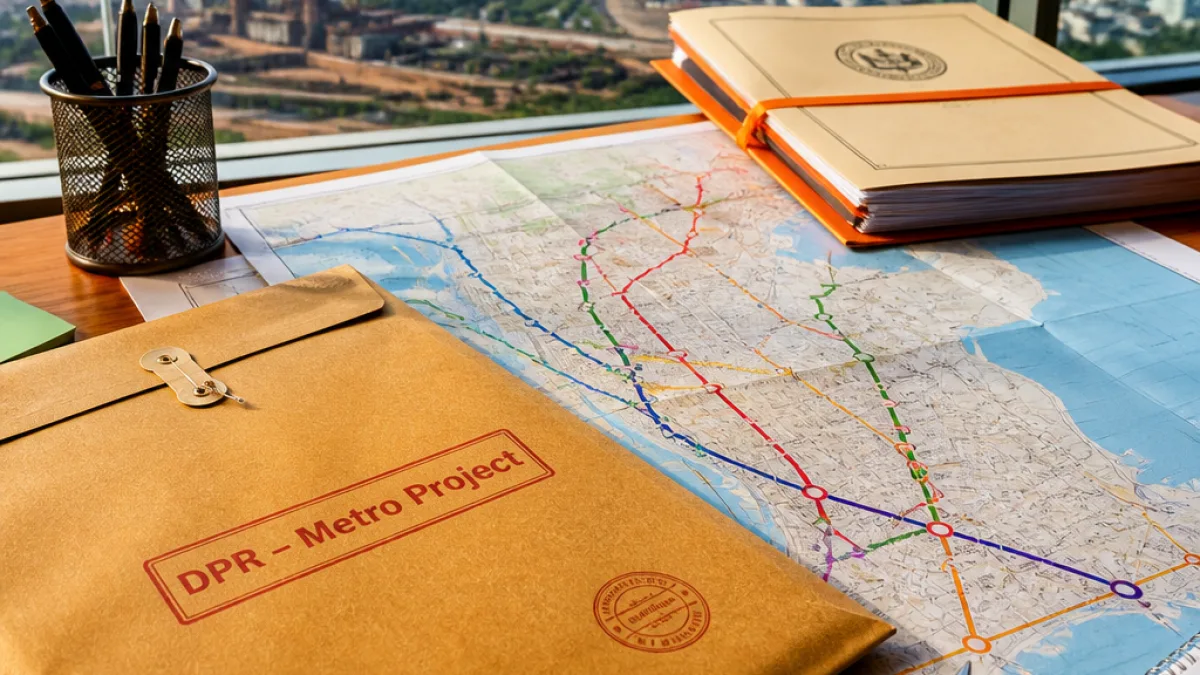
Fresh full-scale DPR sent to UPMRC; state approval next
Prayagraj — A fresh detailed project report (DPR) for a full-fledged metro rail network in Prayagraj, estimated at ₹12,000 crore, has been prepared and submitted to the Uttar Pradesh Metro Rail Corporation (UPMRC), officials said on Wednesday. Railway technical consultancy firm RITES prepared and handed over the report, and UPMRC will now seek approval from the state government before forwarding the proposal to the Centre for final clearance and funding arrangements.
The latest plan retains the two corridors proposed in earlier studies. The first corridor is planned to link Shantipuram with Chheoki in Naini, while the second is designed to connect Jhunsi with Bamrauli airport and the proposed Aerocity area. The route linking Jhunsi and Bamrauli has been extended up to the airport in the fresh DPR, according to the Prayagraj Development Authority (PDA) vice-chairman Rishiraj, who is the nodal officer for the metro project.
"The Jhunsi–Bamrauli route has now been extended up to the airport in the fresh proposal," the PDA vice-chairman said, confirming the changes in alignment.
Features retained and new additions
The DPR retains the twin-corridor approach that aims to connect key residential, commercial and transport nodes. A ropeway station at Parade has been incorporated at the junction of the two proposed metro routes in the fresh submission, signalling an integrated multimodal intent in the design.
- Two corridors: Shantipuram–Chheoki (Naini) and Jhunsi–Bamrauli (extended to airport and Aerocity).
- Ropeway station proposed at Parade to link the corridors.
- Submission path: RITES → UPMRC → State Govt → Centre (for final clearance and funding).
Background and changes since earlier proposals
The project has undergone several revisions over the past few years. An earlier DPR envisioned a full-scale metro system. On the direction of the state government, RITES later prepared a MetroLite DPR, proposing lighter infrastructure and smaller stations. Following suggestions from UPMRC, RITES conducted a new survey last year and prepared the fresh DPR for a full-fledged metro, which has now been submitted to UPMRC.
PDA officials emphasised that both state and central approvals will be required before the project can proceed. After the state government clears the ₹12,000-crore proposal, the DPR will be forwarded to the Centre; central approval and funding arrangements will be necessary for implementation and contract awards.
Implications for city planning and travel
If cleared and financed, the proposed network aims to connect major residential and commercial areas with key transport nodes, notably the railway hub at Chheoki and Bamrauli airport. The inclusion of an Aerocity link and a ropeway interchange at Parade suggests planners are seeking to integrate existing transport corridors with new urban-development nodes.
| Element | Detail in latest DPR |
|---|---|
| Estimated cost | ₹12,000 crore |
| Corridors | Shantipuram–Chheoki (Naini); Jhunsi–Bamrauli (extended to airport and Aerocity) |
| Additional features | Ropeway station at Parade |
| Next procedural steps | State government approval → DPR to Centre → central clearance and funding arrangements |
Officials said the fresh DPR has revived the prospect of a full-fledged metro network for Prayagraj, though its progress will now depend on timely clearances and the Centre–state funding framework. No timeline for state or central approvals was provided in the submission, and PDA sources indicated previous iterations of the proposal were altered to reflect changing policy guidance and technical recommendations from UPMRC and RITES.
The development marks a move away from the MetroLite option that had been examined earlier and returns to a heavier metro model, which implies larger stations, heavier rolling stock and higher capital outlay. The final decision on the project configuration, phasing, and financing will rest on approvals at the state and central levels.
For Prayagraj residents and planners, the DPR's submission represents a key procedural milestone: it places the project one step closer to potential implementation but leaves substantive decisions — and the question of when construction might begin — to upcoming government reviews and funding commitments.