
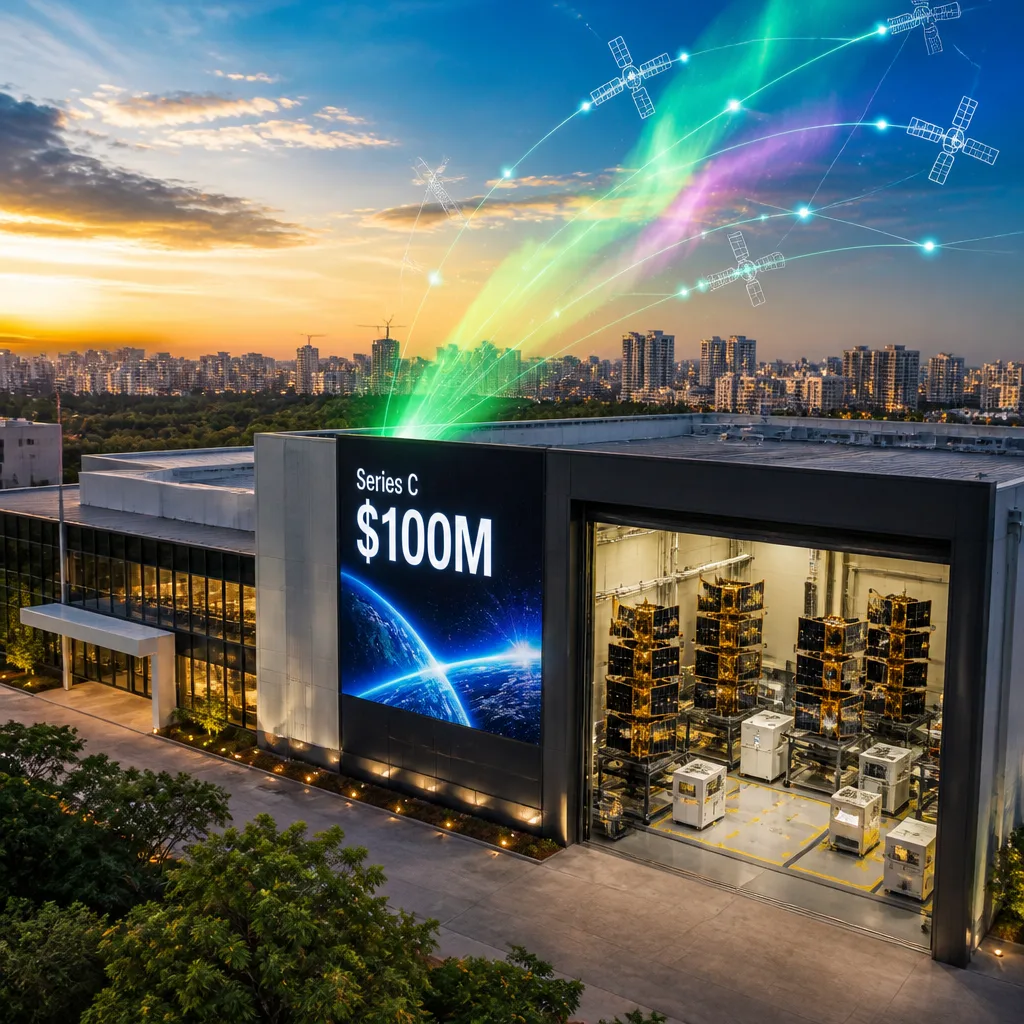
Pixxel, a Bengaluru-based space-technology startup backed by Google, has raised $100 million in a Series C financing round led by Singapore state investor Temasek and UK space-technology fund Seraphim, the company said on Monday. Existing investors Radical Ventures and growX Ventures participated, while new investors 360 ONE Asset and IMM Investment joined the round.
What the deal is and where the money will go
The fresh capital brings Pixxel’s total funding to $195 million. According to the company, the Series C will be deployed to expand its sensing capabilities and strengthen satellite infrastructure — moving beyond imagery collection to build an integrated Earth-observation and intelligence offering.
- Amount raised: $100 million (Series C)
- Total funding to date: $195 million
- Lead investors: Temasek, Seraphim
- Other participants: Radical Ventures, growX Ventures, 360 ONE Asset, IMM Investment
Pixxel was co-founded by Awais Ahmed and began with a focus on hyperspectral satellites — sensors that capture data across many bands of the electromagnetic spectrum, enabling more detailed analysis of surface materials and processes than conventional optical imagery. The company now describes its offer as three linked components: the Honeybee satellite constellation, high-resolution optical imaging satellites, and Aurora, its Earth intelligence software platform that combines sensors, software and space systems.
Context: private players and India's space sector
The fundraise highlights the expanding role of private companies in India's space economy after policy changes opened the sector to non-government players. Pixxel's Series C is the single-largest funding round for a space-technology company in India, underlining investor appetite for end-to-end Earth-observation capabilities that pair hardware and analytics.
Hyperspectral imaging, the technology central to Pixxel’s early work, has applications across agriculture, mining, environment monitoring and disaster response because it can identify and classify materials on the ground with greater precision than standard imagery. By combining such sensing with software analytics, Pixxel aims to sell actionable intelligence to governments, industries and institutions rather than raw images alone.
| Pixxel offering | Role |
|---|---|
| Honeybee constellation | Hyperspectral sensing from multiple satellites |
| High-resolution optical satellites | Conventional imagery for visual analysis |
| Aurora (software) | Earth intelligence platform for data processing and products |
What it means for investors, customers and the market
For investors, the round signals continued confidence in space-tech startups that offer integrated hardware-and-software solutions. For potential customers — including government agencies and enterprises in agriculture, energy and environment — the deal could accelerate availability of more frequent, higher-resolution and multi-spectral data fused with analytics.
For the Indian space ecosystem, a large, well-backed private player scaling both satellites and downstream analytics may help build supply chains, attract talent and spur complementary services such as ground-station networks and data platforms. Increased private investment can also deepen competition and may push incumbents and new entrants to expand product quality and pricing options.
However, the transition from prototype satellites to a full commercial constellation and sustainable recurring revenues remains capital intensive and complex. Building manufacturing capacity, launch arrangements, regulatory clearances, ground infrastructure and long-term customer contracts are necessary next steps before scale translated into consistent cashflows.
Pixxel’s founders and backers have so far marshalled significant capital: the company now lists nearly $200 million raised in total. How swiftly Pixxel converts the Series C into expanded in-orbit capability, commercial contracts and recurring revenue will determine whether the raise becomes a watershed moment for India’s private space industry or one milestone among several rounds required to reach commercial scale.
From a user perspective, the likely outcome is increased availability of specialised Earth-observation products in coming years — more timely, multi-spectral insights that can inform crop management, resource monitoring and environmental compliance. That parallels a broader industry shift: governments and companies increasingly value interpreted intelligence over raw imagery.
The participation of global institutional investors such as Temasek and Seraphim underscores international interest in Indian space startups with technology and market ambitions beyond national borders. Pixxel’s expanded footprint could also strengthen India’s role in the global Earth-observation value chain.