Shortages stretch hospital staff, raise patient-safety concerns
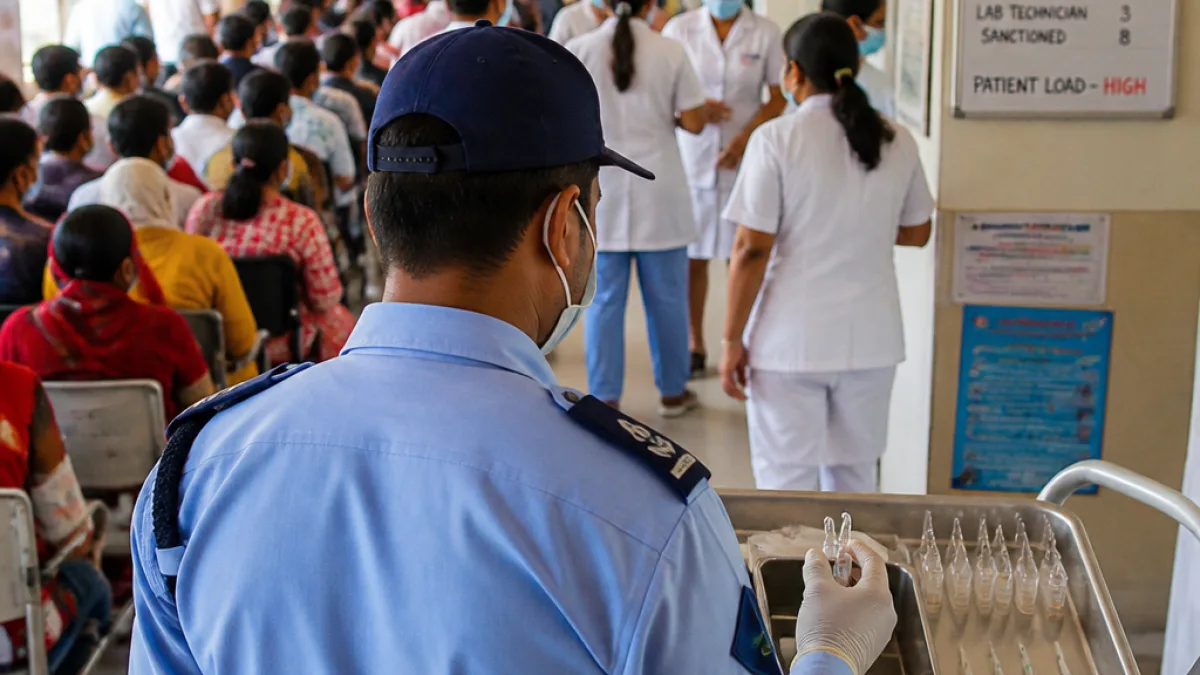
NOIDA: A video in which a security guard was recorded filling syringes for clinical use has drawn scrutiny to a wider staffing crisis in Noida’s public health facilities, with officials and hospital data saying chronic shortages of nurses, doctors and paramedical staff are straining services across the district.
The footage — which showed a non-medical employee preparing injections from ampoules while clinical staff were reportedly overwhelmed — prompted administrative action and the suspension of two persons involved, the report said. Authorities described the act as unlawful and a breach of the line between medical and non-medical duties.
Hospital records and officials quoted in the report indicate the Noida district hospital handles roughly 4,000 out‑patient department (OPD) cases and about 300 in‑patients daily with an available complement of 45 doctors and about 100 staff nurses. According to the same data, the facility requires at least 100 more staff nurses and 50 more doctors across wards to adequately meet patient needs.
- Bhangel Community Health Centre (CHC) manages around 700–800 OPD patients daily but has only seven nurses, the report said.
- Jewar CHC is operating with five doctors and six paramedical staff, officials reported.
"At one given moment, a nurse takes care of multiple different things. On one hand, she checks a reading of a post-operative patient’s blood pressure, fields questions from family members, gives injections to other patients, records readings and manages various essential work. It is very tiring and humanly impossible at times. There is an urgent need to recruit more staff nurses," a nurse at Noida district hospital said, the report added.
Indian Public Health Standards (IPHS) and the Indian Nursing Council (INC) recommend a nurse‑to‑patient ratio of 1:6 in general hospital wards. Current staffing at the district hospital, based on the figures in the report, falls well short of that benchmark, officials said.
Operational impact and service delays
Hospital administrators and staff allege the shortage has a direct operational impact: nurses and doctors routinely juggle multiple roles, increasing waiting times and intensifying pressures during peak OPD hours. Patients typically wait one to two hours before being attended to, the report said.
Officials noted that the staffing crunch is not limited to the district hospital but extends to CHCs and other government facilities across the district, complicating routine care delivery and emergency response readiness.
| Facility | Reported daily OPD / In‑patients | Current staff (doctors / nurses) | Reported shortfall |
|---|---|---|---|
| Noida district hospital | ~4,000 OPD; ~300 in‑patients | 45 doctors; ~100 nurses | ~50 doctors; ~100 nurses |
| Bhangel CHC | 700–800 OPD | 0 doctors cited; 7 nurses | Significant shortfall against needs |
| Jewar CHC | Not specified | 5 doctors; 6 paramedical staff | Insufficient for service load |
Health officials, as described in the report, said recruitment is required urgently to relieve overburdened staff and to ensure medical tasks are performed only by trained personnel. The episode has prompted administrative review of duty allocation and supervision across facilities.
Accountability and next steps
While the two individuals allegedly involved in the syringe‑preparation incident were suspended, officials told the report that systemic solutions are needed — including faster recruitment drives, better deployment of paramedical staff, and strengthened on‑site supervision — to prevent recurrence and to protect patient safety.
The incident has highlighted the trade‑offs hospitals face when daily patient loads far exceed available clinical personnel. For Noida, one of Uttar Pradesh’s most populous and rapidly urbanising districts, the gap between current staffing and recommended norms underlines both an operational risk and a public‑administration challenge requiring coordinated action by health authorities.
All figures and accounts in this article are based on the reporting cited in local media and statements attributed therein.