District orders limits on smart-board usage amid parental complaints
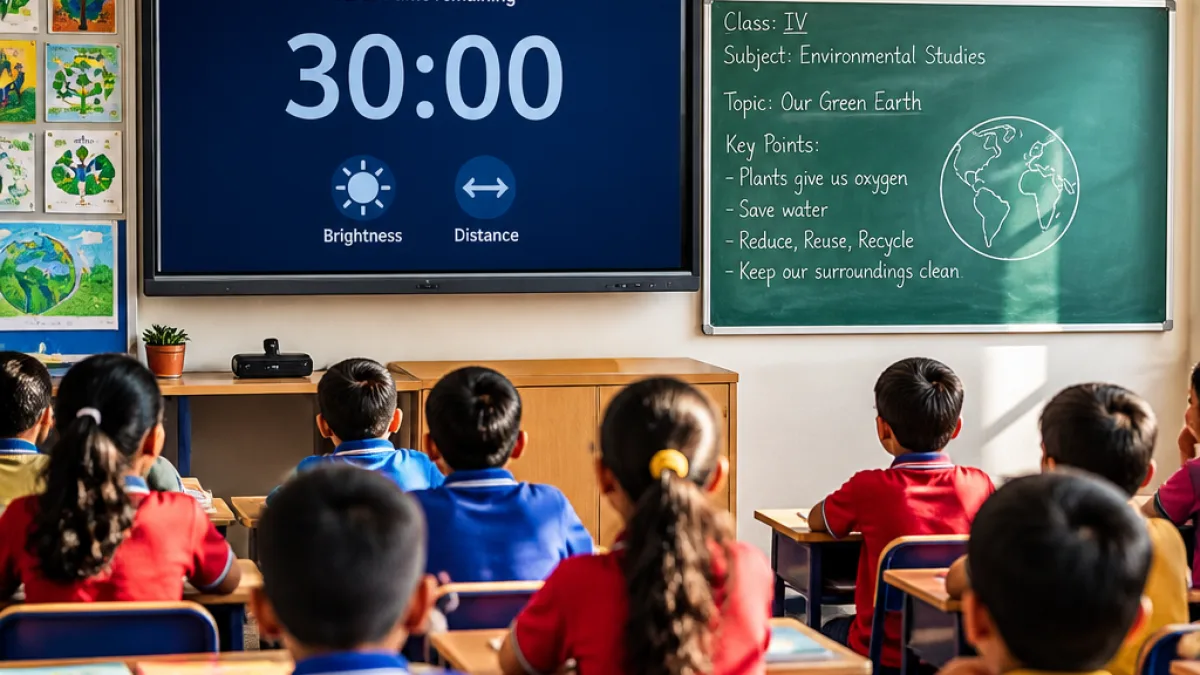
The Gautam Buddh Nagar district administration has directed all government, aided and private schools in Noida and Greater Noida to limit daily screen time on smart and digital boards to 30 minutes for primary classes and 60 minutes for upper-primary classes. The order follows complaints from parents' associations that pupils were spending several hours a day facing screens used for classroom instruction, the administration said in an official statement on Thursday.
The administration said designated magistrates and nodal officers have been assigned to monitor compliance. It emphasised that smart and digital boards should remain a supplementary teaching aid and not replace traditional methods of classroom instruction.
"Smart and digital boards are a supplementary medium to make teaching more effective, but their continuous and unnecessary use should not affect the health, studies, sports and other activities of students," the statement said.
Authorities cited potential health risks from prolonged screen exposure, including eye strain, short-sightedness, headaches, reduced concentration and other physical and behavioural problems. The guidelines urge schools to adopt "limited, balanced and purposeful use of smart boards and digital boards" in keeping with the health and overall development of students.
- Daily screen-time cap: 30 minutes for primary classes, 60 minutes for upper-primary classes.
- Use smart boards primarily for explaining complex concepts and showing relevant pictures or videos.
- For writing practice, question-answer sessions and participatory activities, schools should use blackboards, whiteboards or greenboards.
- Schools must manage screen brightness, classroom lighting and ensure proper viewing distance; breaks should be provided.
The administration specifically instructed that smart boards should not be used continuously to display entire textbooks or to conduct all classwork. For routine writing and interactive activities, teachers have been asked to continue regular use of traditional boards so that students are not continuously exposed to digital screens.
| Category | Primary | Upper-primary |
|---|---|---|
| Maximum daily screen time | 30 minutes | 60 minutes |
| Monitoring mechanism | Designated magistrates and nodal officers | |
Officials said the restrictions are intended to protect the "health and overall development" of children. The statement also directed schools to ensure appropriate screen brightness and classroom lighting and to maintain proper distance between students and screens. It added that schools should provide regular breaks during classes that use digital displays.
The move comes amid growing concern among parents in the district after reports that smart and digital boards were being used continuously — at times for four to five hours daily — to display textbooks, conduct classwork, and hold question-answer sessions and homework. Parent-teacher associations had raised these issues with the district, prompting the administration to frame the current directive.
The guidelines do not enumerate penalties in the statement but make clear that compliance monitoring will be conducted through the appointed magistrates and nodal officers. Schools in Noida and Greater Noida will be required to align classroom practices with the policy and document the limited, purpose-driven use of digital boards.
Education experts nationally have previously warned that uncontrolled screen exposure at a young age can affect attention spans and visual health; however, the district's directive focuses on practical classroom limits and administrative oversight to balance digital teaching tools with traditional methods.
Implementation details, timelines for compliance and any follow-up assessments were not specified in the statement. Schools and parent groups in the district are likely to await further communication from the education department or district authorities on monitoring protocols and any reporting requirements.