Uttar Pradesh issues tenders for Yamuna–Ganga link; construction to take three years
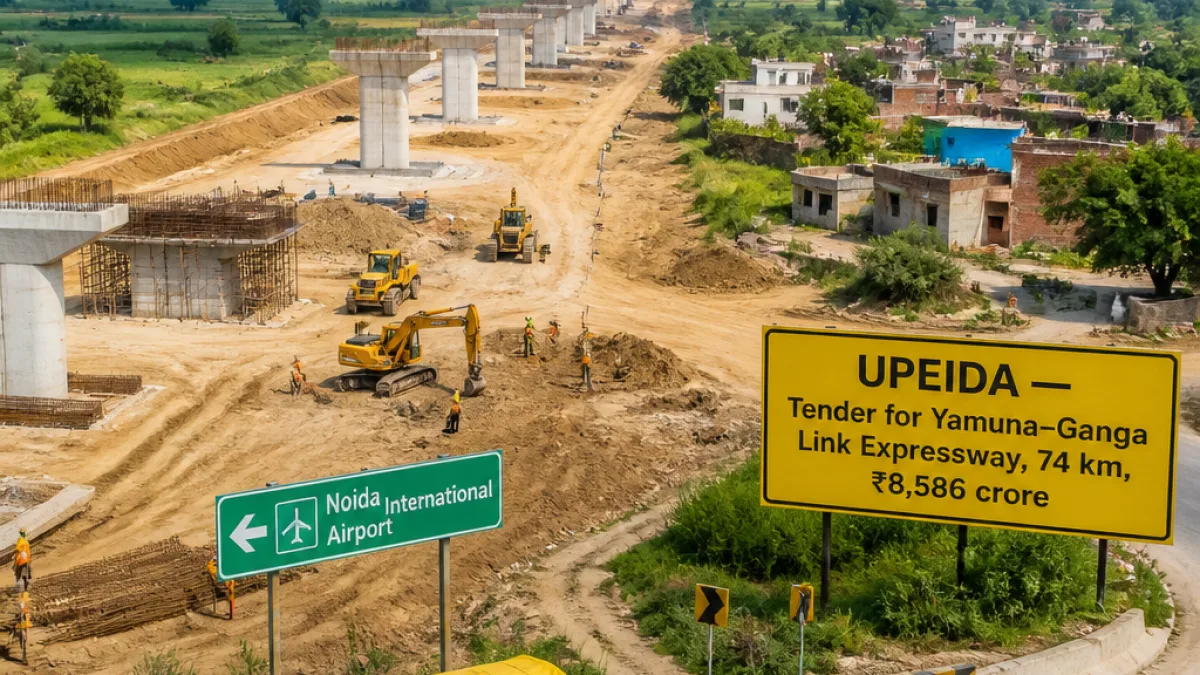
The Uttar Pradesh government has taken formal steps to build a 74-kilometre link expressway connecting the Yamuna Expressway with the Ganga Expressway, issuing tenders through the Uttar Pradesh Expressway Industrial Development Authority (UPEIDA) for developers to execute the project in phases.
Officials said the work will be carried out under a design, engineering, procurement and construction model, with the selected contractor also responsible for maintenance during a five-year defect liability period. The project has been estimated at approximately ₹8,586 crore and is scheduled to be completed in three years.
Purpose and alignment
Authorities stated the link is intended to provide faster, more direct road access to the Noida International Airport from parts of western Uttar Pradesh, especially Bulandshahr and neighbouring districts. The expressway will start near the 24.8 km mark of the Yamuna Expressway, close to the proposed Film City in Sector 21 of the Yamuna Expressway Industrial Development Authority (YEIDA) area, and will join the Ganga Expressway around the 44.3 km point near Syana in Bulandshahr.
The alignment will pass through 56 villages—eight in Gautam Buddh Nagar and 48 in Bulandshahr—bringing land acquisition and local impact into focus as the implementation proceeds.
Land acquisition and budgetary allocation
UPEIDA officials reported that land acquisition work is underway in both Gautam Buddh Nagar and Bulandshahr. They added that roughly 90 per cent of the required land in the Yamuna authority area has been acquired; remaining tracts include about 23 hectares in the villages of Mehndipur and Bhaipur. Acquisition work in Bulandshahr is ongoing.
For the current fiscal, the state government has earmarked ₹250 crore under a supplementary budget to advance the project, officials said. The cabinet has already cleared the plan for construction.
Design and civil works
The link will be a controlled-access six-lane expressway with provision to expand to eight lanes later if required. Project documents and officials indicate significant ancillary works will be part of the contract package. Planned structures include:
- Seven underpasses
- Eleven minor bridges
- Three major bridges
- One flyover
- Four railway overbridges
Construction will be delivered in two phases, with the contractor required to meet technical, environmental and social safeguards as part of the tender conditions, officials added.
Project summary
| Parameter | Detail |
|---|---|
| Length | 74 km |
| Estimated cost | ₹8,586 crore |
| Capacity | Six lanes (expandable to eight) |
| Completion target | 3 years |
| Maintenance | Five-year defect liability period |
| Villages affected | 56 (8 in Gautam Buddh Nagar, 48 in Bulandshahr) |
Local impact and next steps
Officials said tenders have been issued for developers to implement the first and second phases. The successful bidder will be responsible for full execution of civil works, including construction of underpasses, bridges and railway crossings, as well as procurement and commissioning of road safety and access-control features.
For residents and landowners in the affected villages, the immediate issues will be land acquisition, compensation and rehabilitation. Authorities have signalled ongoing acquisition activity in both districts; exact timelines for plot demarcation, compensation schedules and grievance redressal mechanisms will be specified in formal acquisition notifications and tender documents.
Completion of the link is expected to shorten travel times between western parts of the state and the airport, and to improve freight and passenger movement between the two expressway corridors. Observers note that the corridor could also catalyse industrial and real-estate development in nodal areas along the route.
UPEIDA will publish detailed tender documents and bid conditions on its portal; developers and contractors eyeing the work will need to meet technical eligibility and financial capacity criteria set out by the authority.
As the project moves from tendering to implementation, monitoring of land acquisition, environmental clearances and contractor mobilisation will determine whether the state meets the three-year completion target.