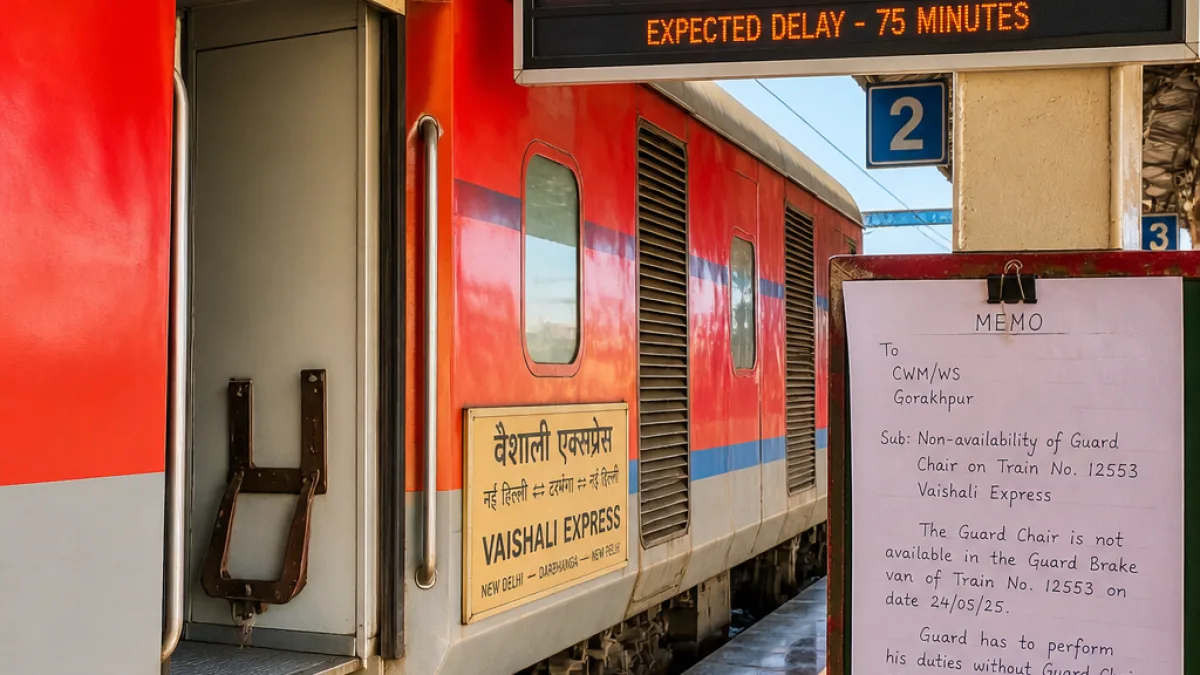
Train detained at Gorakhpur after manager raises safety concern over missing seat
The New Delhi–Lalitgram Vaishali Express (15566) was held at Gorakhpur Junction on Monday after the train manager discovered there was no designated chair in the guard coach. The omission led to a delay that stretched to more than an hour by the time the train departed the station, according to official railway timings.
Railway records show the Vaishali Express was scheduled to arrive at Gorakhpur at 9.17am but arrived at 9.48am, making it 31 minutes late on arrival. The train was due to depart at 9.27am but finally left the platform at 10.36am, by which time the recorded delay had grown to one hour and nine minutes.
- Train: Vaishali Express (15566), New Delhi–Lalitgram
- Location: Gorakhpur Junction, Platform No. 2
- Cause: Missing chair in the guard coach; train manager refused to proceed without seating
- Delay recorded: 31 minutes on arrival; 1 hour 9 minutes on departure
“Safety comes first,” the train manager said, adding that a train manager could not be expected to perform a duty lasting more than eight hours without proper seating, particularly on a train travelling at speeds of over 100 kmph.
According to reporting of the incident, the train manager who took charge at Gorakhpur — identified in media accounts as Ramashish Das — found no chair in the guard coach, which serves as the operational workspace for the train manager. He raised the matter with station authorities, photographed the coach and informed control rooms in the Varanasi and Sonpur divisions before deciding not to proceed until the deficiency was addressed and formally recorded.
Railway procedures require a functioning workspace in the guard coach so the train manager can carry out safety checks, maintain records and manage communications. The manager concerned pointed out that his counterpart who handed over charge at Gorakhpur had apparently travelled in the power car despite the absence of a chair in the guard’s working area.
Operational implications and local context
Gorakhpur Junction is a major rail hub in eastern Uttar Pradesh and delays at the station can cascade across schedules on busy routes. Even routine operational issues can have outsized effects on punctuality, given the high traffic on tracks in the region.
By insisting the shortage be officially documented, the train manager followed a precaution intended to protect passengers and staff and to ensure responsibility for the deficiency was recorded. He later sent a memo to the station superintendent before proceeding with the journey.
| Scheduled | Actual | Delay |
|---|---|---|
| Arrival at Gorakhpur: 9.17am | 9.48am | 31 minutes |
| Departure from Gorakhpur: 9.27am | 10.36am | 1 hour 9 minutes |
Railway officials routinely handle equipment and furnishing shortages across large fleets, and remedial action typically includes replacing missing items, recording the defect and reviewing handover procedures between crew members. In this case, the train manager communicated with divisional control offices before resuming the run.
For passengers and regular rail users in Gorakhpur, the incident highlights two points: the centrality of guard‑coach facilities to operational safety, and the potential for small equipment lapses to cause measurable timetable disruptions at major junctions. Timely reporting and formal recording of such deficiencies are part of the safety culture the railways aim to enforce.
No further information was available from railway authorities on whether a formal inquiry or corrective action was ordered after the memo was submitted to the station superintendent. The delay added to the train’s earlier lateness before it reached Gorakhpur.
Local commuters and those travelling through Gorakhpur are advised to check live running status and platform information through official railway channels for updates on punctuality and any operational advisories.