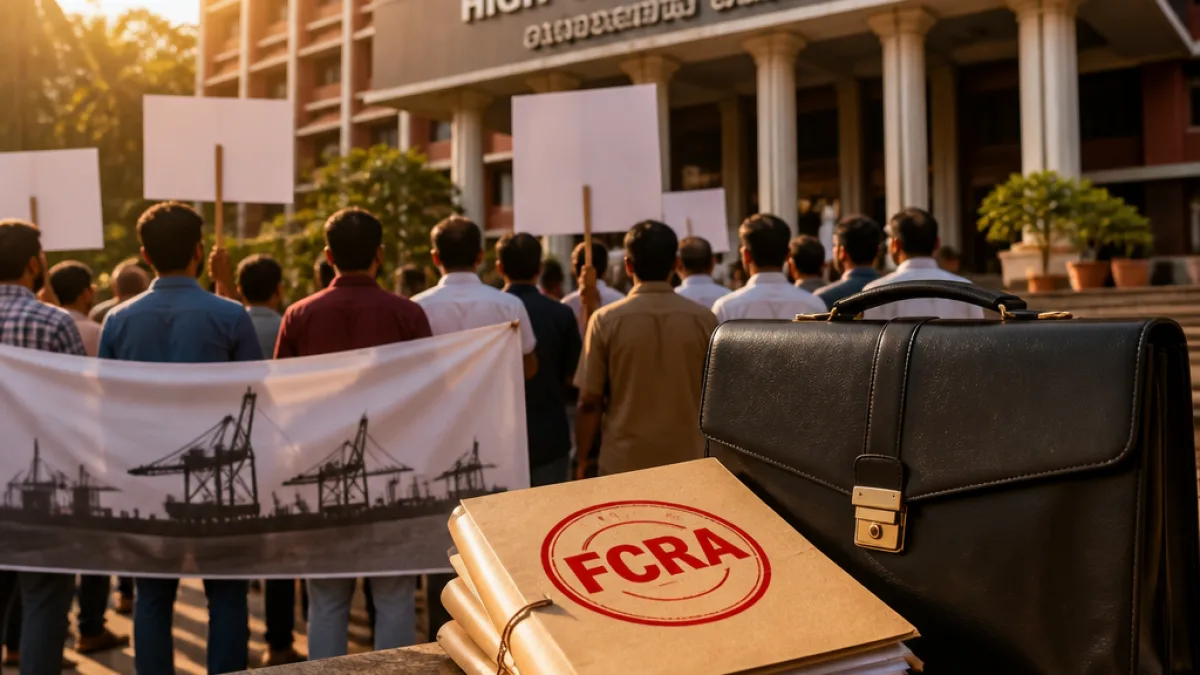
Kochi: The Kerala High Court on August 11 set aside the Centre’s refusal to renew the FCRA licences of two non-governmental organisations that central agencies had linked to agitations against the Vizhinjam port project, holding that financial assistance to a peaceful protest does not ipso facto amount to diversion of foreign contributions.
Court underscores constitutional right to protest
The single-judge bench observed that the right to protest is constitutionally guaranteed and cannot be labelled an "undesirable purpose" under the Foreign Contribution (Regulation) Act merely because the Government disapproves of the protest. The court said executive displeasure cannot convert the exercise of a constitutional right into a legal violation.
"When the right to protest is constitutionally guaranteed, exercise of such rights cannot be labelled as an 'undesirable purpose' or against public interest," the order dated August 11 said.
In its judgement, the High Court interpreted the phrase "undesirable purpose" in section 12(4)(a)(ii) of the FCRA narrowly, saying the term cannot be read to mean undesirable to the political will or the Government. The bench held that a peaceful protest by persons who apprehend injury or have grievances cannot be treated as an activity contrary to public interest solely on the ground of political disapproval.
Legal standard for ‘undesirable’ must be rooted in law or public injury
The court further stated that characterising an activity as undesirable must be rooted in a legal prohibition or demonstrable public injury. It recorded that even if some financial support was provided to protesters, such support would not automatically constitute diversion of foreign funds for an undesirable purpose under the FCRA.
The judgment emphasised that administrative distaste for dissent cannot be the basis for treating lawful expression of discontent as a ground to deny statutory benefits or licences. The order set aside the impugned executive action and directed restoration of the renewal process for the two NGOs.
Implications for NGOs and regulation of foreign funds
Legal observers say the judgement could have wider implications for civil society groups operating in Kerala and elsewhere, particularly where the receipt or utilisation of foreign funds has been questioned in the context of protest activity. The court’s approach insists on a clear legal nexus before administrative action under the FCRA can be sustained.
While the order does not alter the substantive obligations placed on organisations under the FCRA, it places a check on administrative overreach by requiring that allegations of diversion or undesirable use be grounded in law and demonstrable harm rather than mere policy displeasure.
| Date | Provision cited | Outcome |
|---|---|---|
| 11 August 2026 | Section 12(4)(a)(ii) of the FCRA | Centre's refusal to renew FCRA certificates set aside; renewal process to be reconsidered |
Background and local context
The case arises against the backdrop of long-running protests in parts of coastal Kerala over the contentious Vizhinjam port development. Central agencies had alleged that certain NGOs were facilitating and financing the agitation — allegations which formed the basis for the Centre's decision not to grant renewed FCRA licences. The High Court, however, found that those allegations, even if assumed, did not meet the legal threshold to deny renewal on the ground of an "undesirable purpose".
- Date of order: 11 August 2026
- Law referenced: Foreign Contribution (Regulation) Act, section 12(4)(a)(ii)
- Direct effect: Centre's refusal set aside; NGOs' renewal process to be revisited
The verdict is likely to be watched closely by NGOs, civil liberties groups and the government. It reiterates constitutional protections for peaceful assembly and dissent, and outlines limits on the administrative use of the FCRA to regulate such activity.
The High Court’s order did not list specific punitive findings against the organisations for diversion of funds. The State and central authorities now face the task of applying the judgement in subsequent administrative steps, which may include fresh hearings or further scrutiny consistent with the legal standards articulated by the court.
Legal practitioners note that higher courts or appellate remedies remain available to parties dissatisfied with the judgement. The ruling, however, represents a significant articulation by a constitutional court on the interplay between statutory regulation of foreign contributions and fundamental democratic freedoms in Kerala.