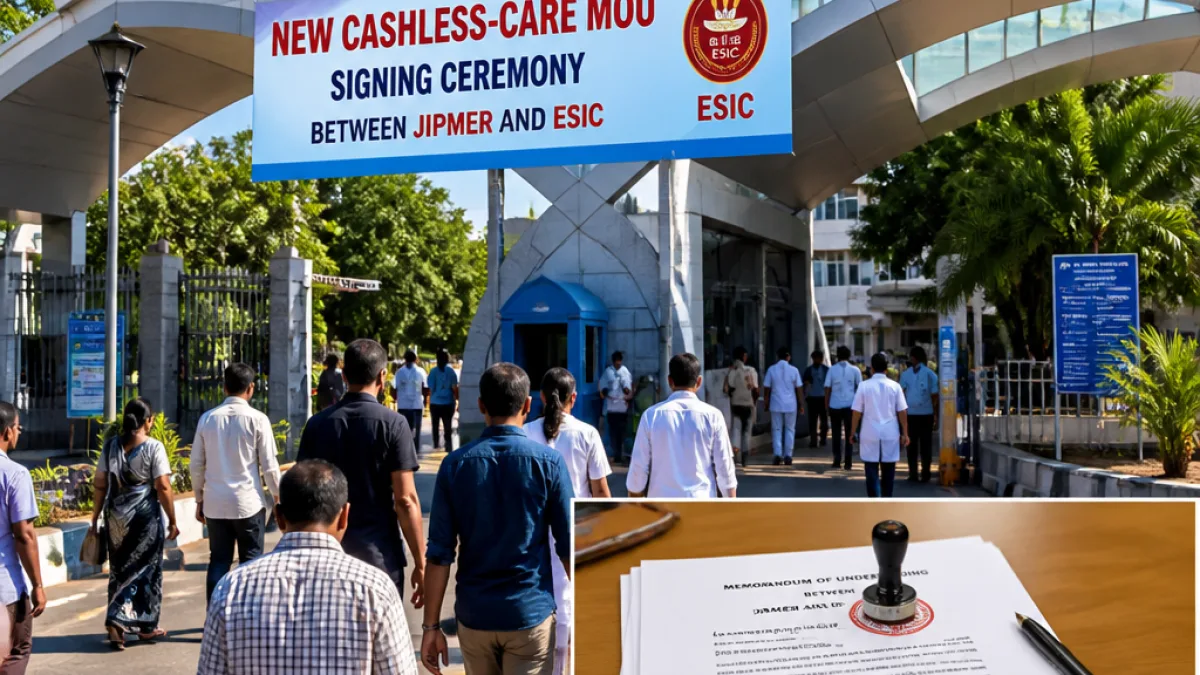
The Jawaharlal Institute of Postgraduate Medical Education and Research (JIPMER) and the Employees’ State Insurance Corporation (ESIC) on Friday signed a memorandum of understanding to provide cashless healthcare services to ESIC beneficiaries and their dependents at the Puducherry institute.
Scope of services under the agreement
According to the terms of the agreement made public on Friday, the arrangement covers a broad range of medical care offered by JIPMER, including:
- Outpatient consultations and inpatient treatment
- Diagnostic investigations
- Emergency treatment
- Surgeries and specialised medical procedures
The MoU allows emergency care to be availed without prior referral, but this is subject to beneficiary verification and follow-up communication with ESIC for administrative clearance.
Referral and claims process
The agreement provides for online referrals through the ESIC referral system. Cashless treatment will be provided in accordance with applicable ESIC policies and at mutually agreed rates between the two institutions. The initial term of the MoU is two years, with a possible extension of one year if both parties agree to continue the arrangement.
| Feature | Detail |
|---|---|
| Institutions | JIPMER and ESIC |
| Beneficiaries covered | ESIC insured persons and their dependents |
| Services included | OP/IP care, diagnostics, emergency treatment, surgeries, specialised procedures |
| Emergency care | Avail without prior referral; verification and communication with ESIC required |
| Referral mode | Online referrals through ESIC system |
| Duration | Two years initially; may be extended by one year on mutual terms |
What this means for beneficiaries in Puducherry
The MoU is intended to streamline access for insured workers and their families to tertiary-level care at JIPMER without immediate out-of-pocket expenditure at the point of service, provided the patient is verified as an ESIC beneficiary and the treatment falls under the agreed categories and rates. The provision for emergency care without a prior referral aims to reduce delays in critical situations, though hospitals and ESIC will still complete verification and administrative formalities afterwards.
For beneficiaries, practical steps under the arrangement are likely to include presenting ESIC identity documentation on arrival and following the online referral or verification process where applicable. The institutions have said cashless treatment will be governed by ESIC's policy framework, which determines package rates, pre-authorisation rules and reimbursement procedures.
Operational and administrative considerations
Implementation will require coordination between JIPMER's administrative and billing units and ESIC's claims processing system. Mutual agreement on rates and the digital referral workflow will be necessary to avoid delays in treatment and reimbursement. The two-year duration gives both sides time to operationalise the mechanisms and evaluate whether to continue the arrangement.
Healthcare analysts note that tie-ups between tertiary hospitals and insurance schemes can expand access but depend on clear processes for pre-authorisation, verification and dispute resolution. The MoU's emphasis on online referrals and post-emergency verification aims to balance clinical urgency with administrative accountability.
Officials at JIPMER and ESIC have not provided a breakdown of the specific packages or the exact patient registration steps in the public release. Beneficiaries seeking to use the facility are advised to carry valid ESIC identity documentation and to contact local ESIC offices for clarification on the referral process.
Emergency treatment can be availed without prior referral, subject to beneficiary verification and subsequent communication with ESIC.
The arrangement is effective immediately for the two-year initial period and may be extended by mutual consent for another year.