
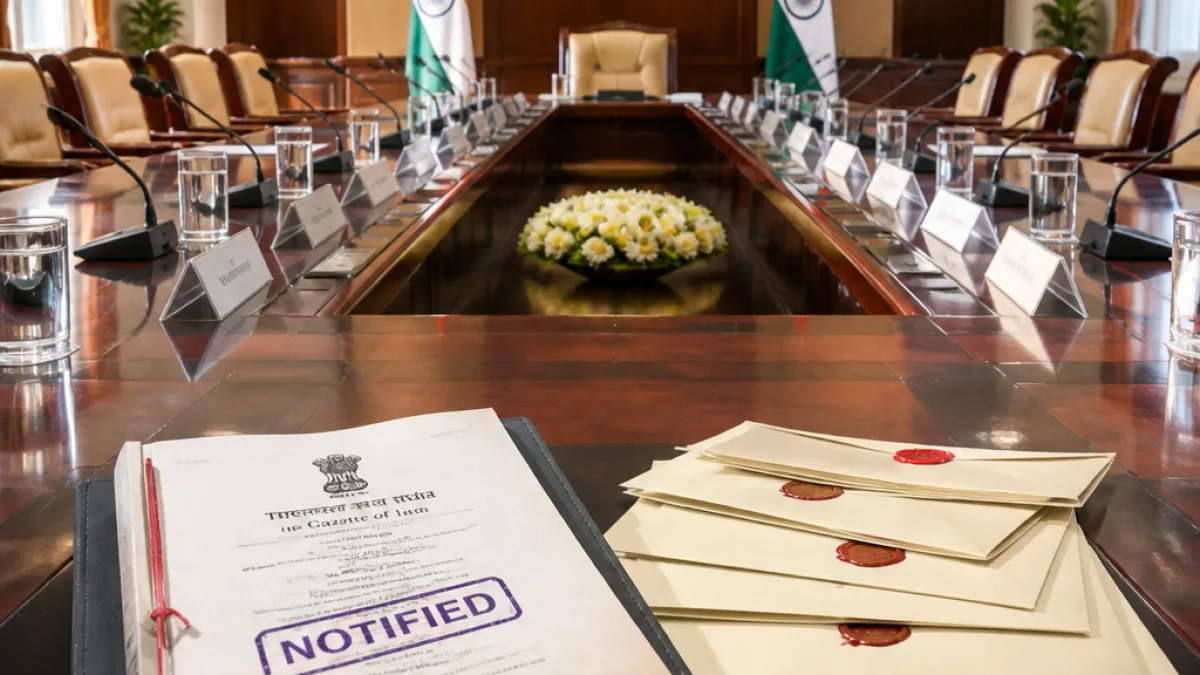
New Delhi: President Droupadi Murmu has amended the rules governing the Inter‑State Council to provide that the lieutenant governors of Union territories with legislatures — including Puducherry — may be invited to participate in council meetings when President's rule is in force, the Ministry of Home Affairs (MHA) said.
What the amendment changes
The amendment, notified by the MHA on September 9 and published on September 19, revises a proviso in the Inter‑State Council Order, 1990. The 1990 order established the council, whose membership includes the Prime Minister, chief ministers of all states, specified Union Territory representatives and six Union ministers of Cabinet rank.
Under a proviso introduced in July 1990, the attendance of a governor was addressed when a proclamation under Article 356 (President's rule) was in force in a state. The new notification replaces that single proviso with a four‑part provision, retaining the existing arrangement for states and adding three specific provisions covering Union territories with assemblies.
- It retains that if a state is under Article 356, the governor of that state shall be invited to attend council meetings.
- It specifies that when an order under Section 51 of the Government of Union Territories Act, 1963 is in force in Puducherry, the Lieutenant Governor of Puducherry shall be invited to attend the Inter‑State Council meetings.
- It makes similar provisions for the Union territory of Jammu and Kashmir when an order under Section 73 of the Jammu and Kashmir Reorganisation Act, 2019 is in force, and for the National Capital Territory of Delhi under its relevant statutory provisions.
"the lieutenant governor of the Union territory of Puducherry shall be invited to attend the meetings of the council."
Scope and legal references
The notification refers to three distinct legal frameworks in which the participation of governors or lieutenant governors is treated when central rule replaces elected governments:
| Situation | Legal provision referenced | Effect |
|---|---|---|
| State under President's rule | Article 356 of the Constitution | Governor invited to Inter‑State Council meetings |
| Puducherry under central administration | Section 51, Government of Union Territories Act, 1963 | Lieutenant Governor invited to meetings |
| Jammu and Kashmir under central order | Section 73, Jammu and Kashmir Reorganisation Act, 2019 | Lieutenant Governor invited to meetings |
| Delhi under corresponding provision | Statutory provision for NCT of Delhi | Lieutenant Governor invited to meetings |
Context and implications
The Inter‑State Council was constituted to foster cooperative federalism and to provide a forum for discussion and coordination between the Centre and states. The amendment formalises the position of lieutenant governors of Union territories with legislatures — Puducherry, Jammu and Kashmir, and the NCT of Delhi — enabling their participation in council deliberations specifically when the constitutional or statutory mechanism places those territories under central administration.
The change follows structural adjustments since 1990 — notably the reorganisation of Jammu and Kashmir in 2019 — and clarifies the procedural mechanics for representation in the council when elected state or territorial governments are temporarily superseded by central rule or orders. The MHA notification replaces the earlier single proviso with a more detailed, four‑part provision to cover both states and the three Union territories with assemblies.
Official procedural detail
The Inter‑State Council Order, 1990, continues to list the Prime Minister and chief ministers of all states as primary participants. The amended proviso ensures that the invitee role of a governor or lieutenant governor during periods of central control is explicitly set out for each relevant constitutional or statutory situation.
The notification does not alter the permanent composition of the council or its core mandate, but specifies who is to be invited to attend when an elected government is not in office because an order under the cited constitutional or statutory provision is in force.
What is not changed
- The amendment does not change the council's purpose or standing membership.
- It does not create new executive powers for lieutenant governors; it addresses only their invitation to participate in council meetings under defined circumstances.
The MHA notification was published on September 19, and will guide the Inter‑State Council's invitation practice in instances where central orders under Article 356 or the specific territorial statutes are operative.













