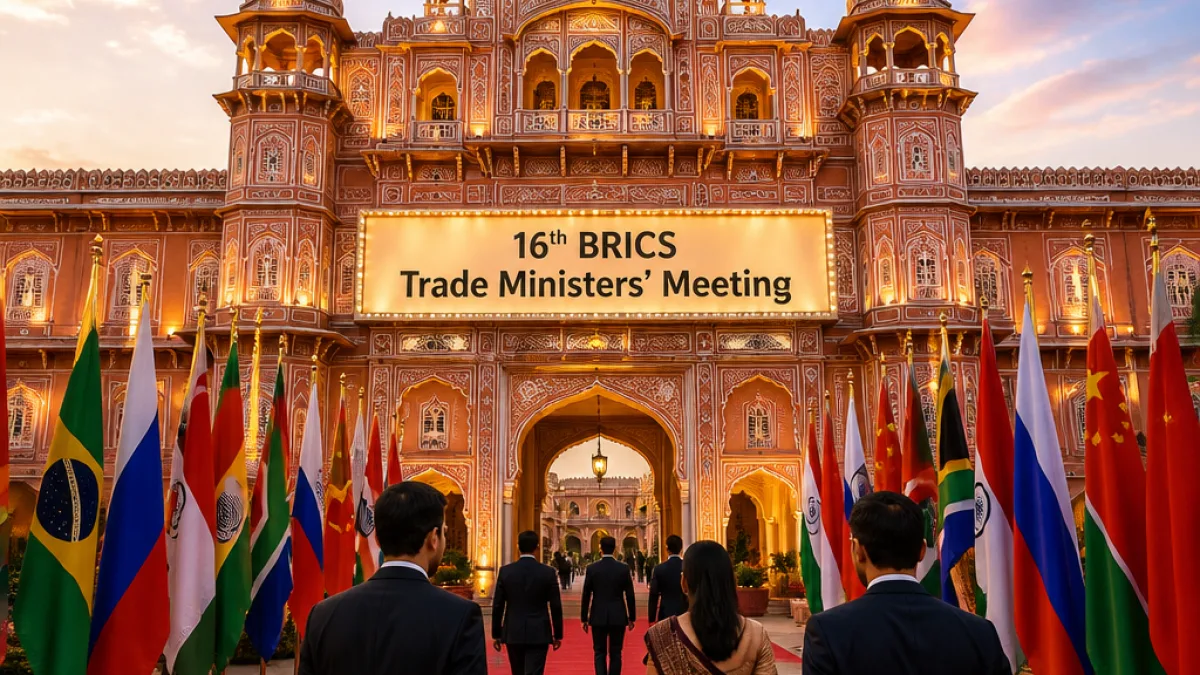
Jaipur meeting finalises BRICS economic strategy and new MSME credit principles
Jaipur — The 16th BRICS Trade Ministers’ Meeting concluded on 7 August 2026 at Sawai Man Mahal in Jaipur under India’s BRICS Chairship 2026, with delegations from the bloc’s member countries converging on the Rajasthan capital to finalise long-term trade instruments and measures to support smaller businesses.
The session was chaired by Union Minister of Commerce and Industry Piyush Goyal, and attended by Minister of State Jitin Prasada and Commerce Secretary Rajesh Agrawal, according to the meeting communiqués. The meeting focused on trade facilitation, market access, global value chains and remedial steps to bridge the global trade finance gap affecting micro, small and medium enterprises (MSMEs).
Officials at Jaipur adopted several key documents for transmission to BRICS leaders at the forthcoming summit in New Delhi. Foremost among these is the Strategy for BRICS Economic Partnership 2030, which ministers finalised for leader-level consideration. They also issued the Jaipur Consensus and approved Guiding Principles for MSME credit, aimed at addressing the estimated $2.5 trillion global trade finance shortfall.
- Strategy for BRICS Economic Partnership 2030 finalised for leaders’ endorsement.
- Jaipur Consensus adopted to guide trade cooperation among members.
- Guiding Principles for MSME credit agreed to promote cash-flow-based lending.
- A Global Value Chains action plan for 2026–2030 was endorsed, including the creation of a BRICS Technical Council.
The MSME credit principles promote cash-flow-based lending, which uses business receipts and operating cash flows as the basis for credit assessment rather than conventional collateral-based methods. This approach was presented as a means to expand credit access for smaller enterprises that form the backbone of manufacturing and services employment in many BRICS economies.
"Safeguarding farmers’ interests, ensuring food security, and preserving Special and Differential Treatment provisions within the World Trade Organization framework."
The meeting record notes that Mr Goyal emphasised India’s sustained position on trade matters, particularly in protecting agricultural stakeholders and maintaining the Special and Differential Treatment provisions at the World Trade Organization (WTO). These provisions allow developing countries longer transition periods, technical assistance and policy flexibilities, a point that features prominently in India’s negotiating stance.
Delegates also endorsed a Global Value Chains action plan for 2026–2030. The plan foresees the establishment of a BRICS Technical Council and the launch of a BRICS Connect initiative to strengthen cooperation across production, logistics and trade facilitation. The measures aim to make supply chains more resilient and diversified across member economies.
| Outcome | Purpose |
|---|---|
| Strategy for BRICS Economic Partnership 2030 | Provide a roadmap for economic cooperation up to 2030 |
| Jaipur Consensus | Set shared principles for trade and cooperation |
| Guiding Principles for MSME credit | Tackle the $2.5 trillion trade finance gap via cash-flow lending |
| Global Value Chains action plan | Improve resilience and coordination 2026–2030; create Technical Council |
For Jaipur, hosting the meeting consolidated the city’s role as a venue for international diplomacy and policy-making during India’s BRICS chairship. The choice of Sawai Man Mahal, a heritage precinct in the old city, underscored Rajasthan’s blending of tradition with contemporary governance forums.
Beyond symbolism, the policy outcomes have practical implications for firms in Jaipur and Rajasthan. The emphasis on cash-flow-based credit could ease financing for local micro and small enterprises engaged in handicrafts, textiles and ancillary manufacturing that often lack formal collateral. Endorsement of global value chain measures may also open avenues for deeper integration of state producers into regional production networks, subject to implementation by national agencies and follow-up at the leaders’ summit.
Ministers concluded the deliberations with the adopted texts scheduled to be submitted to BRICS leaders at the upcoming summit in New Delhi, marking Jaipur’s contribution to the bloc’s medium-term economic agenda.
Reported from Jaipur.