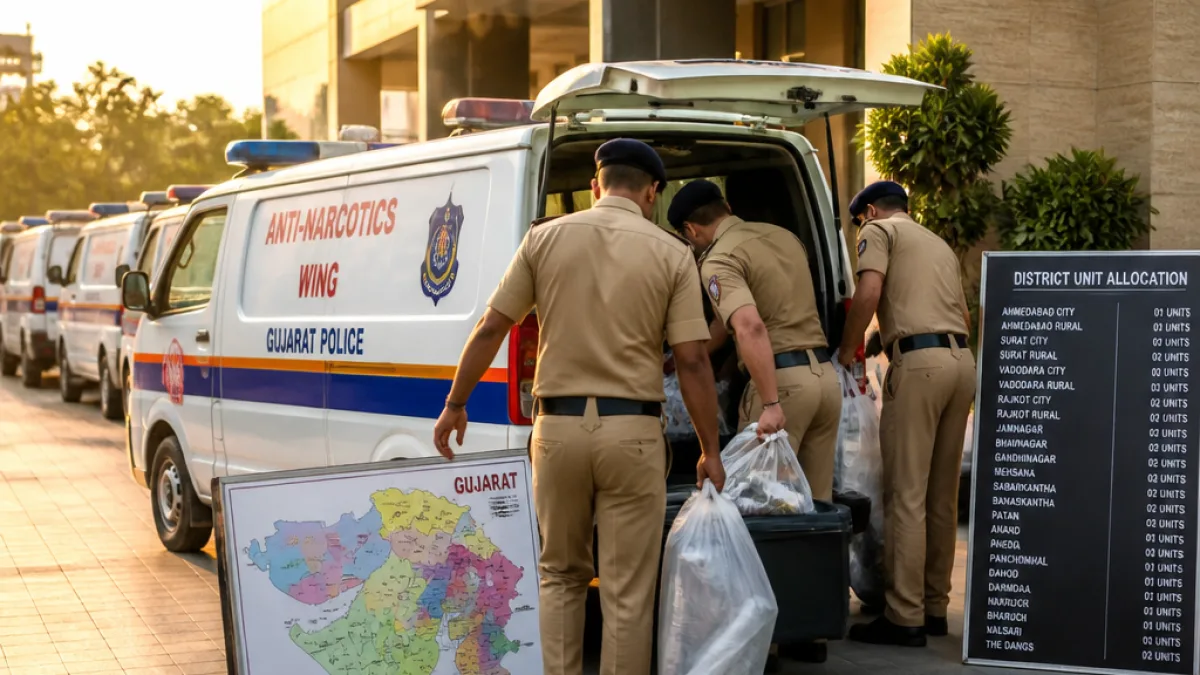
Amedabad: The Gujarat police have ordered the establishment of a dedicated Anti‑Narcotics Wing (ANW) in each district and police commissionerate across the state, with the units instructed to become fully functional within seven days, an official release said on Sunday.
Structure and immediate deployment
According to the directive issued by Director General of Police G S Malik to commissioners, range IGs and district superintendents, every ANW will be a compact, specialist team focused exclusively on offences under the Narcotic Drugs and Psychotropic Substances (NDPS) Act. Each unit will consist of eight personnel and be provided a separate vehicle with a driver for field duties.
- Team composition: one inspector, one sub‑inspector, two assistant sub‑inspectors/head constables and four constables.
- Command: district ANWs will report to the superintendent of police; city units will be supervised by senior commissioners' office officials.
- Timeline: units ordered to be operational within seven days of the release.
City allocations and supervisory limits
The release specifies additional city units where drug challenges are high: Ahmedabad and Surat will each have two ANWs, while Vadodara and Rajkot will each have one city unit. The order also clarifies the functional boundaries of the new wings: they will not be assigned matters relating to liquor or gambling, nor will they be subordinated to the Local Crime Branch, Special Operations Group, Prevention of Crime Branch or Detection of Crime Branch.
| Unit element | Details |
|---|---|
| Personnel | 1 Inspector; 1 Sub‑Inspector; 2 ASI/Head Constables; 4 Constables |
| Transport | Dedicated vehicle and driver per unit |
| Cities with extra units | Ahmedabad (2), Surat (2), Vadodara (1), Rajkot (1) |
Mandate: intelligence, hotspots and preventive proposals
The ANWs will be tasked with continuous intelligence gathering on substances covered by the NDPS Act, sustained surveillance of suspected peddlers and monitoring of identified hotspots. They are also expected to keep watch on hotels listed by the state Anti‑Narcotics Task Force and to identify habitual offenders eligible for preventive detention under the PIT‑NDPS Act, sending such proposals to CID Crime for consideration, the release said.
While the new wings are intended to deliver focused, result‑oriented action against narcotics trafficking and distribution, the order emphasises that responsibility for detection and registration of NDPS offences remains with local police stations. The directive warns that any negligence, dereliction of duty or indifference detected during ANW probes into local cases may invite disciplinary proceedings.
Data, technology and enforcement context
Police figures supplied with the announcement underline the scale of the challenge over recent years: in the last five years, more than 3,700 NDPS cases were registered and authorities arrested around 5,346 persons. Seizures reported in that period totalled approximately 1.36 lakh kg of narcotic substances, with an estimated street value near ₹13,600 crore.
The state police also cited the use of an AI‑driven tool, NARIT (Narcotics Analysis & Retrieval‑Augmented Generation‑based Investigation Tool), to follow dark‑web activity, financial trails and cross‑border links in narcotics investigations. The ANWs are expected to coordinate with existing technology and task forces while operating within their defined mandate.
Local policing, operational challenges and next steps
Senior officers said the intent is complementary deployment rather than duplication. The ANWs will supply targeted intelligence and coordination for preventive detention proposals, yet routine investigation and FIR registration will remain with local police stations. The balance of responsibilities will be critical in urban centres with multiple investigating wings.
Implementation within a seven‑day window will demand rapid staffing, training and logistics — especially in larger commissionerates where the new units must integrate with ongoing operations. How the wings coordinate with CID Crime, the state Anti‑Narcotics Task Force and digital investigative platforms will determine early outcomes.
The order is the latest policy step by Gujarat police to sharpen narcotics enforcement and streamline specialist capacity at district and city level, while preserving accountability at the local‑station level.