Panaji: The Goa transport department has ordered all government offices, departments, autonomous bodies, corporations, local bodies and other state establishments to strictly enforce provisions for parking spaces reserved for persons with disabilities (PwDs), warning that unauthorised occupation of such bays will attract monetary penalties.
Fines, demarcation and awareness measures
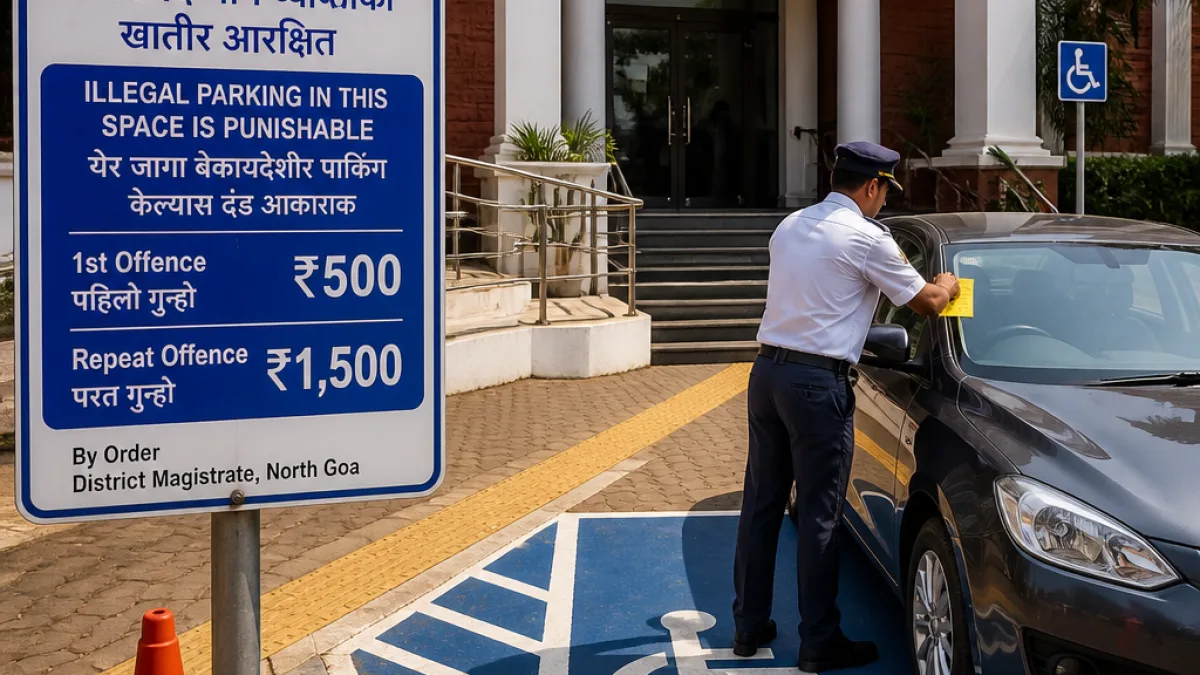
The circular, issued to ensure implementation of the Rights of Persons with Disabilities Act, 2016, specifies that vehicles found occupying reserved PwD parking without authorisation will be treated as breaching the law. It prescribes a fine of ₹500 for a first offence and ₹1,500 for a second or subsequent offence.
Authorities have been asked to ensure that PwD-exclusive parking spaces are:
- clearly demarcated with the prescribed signage and road markings,
- located as close as practicable to the accessible entrance of a building, and
- provided with the required access aisle to facilitate movement and transfers.
The transport department has also instructed establishments to prominently display suitable awareness signboards to inform motorists that unauthorised parking in spaces reserved for PwDs constitutes a violation of the law.
Administrative follow-up and legal basis
The directive follows a suo motu order recently issued by the Goa State Commission for Persons with Disabilities, according to the circular. The transport department has been tasked with ensuring effective implementation of the Act's provisions relating to accessibility and reserved parking facilities.
The move places clear administrative responsibility on public bodies to both create accessible parking and to enforce compliance. It also signals an attempt to translate statutory entitlements for persons with disabilities into tangible, on-ground measures at government premises across the state.
What government establishments must do
Broadly, the circular requires public entities to:
- audit existing parking areas and mark PwD bays according to norms,
- ensure proximity of reserved bays to accessible entrances,
- provide the mandatory access aisle and keep it unobstructed, and
- install awareness signage about legal penalties for unauthorised use.
By placing these responsibilities on all tiers of government bodies, the transport department aims to create a consistent standard of accessibility at sites frequented by the public.
Enforcement mechanics
The circular makes the transport department responsible for monitoring implementation. It does not, however, specify the enforcement mechanism — for example, whether local police, traffic officials or designated staff at the establishments will impose fines. The state commission's suo motu order prompted the directive, indicating oversight pressure from a statutory body tasked with disability welfare.
| Offence | Prescribed Fine |
|---|---|
| First offence | ₹500 |
| Second or subsequent offence | ₹1,500 |
Context and likely impact
Reserved parking close to accessible entrances is a key component of built-environment accessibility. The circular addresses common problems such as unclear marking, inadequate access aisles and unauthorised use that can render facilities effectively inaccessible even where physical provision exists.
If implemented systematically, the directive could reduce barriers for PwDs when accessing government services, offices and public institutions. It may also set a compliance benchmark that private establishments could be expected to follow, though the current order applies explicitly to government entities.
Practical effects will depend on follow-through: clearly marked bays, regular monitoring and an enforcement mechanism are necessary for fines to act as a deterrent rather than remain a paper regulation.
What users should know
- Drivers must not occupy bays reserved for persons with disabilities unless authorised to do so; fines are now prescribed at state level for government premises.
- Government establishments are required to mark and maintain PwD spaces and put up awareness signage.
- Persons who believe reserved spaces are being misused at public offices can seek redress through administrative channels or raise complaints with the state commission for persons with disabilities.
The transport department's circular reflects an administrative push to enforce accessibility provisions under existing law and responds to oversight from the state commission. Its effectiveness will be measured by how quickly and consistently government bodies translate the directive into marked bays, functioning access aisles and routine enforcement.