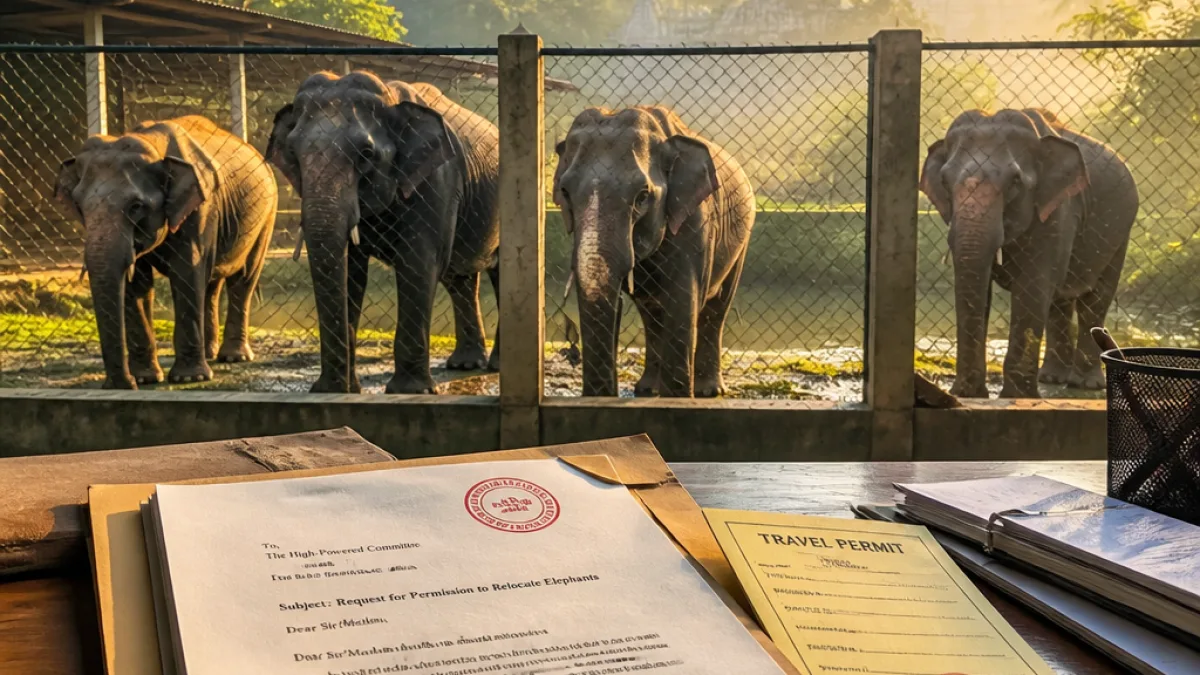
GUWAHATI: An eastern Assam-based conservationist has urged the Supreme Court-appointed High‑Powered Committee to stop the transfer of five captive elephants to Tamil Nadu and sought an inquiry into the circumstances of the movements, according to a letter submitted on Friday (September 11, 2026).
Challenge to interstate elephant transfers
Rohit Choudhury, identified in the correspondence as a conservationist working in eastern Assam, asked the committee’s chairperson to halt the transfer of four elephants still in Assam and examine the recent relocation of a fifth animal, a five‑year‑old female named Durga, which has already been shifted to Madurai’s Meenakshi Amman Temple.
Mr Choudhury questioned both the legality and the welfare implications of moving the animals outside Assam, and sought clarity on whether the transfers are permanent or for a limited period. The letter also requested a formal probe into the decision‑making and documentation around the removals.
Animals, ages and destinations
Official documents cited in the letter name the elephants proposed for transfer from Assam to Tamil Nadu. The conservationist singled out concerns over four animals still in Assam and the already‑moved Durga.
| Elephant | Age | Destination (Temple) |
|---|---|---|
| Hiralal | 8 years | Arulmigu Arunachaleshwarar Temple, Tiruvannamalai |
| Shiva | 6 years | Arulmigu Arunachaleshwarar Temple, Tiruvannamalai |
| Rupsing | 13 years | Sri Vaidyanatha Swamy Temple, Vaitheeswaran Koil (Nagapattinam) |
| Bijuli | 5 years (female) | Shri Kanchi Kamakoti Gajashala, Kancheepuram |
| Durga | 5 years (female) | Meenakshi Amman Temple, Madurai (already moved) |
Legal context: committee powers and permits
Mr Choudhury invoked the supervisory role granted to the High‑Powered Committee by the Tripura High Court, a mandate subsequently expanded by the Supreme Court. The conservationist emphasised that Chief Wildlife Wardens may issue travel permits for elephants only on the committee’s recommendation and that transfers should follow an inquiry by the panel before travel permits are granted.
“To the best of my knowledge, the transfer of these five elephants has not been considered by this Committee, and therefore transfers cannot take place,”
The letter warned that available records show a large number of privately‑held elephants in Assam and documentation issues for hundreds of animals, a point Mr Choudhury raised to question underlying ownership and transfer permits.
Welfare and ownership concerns
In his correspondence, the conservationist noted data indicating that a significant number of elephants in Assam are privately owned and that many lack formal ownership certificates or face pending documentation processes. He suggested the ownership and sale of elephants remain opaque in some cases, which complicates legal transfer and welfare oversight.
By seeking suspension of the movements and an investigation, Mr Choudhury is asking the committee to consider whether the proposed transfers comply with statutory protections, whether appropriate welfare measures are in place for transportation and post‑transfer care, and whether permits were issued following the committee’s established procedure.
Implications for Tamil Nadu temples and Assam authorities
The proposed destinations include prominent temples in Tiruvannamalai, Nagapattinam, Kancheepuram and Madurai. Temple administrations, local forest departments and the High‑Powered Committee will be central to resolving the dispute if the panel accepts the petition for review or the Supreme Court’s expanded mandate is invoked.
- Immediate outcome sought: Suspension of the outstanding transfers and probe into Durga’s relocation.
- Authority referenced: High‑Powered Committee constituted under judicial direction and Chief Wildlife Wardens who issue travel permits.
- Key issues: Legality of transfers, ownership documentation, animal welfare during and after transport.
If the committee decides to examine the matter, it could request records from Assam’s forest authorities, the temples involved and any private owners listed in transfer documents. The petition highlights how interstate movement of captive elephants engages both conservation law and cultural practices tied to temple rituals.
Further developments will depend on the committee’s response to the letter and any subsequent steps taken by judiciary or forest authorities in Assam and Tamil Nadu.