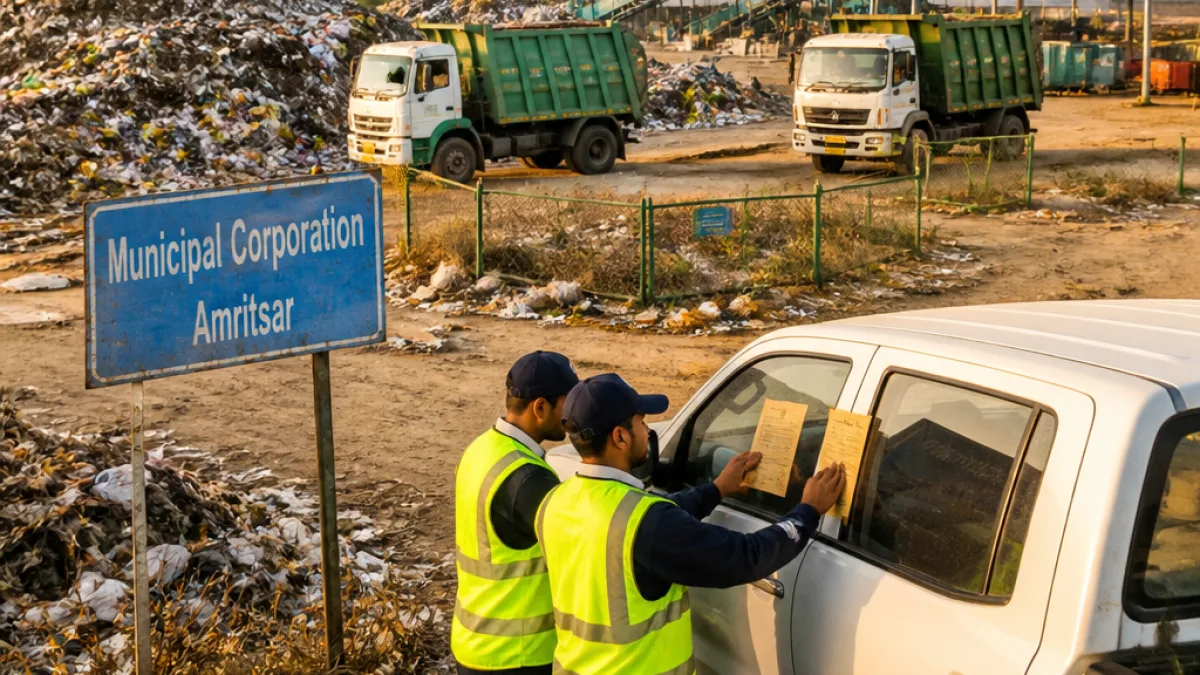
The Amritsar Municipal Corporation (MC) has acknowledged in an affidavit filed before the National Green Tribunal (NGT) that roughly one-third of the city’s daily municipal solid waste is still being dumped at landfills without adequate processing, even as it pursues larger treatment projects and enforcement drives. The admission comes in a response dated September 3 to a petition by BJP leader and former IAS officer Jagmohan Singh Raju.
Official figures show processing shortfall
In the affidavit the civic body said Amritsar generates and collects about 680–720 metric tonnes (MT) of fresh waste each day. Of this, approximately 220 MT of dry waste is being channelled for recovery and about 240 MT of wet waste is being processed, while the remaining 220–260 MT is being dumped without processing.
The MC rejected allegations of "wilful negligence", systemic failure and administrative apathy in its reply, saying multiple measures are underway to strengthen collection, transportation, processing and disposal systems.
Enforcement and legacy-waste work
Alongside infrastructure efforts, the corporation has stepped up enforcement against littering and open burning. The affidavit recorded that the MC issued 2,298 challans to defaulters, including four for open burning of waste. The affidavit also acknowledged a disruption in services last year when operations in 18 wards were affected between September 6 and October 6, 2025, after Amritsar MSW Ltd abandoned its activities, forcing the MC to manage waste with limited resources.
On the issue of legacy waste, the corporation said bio-remediation at the Bhagtanwala dumping site began on October 2, 2025, and reported that 7,99,838 MT of legacy waste had been bio-remediated.
Planned capacity expansions and contracts
To close the present treatment shortfall, the MC told the NGT it is developing larger processing infrastructure including:
- 450 MTPD material recovery facility (MRF)
- 300 MTPD bio-CNG plant
- 750 MTPD integrated waste-sorting facility
The civic body also restructured service delivery by dividing the city into two territories and awarding public–private partnership (PPP) contracts to 3R Management Ltd in consortium with Suntan Life. These two contracts cover 41 and 44 wards respectively, with a combined project cost of about ₹98 crore.
"The corporation is taking several measures to strengthen waste collection, transportation, processing and disposal," the affidavit said.
Local implications and remaining gaps
For Amritsar residents, the MC’s disclosure confirms what many neighbourhoods have long experienced: visible dumping and occasional open burning in peri-urban areas and at legacy sites, which carry public-health and environmental risks. While the announced capacity additions, if implemented on schedule, would markedly increase throughput, the current reality is that roughly 220–260 MT of freshly collected waste is not processed daily.
Key operational challenges flagged in the affidavit include the mid-2025 service disruption after the private operator left certain wards and the time required to commission large facilities such as bio-CNG and integrated sorting plants. Until the new plants become fully operational, the MC will rely on interim measures and enforcement to reduce improper disposal.
| Parameter | Figure |
|---|---|
| Daily waste generated/collected | 680–720 MT |
| Dry waste channelled | ~220 MT |
| Wet waste processed | ~240 MT |
| Waste dumped without processing | 220–260 MT |
| Challans issued | 2,298 (incl. 4 for open burning) |
| PPP project cost | ₹98 crore |
Residents and environmental groups will likely press the MC and state authorities for firm timelines, operational details and transparent monitoring as new plants are commissioned. For farmers and peri-urban communities downwind of legacy dumps, accelerated bio-remediation and tighter enforcement against open burning are immediate priorities.
The affidavit, filed in response to a public interest petition, offers a snapshot of both the progress made and the gap that remains before Amritsar can claim a fully closed-loop municipal waste system.