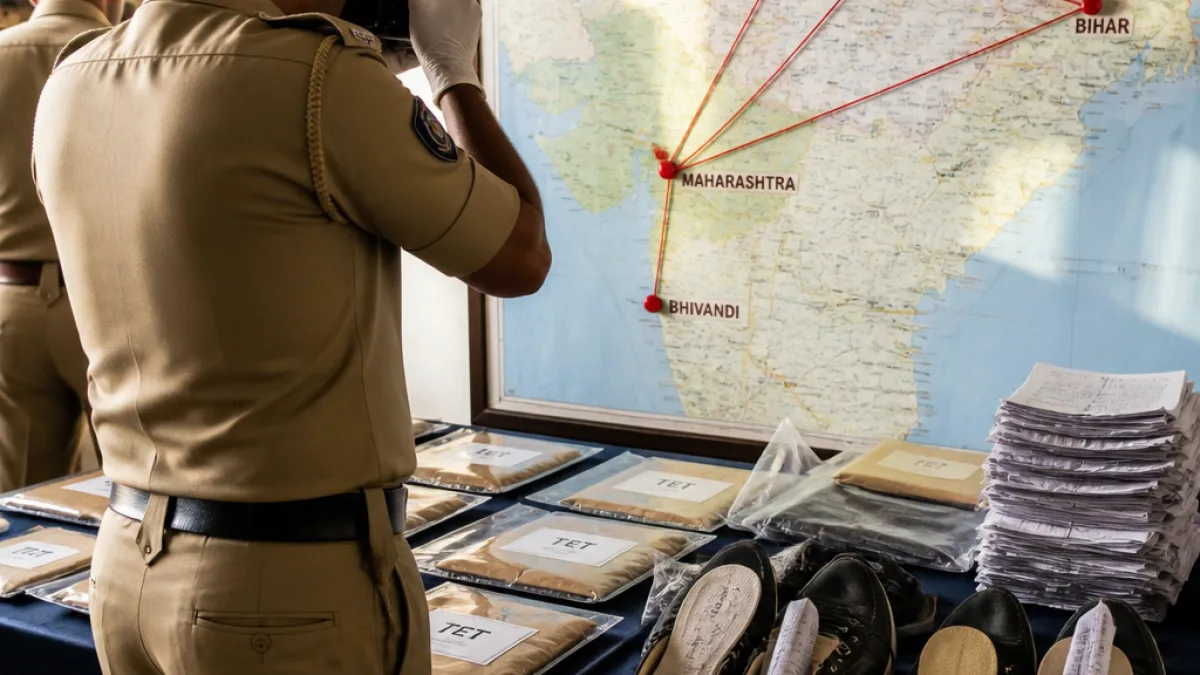
Bhiwandi/Thane, Maharashtra — Police have arrested the final two absconding suspects in the Maharashtra Teacher Eligibility Test (TET) question paper leak, completing custody of all 18 accused named in the chargesheet, officials said on Sunday.
Last two suspects traced to Beed and Bihar
Bhiwandi Police arrested Prakash Misal and Ashok Sav after tracking them through technical intelligence, financial transaction trails and location logs, an officer involved in the probe said. With these arrests, all persons listed in the chargesheet filed by Thane Police are now in custody.
“The two suspects—Sav and Misal—were tracked down through technical intelligence, financial transaction trails, and location logs monitored by the police SIT,” the officer said.
The investigation, led jointly by Thane City Police and officers from Bhiwandi Division (Zone II), has uncovered what officials described as a multi‑state examination fraud network with links in Maharashtra, Bihar, Uttar Pradesh and Delhi.
How the racket came to light
Police say the conspiracy came to the attention of law enforcement a day before the Teacher Eligibility Test scheduled on 28 June. Deputy Commissioner of Police (Zone II) Pavan Bansod received a tip‑off that three men were attempting to sell examination papers to a resident of Bhiwandi.
Acting on the information, officers laid a trap in the Kongaon area using decoy personnel. The suspects who turned up were detained and police seized four sets of question papers. These were later verified by officials of the Maharashtra State Council of Examination (MSCE), who confirmed the seized material matched the actual question paper used in the TET.
Printing press links and method of smuggling
The chargesheet, submitted before a local court in Bhiwandi, says the question papers were smuggled out from a printing press in Agra. Two employees of the press allegedly hid the papers inside shoe insoles and received Rs 8,000 for their role, according to the document.
The formal complaint names alleged mastermind Bijendra Gupta, who was earlier implicated in a paper leak in Odisha. Police have invoked provisions under the Bharatiya Nyaya Sanhita (BNS) relating to cheating, criminal breach of trust and criminal conspiracy, as well as state laws addressing examination malpractices and use of unfair means.
Charges and ongoing probe
The chargesheet lists 18 accused and sets out the roles attributed to each. Investigating officers said the case remains active as they continue to map the full extent of the network, including financial flows and communication channels used to coordinate the leak and sale of papers across states.
| Detail | Information |
|---|---|
| Number of accused in chargesheet | 18 |
| Last arrested | Prakash Misal (Beed), Ashok Sav (Bihar) |
| Exam date | 28 June |
| Printing press | Agra |
| Payment to press employees | Rs 8,000 |
Impact on aspirants and official response
The TET is a competitive examination that determines eligibility for teaching posts in state schools; leaks undermine the credibility of the selection process and affect thousands of aspirants. MSCE officials verified the confiscated papers against the actual question paper, confirming the material was genuine, the chargesheet said.
Officials from the investigating teams said action will continue against any additional suspects identified through bank records, call data and other technical evidence. The agency has also been examining whether similar methods were used in other paper leaks linked to the same suspects.
What remains to be done
- Police will complete forensic analysis of seized devices and financial trails to establish the network's hierarchy and wider connections.
- Authorities are likely to pursue recovery of funds and probe the role of intermediaries who facilitated movement of papers across state borders.
- The MSCE and other examination authorities are expected to review printing and distribution protocols to prevent recurrence.
Investigators said they will present the complete case before the court as the legal process moves forward. The arrests mark a significant development in a case that has drawn attention to the vulnerability of examination processes and the need for stricter safeguards.