Gold buying guidance for Ajmer households ahead of purchasing decisions
AJMER: Local buyers and jewellers in Ajmer have been urged to pay close attention to purity marks, additional charges and regulatory limits after a market update on 13 August 2026, Business Today reported. The advisory reiterates established rules on karat purity, the final price calculation for showroom purchases and documentation requirements for high-value transactions.
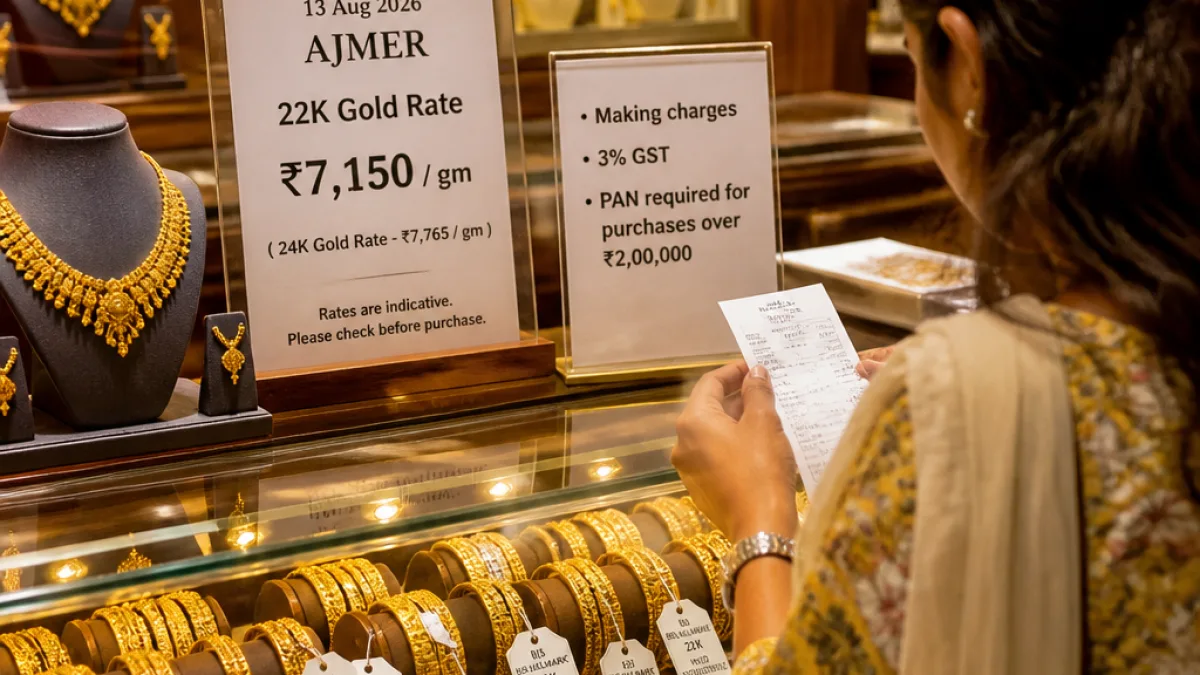
The bulletin underlines that the rate shown online is a benchmark and the amount a customer finally pays at a jewellery showroom will be higher due to factors such as making charges and statutory levies. Buyers in Ajmer are advised to budget for these additions when planning purchases, particularly for traditional jewellery made in 22-carat (22K) designs.
What buyers in Ajmer must check
- BIS hallmarking: Verify the BIS logo, the purity grade (for example 916 for 22K) and the 6-digit HUID code on the hallmarked piece.
- Making charges and GST: The final showroom price comprises the base gold price plus making charges and 3% GST, which is applied on the entire ornament value.
- Stone deductions: For studded jewellery, the weight of embedded stones is excluded when calculating net gold weight for pricing.
These reminders are particularly pertinent in Ajmer where customary purchases — bridal sets, festival jewellery and small investment ornaments — remain an important household expense. Local jewellers said customers often overlook the role of making charges and stone-weight deductions when comparing offers.
"Check the hallmark and demand the HUID code. Also ask for a breakup of making charges and stone deductions before agreeing to the purchase," a city jeweller advised, according to the report.
Purity, options and paper-gold alternatives
The update explains common purity standards used across India and their typical applications:
| Standard | Purity | Typical use |
|---|---|---|
| 24K | 99.9% | Investment in coins and bars (too soft for most jewellery) |
| 22K | 91.6% | Traditional Indian jewellery |
| 18K / 14K | Lower gold content | Stronger alloys for durable jewellery |
For residents who prefer not to hold physical metal, the report summarises digital and paper alternatives available in India: digital gold (purchases from Re 1), Gold ETFs and mutual funds which offer liquidity and market tracking, and Sovereign Gold Bonds (SGBs), which are government-backed instruments that pay an additional interest component alongside price appreciation.
Regulatory and tax notes affecting Ajmer buyers
Buyers in Ajmer should also note the KYC and tax thresholds set out in the update. According to the report:
- Providing PAN is mandatory for gold purchases exceeding ₹2 lakh.
- Cash purchases above ₹10 lakh trigger strict KYC requirements.
- All gold purchases attract a flat 3% GST.
Capital gains on sale apply according to holding period rules, and inherited gold is not taxed until sold. Gift rules were also noted: gifts received at the time of marriage or from specified relatives are exempt, while other gifts above specified monetary limits may attract tax treatment under existing law.
Ajmer households planning festival or wedding buys in the coming weeks are likely to weigh traditional preferences for 22K jewellery against the convenience and lower transactional friction of digital alternatives. Jewellery traders in the city continue to emphasise clear invoices, visible hallmarking and transparent disclosure of making charges to reduce disputes during resale or valuation.
The guidance is aimed at giving local consumers the practical details needed to compare offers and make informed choices in a market where headline rates are only the starting point for the final price.