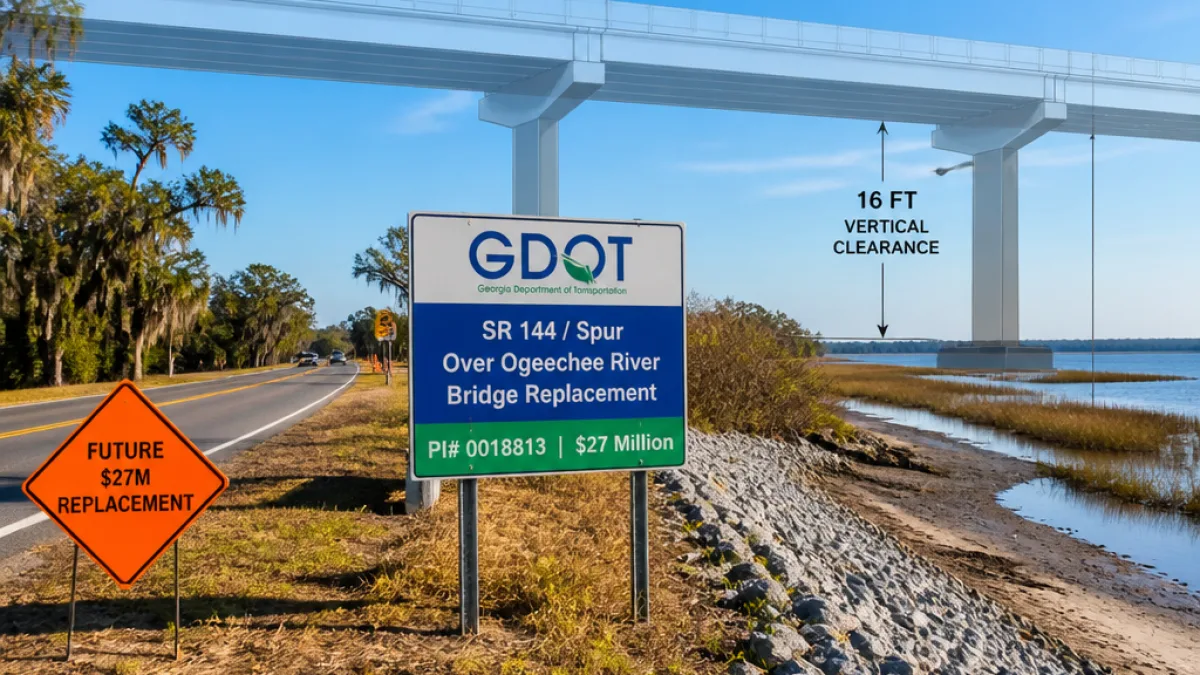
Richmond Hill officials are weighing a major engineering response after riverbank erosion began to undermine the only roadway leading to a low-lying community and state parkland. The Georgia Department of Transportation (GDOT) is designing a new bridge over wetlands to replace the most vulnerable stretch of road, with preliminary cost estimates around $27 million.
Why a bridge is being considered
The embankment along the Ogeechee River has been receding toward the roadway known as 144 Spur, the principal in-and-out route serving residents near Fort McAllister State Park. GDOT engineers say crews have been placing large rocks — riprap — to slow the erosion, but those measures are considered temporary.
GDOT is now proposing a bridged alignment just south of the existing pavement that would span wetlands and sit about 16 feet higher than the current roadway. The height increase is intended to reduce long-term risk from river action and lessen the need for frequent, costly repairs.
Design, timeline and community reaction
Design funding has already been approved and officials say the project remains in the design phase while they seek construction funding. GDOT’s current target is to put the project out for bids in 2029.
- Estimated total project cost: $27 million
- Estimated construction portion: $24 million
- Projected elevation above existing roadway: 16 feet
- Public meeting feedback (March): 26 supported, 6 opposed, 5 undecided (37 attendees)
According to the plan documents, the bridge will be designed to minimise its visual impact on the riverscape. GDOT said some dock structures could be affected during construction, but no homes or businesses are expected to be displaced.
"The measures we're doing right now with the riprap is helping, but it's not a long-term solution. So, we continue to put money into these repairs and help with the erosion,"
That comment, supplied by GDOT in public materials, reflects the agency view that short-term armouring can stabilise an embankment temporarily but does not replace the need for a structural solution when an access route is the only way in and out of a neighbourhood.
Traffic and access during construction
Because 144 Spur is the single access road for the area, GDOT says traffic will remain on the existing road while the new bridge is built. The agency indicates there will not be a full detour; motorists would continue to use the present roadway during construction phases.
Keeping traffic on the existing alignment mitigates immediate disruption for residents but raises questions about managing safety and construction staging where erosion has already encroached on the embankment. GDOT has signalled it will continue to perform patching and armouring work as part of interim maintenance.
Local context and broader implications
This is an instructive example of how shoreline and riverbank erosion can force substantial public-works responses when a community’s connectivity depends on a single corridor. For communities across Ontario and southern Canada that face increasing levels of extreme weather, melting permafrost in some regions, or rising water levels in others, the costs of converting vulnerable roadways to bridges or relocating infrastructure are becoming part of long-term municipal and provincial planning discussions.
Residents in the affected Richmond Hill area have largely supported the design proposal. At the public meeting in March, 26 of the 37 attendees expressed support, with six opposed and five undecided. GDOT continues to pursue funding to move the design into construction procurement.
| Item | Amount |
|---|---|
| Design and other costs | $3 million (implied) |
| Construction | $24 million |
| Total estimated project | $27 million |
GDOT and local officials will continue to update the public as design advances and as funding commitments are secured. For now, riprap and other maintenance remain the immediate defence while the agency pursues a longer-term bridge solution aimed at preserving access and reducing recurring repair costs.
WE NEWS will monitor developments and report on funding approvals, detailed design releases and any impacts to residents and park access as the project moves toward the 2029 bid timeline.