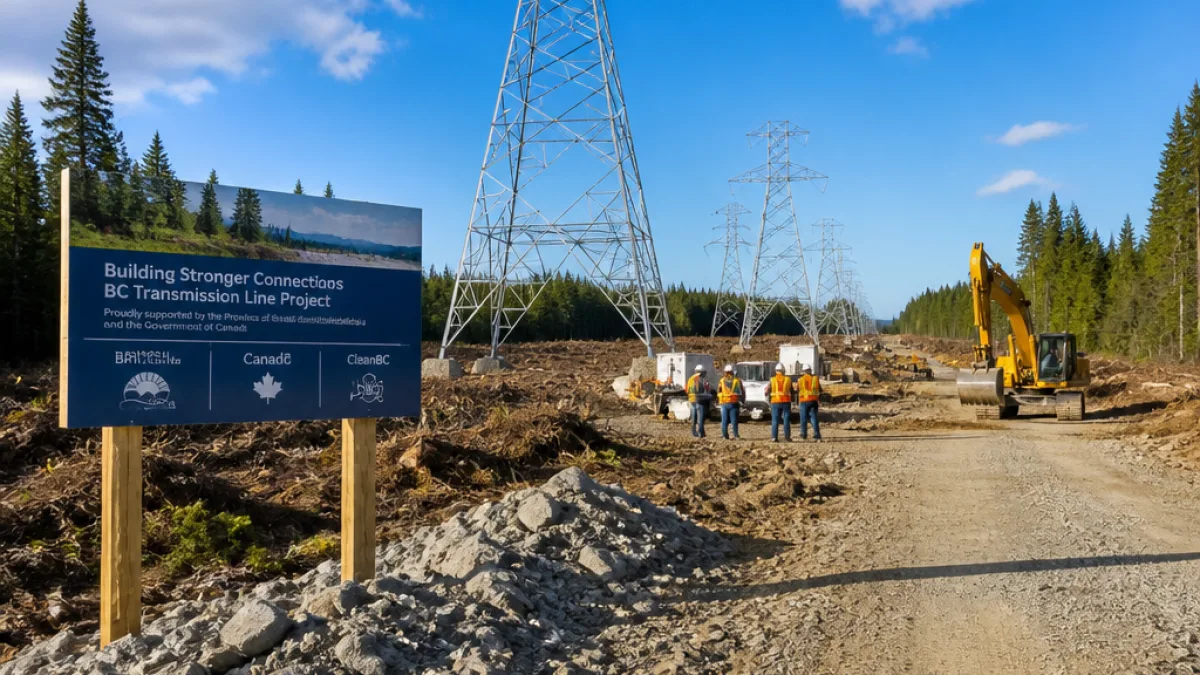
Construction has begun on the long‑planned North Coast Transmission Line, a major electricity expansion project designed to deliver substantial new power to northwestern British Columbia and support resource development along the coast.
What the project is
The first phase of the project is a 165‑kilometre transmission stretch running from Prince George to an area near Fraser Lake. Over time the full expansion will link Prince George to Terrace, near the North Coast, and is expected to more than double the electricity supply available to coastal B.C.
Both the federal and provincial governments have framed the line as foundational infrastructure for a suite of proposed developments in the region, including a potential Ksi Lisims liquefied natural gas facility and mining projects in the Golden Triangle near the Alaskan border.
Money, jobs and revenue
Ottawa and Victoria agreed in July to jointly commit a combined $3.9 billion to the project. Governments estimate the transmission line will create substantial economic returns and employment:
- About 10,000 direct, full‑time jobs once the line is operational.
- 1,400 jobs at peak construction.
- Approximately $950 million a year in provincial and municipal revenue, according to government statements.
Federal and provincial statements describe the transmission as delivering nearly $10 billion a year to B.C.'s economy, though the governments frame that as a contribution tied to the broader development the new power capacity would enable.
| Item | Figure |
|---|---|
| Committed funding (federal + provincial) | $3.9 billion |
| First‑phase length | 165 km |
| Estimated full‑operation jobs | ~10,000 |
| Peak construction jobs | 1,400 |
| Annual provincial/municipal revenue | $950 million |
Political framing and local impact
Premier David Eby joined federal Energy Minister Tim Hodgson at a groundbreaking event in Prince George. In pre‑event remarks, the premier described the project as a generational investment that will drive “clean growth” and jobs across the province, and said it will help make the province an economic engine for Canada.
“The North Coast Transmission Line is a generational project that will power clean growth and deliver thousands of jobs for families across B.C.,”
Minister Hodgson cast the line as a step toward national self‑reliance on critical infrastructure and resources, saying affordable power is essential to developing a strong grid, critical minerals and LNG.
Why northern B.C. matters
Proponents say the transmission expansion unlocks long‑standing development potential in the northwest: access to reliable, large‑scale electricity is a prerequisite for energy‑intensive industries such as LNG and mining. Government statements link the new capacity to planned or proposed projects in the Ksi Lisims LNG file and the Golden Triangle mining region.
Officials also argue the project will reduce economic dependence on the United States by keeping more of B.C.’s resource processing at home. That positioning ties infrastructure to provincial industrial strategy and jobs retention in communities across northern B.C.
Timing and regulatory pathway
The transmission file was referred to the federal Major Projects Office in November 2025 for possible fast‑tracking before construction began. The timeline foresees phased construction, with the initial Prince George to Fraser Lake segment forming the groundwork for later extensions toward the coast.
Local considerations and unanswered questions
While governments highlight job numbers and revenue, communities and indigenous governments across the north regularly ask for detailed information about economic benefit sharing, environmental assessment outcomes and employment pipelines for local workforces. The government statements name expected job totals and revenue but do not in themselves detail community agreements or specific mitigation measures.
As work proceeds, residents and local governments will watch for:
- Details on procurement and how many contracts go to northern businesses and Indigenous enterprises.
- Environmental assessment findings and how routing and construction will mitigate impacts on land and waterways.
- Timelines for the successive phases connecting to the coast and the projects that will ultimately use the power.
The North Coast Transmission Line marks a major infrastructure decision for B.C.’s north — a project intended to change the region’s economic trajectory by supplying large volumes of electricity to the coast and opening doors for resource development. Its eventual success will depend not only on towers and lines but on detailed agreements with communities, clear environmental safeguards and the timely completion of the full corridor to the coast.