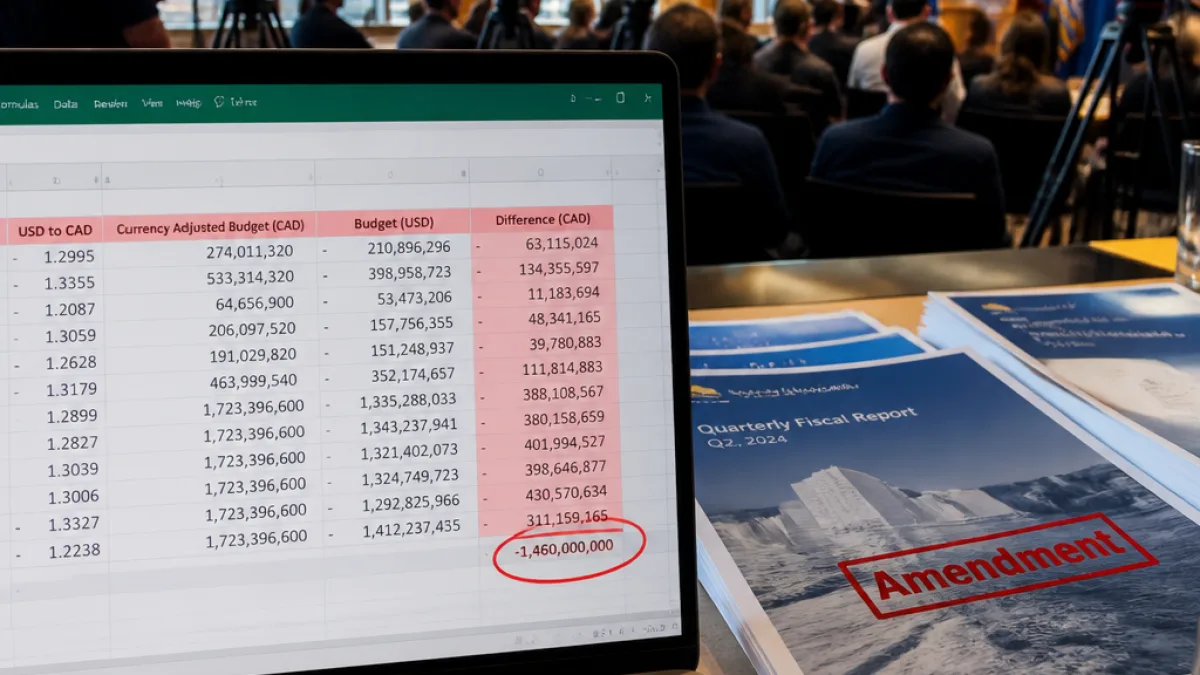
VANCOUVER — British Columbia officials confirmed Tuesday that errors including incorrect currency conversions led to an overstatement of roughly $1.46 billion in forecasted natural gas revenues across five fiscal years, a mistake the energy minister described as serious and which will be corrected in the province's next fiscal report.
What went wrong
Energy Minister Adrian Dix told reporters the most consequential error was a 44-cent overstatement in the forecasted price per gigajoule of natural gas for the 2026-27 fiscal year. Provincial staff, relying on private-sector price estimates provided in both Canadian and U.S. dollars, applied a conversion formula incorrectly across a spreadsheet.
"That part is a normal part. What isn't a part of it is human error that we're acknowledging today and correcting in the budget,"
Dix called the miscalculation a "serious mistake," and said it affects how the province forecasted revenues — not the actual cash the province has collected to date, which fluctuates with market prices.
Fiscal impact and timeline
Senior staff from the ministries of energy and finance briefed reporters and said the errors have been independently verified. Corrections will be reflected in B.C.'s quarterly fiscal report expected later this month, which will clarify the impact on the province's deficit figures. The last publicly stated deficit was $7.7 billion for the 2025-26 fiscal year.
Officials emphasised that revenues from natural gas are inherently volatile: markets have swung widely over recent years, in part tied to international events such as the spike and fall in prices after Russia's invasion of Ukraine. That market variability has previously caused both under- and over-estimates in forecasting; officials said the current issue is distinct because it arose from a data-processing error.
What the province says it will change
Government sources said process changes are being implemented to reduce the risk of similar human errors in forecasting spreadsheets. The ministries did not provide a detailed checklist of new controls at the technical briefing, but said corrected figures will appear in the upcoming quarterly report.
- Principal error: incorrect assumption about whether private-sector inputs were denominated in U.S. or Canadian dollars.
- Result: figures denominated in Canadian dollars were erroneously treated as U.S. dollars and converted again to Canadian dollars, inflating revenue projections.
- Immediate correction: downward adjustment of 44 cents per gigajoule in the 2026-27 forecasted price at plant inlet.
Forecasted price range
The budget documents that contained the errors listed forecasted prices per gigajoule at plant inlet that officials now say are incorrect. The range shown in Budget 2026 was:
| Forecasted price (per GJ) |
|---|
| $2.34 to $4.83 |
Officials said correcting the currency conversion mistake produced the 44-cent reduction in the per-gigajoule forecast for 2026-27; they did not provide revised multi-year ranges beyond that adjustment during the briefing.
Broader implications for budget planning
Natural gas revenues are a material component of B.C.'s resource revenue assumptions used in multi-year fiscal planning. While the province stated that the error pertains to forecasting and not to actual collections, the revision still alters the revenue baseline that planners and ministers use to set spending and borrowing plans.
Analysts and municipalities that rely on predictable provincial transfers will be watching the quarterly fiscal report to see whether the correction meaningfully changes projected deficits or the timeline for balancing the budget. The government has said the full extent of the impact on the stated deficit will be made clear with the release of that report.
Context and next steps
Officials confirmed the mistake was discovered internally, then independently verified. They said changes to forecasting procedures are being made to reduce spreadsheet vulnerability and human error, though specifics on new verification steps were not disclosed publicly on Tuesday.
Natural gas pricing and its role in provincial revenues remain politically sensitive: resource receipts affect program spending, borrowing and the extent to which government can promise new initiatives. The forthcoming quarterly fiscal report will be the first comprehensive disclosure of the corrections and their effects on B.C.'s fiscal picture.
Reporting from the West Coast that weighs growth, environment and community.