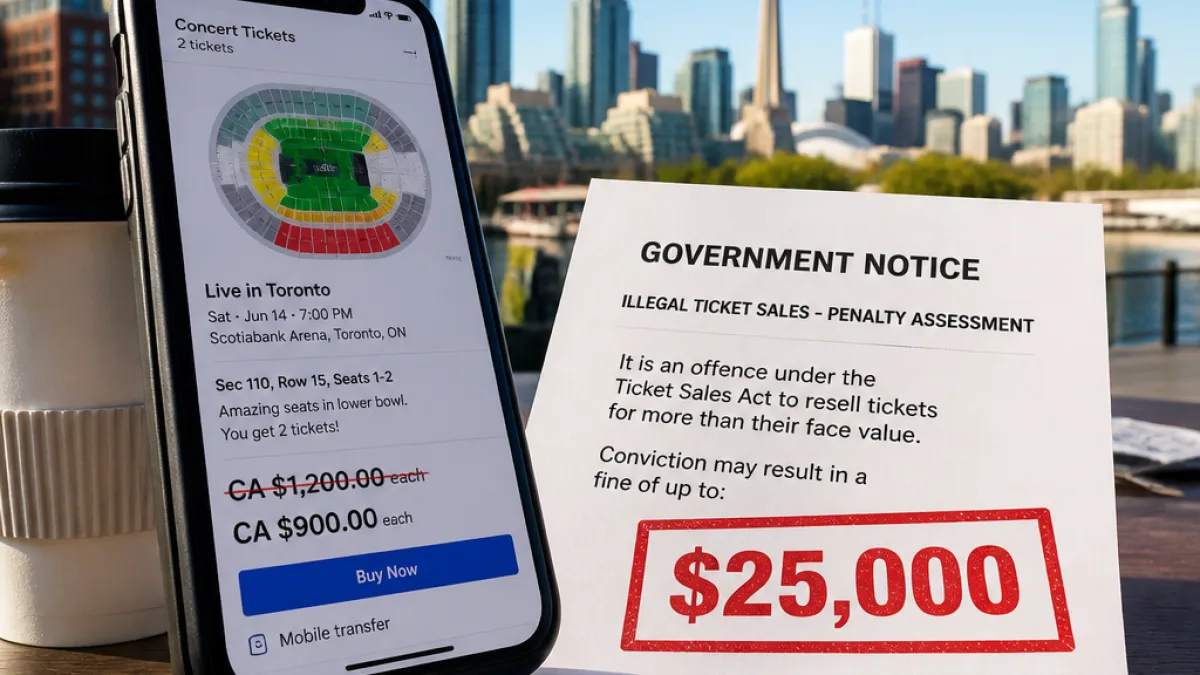
TORONTO — Ontario has issued a $25,000 fine to SeatGeek Canada that appears to be the province’s first enforcement action under the anti‑scalping law introduced in April, according to the provincial consumer‑awareness website.
What the province says
The listing on the government site says the fine was imposed in late August and includes three separate penalties: $10,000 for selling a ticket above face value, $5,000 for failing to disclose the original purchase price, and another $10,000 for facilitating a transaction without proof of the original price paid.
| Allegation | Penalty |
|---|---|
| Sale above face value | $10,000 |
| Failure to disclose original purchase price | $5,000 |
| Facilitating transaction without proof of original price | $10,000 |
A spokesperson for the office of Stephen Crawford, the provincial minister responsible for Public and Business Service Delivery, provided a brief statement but did not confirm the event linked to the fines or whether additional enforcement actions were forthcoming.
“All ticket sellers in Ontario must comply with our legislation that prohibits the resale of tickets above face value,”
Cristian Buzo Tingarov, the minister’s spokesperson, added in an emailed response that “Any seller who breaks those rules could face fines of up to $250,000 and be posted publicly.”
Platform response and practical hurdles
SeatGeek’s vice‑president of government affairs, Joe Freeman, did not say whether the company intends to pay the fines or contest them. He reiterated a point ticketing platforms have raised since the law came into force: it can be difficult for third‑party marketplaces to verify the original face value of tickets sold by independent sellers.
“This means that independent platforms, like SeatGeek, have limited ability to obtain or verify the price paid when the ticket was purchased from the primary seller,”
Freeman noted that many sellers — including season ticket holders — may not have access to the original face value of a ticket. That practical challenge has been central to industry requests for clearer guidance from the province on how platforms should demonstrate compliance.
Context: the law and the marketplace
The ticket resale legislation, brought into force in April, was designed to curb scalping by prohibiting the resale of tickets above face value. It applies to all ticket sellers operating in Ontario and includes the potential for substantial penalties.
The fine against SeatGeek arrives as resellers test the new rules ahead of high‑profile events in Toronto, including the Toronto International Film Festival, when demand for tickets swells and secondary market activity typically increases.
- Enforcement visibility: The provincial consumer site lists the SeatGeek penalty but shows no other ticket‑resale fines, suggesting this may be the first published sanction.
- Maximum penalty: Individual sellers or platforms found in breach can face fines up to $250,000.
- Industry concern: Platforms say verifying original purchase prices from independent sellers is often impractical.
Local impact and unanswered questions
The ruling raises immediate questions for event organisers, ticket buyers and resale platforms across Ontario. For Toronto consumers lining up for festival screenings or concerts, the case signals that regulators are watching secondary markets and willing to impose fines.
At the same time, the province has not publicly clarified how platforms should collect or verify proof of original ticket prices, nor whether exemptions or alternative compliance mechanisms will be available for certain classes of sellers, such as season‑ticket holders.
For now, the notice on the government website stands as a public example of enforcement. The broader test will be whether the province issues further penalties and how courts or administrative processes resolve disputes over the burden of proof and platforms’ ability to police independent sellers.
As enforcement continues, Ontario consumers and sellers will be watching for clearer guidance from regulators and responses from major secondary marketplaces. Ticket availability and pricing this fall — during a season of heavy cultural activity in Toronto — may offer a real‑time test of how the law affects behaviour on both sides of the market.
— Reporting from Toronto.