Classic supercar and personal symbolism turn heads at Monza
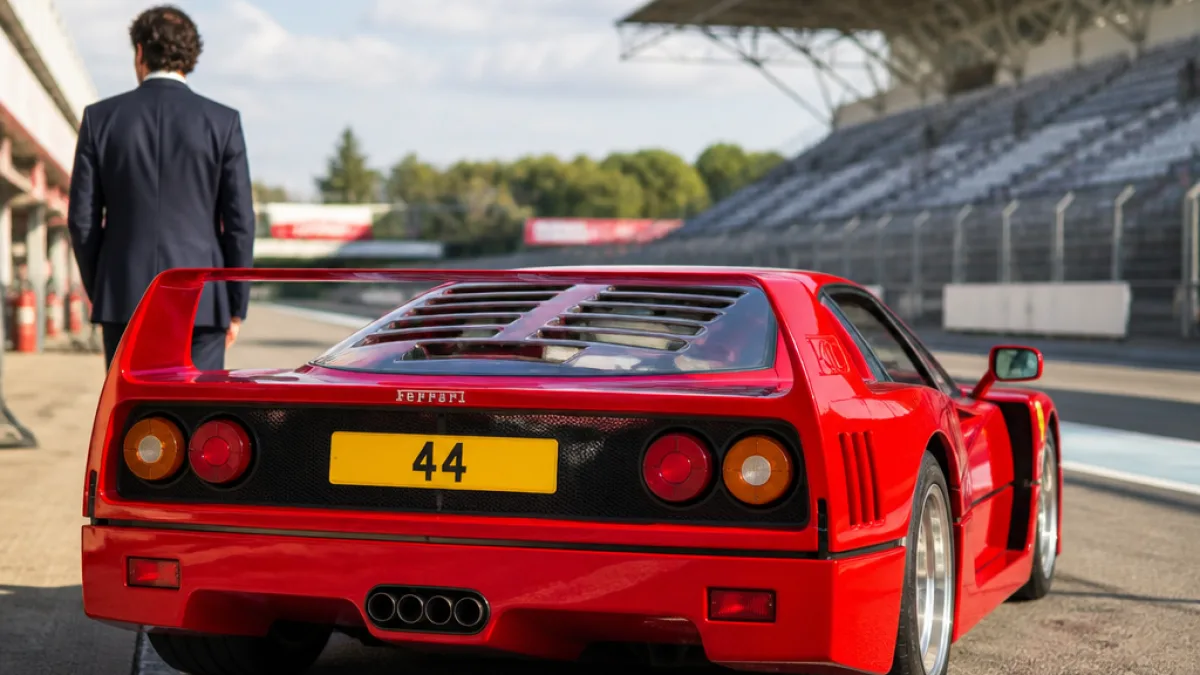
Lewis Hamilton made a deliberately theatrical entrance at the Italian Grand Prix venue in Monza this week, arriving in a restored Ferrari F40 and posing for pictures behind the paddock dressed in a suit, tie, coat and hat. The moment, captured and shared widely, was notable both for the car’s rarity and the way it connected to Hamilton’s racing identity.
Hamilton has been open about the back story to the purchase. He sought an F40 with low mileage and an authentic history — not just another example that had been heavily repainted or otherwise altered. The example he found, restored at Maranello, proved to be a remarkable time capsule: the previous owner drove it 69 kilometres from Maranello to his home and then parked it, rarely if ever starting it again. During restoration teams discovered that the passenger door had never been opened.
- Model: Ferrari F40
- UK plate: '44' — a number Hamilton has used throughout his career
- Distance driven before storage: 69 kilometres
The car also carries a UK licence plate reading '44', a direct nod to Hamilton’s long-standing race number. That number itself has roots in Hamilton’s childhood: he has said the choice traces back to the Vauxhall Cavalier plate on the family car his father drove while taking him to karting events.
Restoration, preservation and the decision to drive
Faced with a vehicle that had been preserved in near-original condition, Hamilton confronted a common dilemma among collectors and restorers: keep the car as a static, museum-like object or bring it back to life to be driven. He ultimately chose the latter, commissioning work that returned the F40 to driving condition because he wanted to experience the car rather than display it as an artefact.
"It’s a dream car of mine... I wanted one with low mileage. I wanted one with a story," Hamilton said of the F40.
He also reflected on the symbolism of arriving at a race in one’s own iconic car. Hamilton noted that, to his knowledge, Ferrari drivers historically have not typically arrived at grands prix in their most celebrated road-going Ferraris — the GTO or F40, for example — and said he felt the moment "had to be done."
Why the moment matters to Canadian and Hamilton audiences
For Hamilton residents who follow Formula 1 and the wider automotive scene, the arrival performs multiple functions. It is a personal statement by one of the sport’s most recognisable figures, a marketing moment for Ferrari’s cultural cachet, and a reminder of the continuing romance surrounding rare, original-condition supercars. The detail that the car carried Hamilton’s long-used racing number gives the arrival an extra layer of meaning for fans who track drivers’ personal brands as closely as their on-track performances.
Locally, the episode will resonate with enthusiasts and collectors across the Hamilton region — a community where classic-car restoration and car-culture events are part of the motoring fabric. Seeing a seven-time world champion choose authenticity and usability over static preservation may influence how local collectors think about restoration versus preservation.
| Attribute | Detail |
|---|---|
| Car | Ferrari F40 |
| Licence plate | UK '44' |
| Distance driven by first owner | 69 km |
| Condition on discovery | Remarkably original; passenger door reportedly never opened |
The staging at Monza — the suit, the setting behind the paddock, the choice to run a period-correct plate — is all part of how modern drivers curate their public image. For Hamilton, who has balanced on-track success with off-track cultural visibility, the F40 arrival was both personal celebration and a moment calculated to capture attention. For Hamilton residents who keep an eye on international motorsports and local car scenes alike, it was a tidy intersection of sport, style and automotive heritage.
As the Grand Prix weekend moved on, the image of a seven-time champion standing beside an F40 — a car as storied and scarce as any in modern automotive lore — served as a reminder that in Formula 1, personal narrative and machine myth-making travel together.