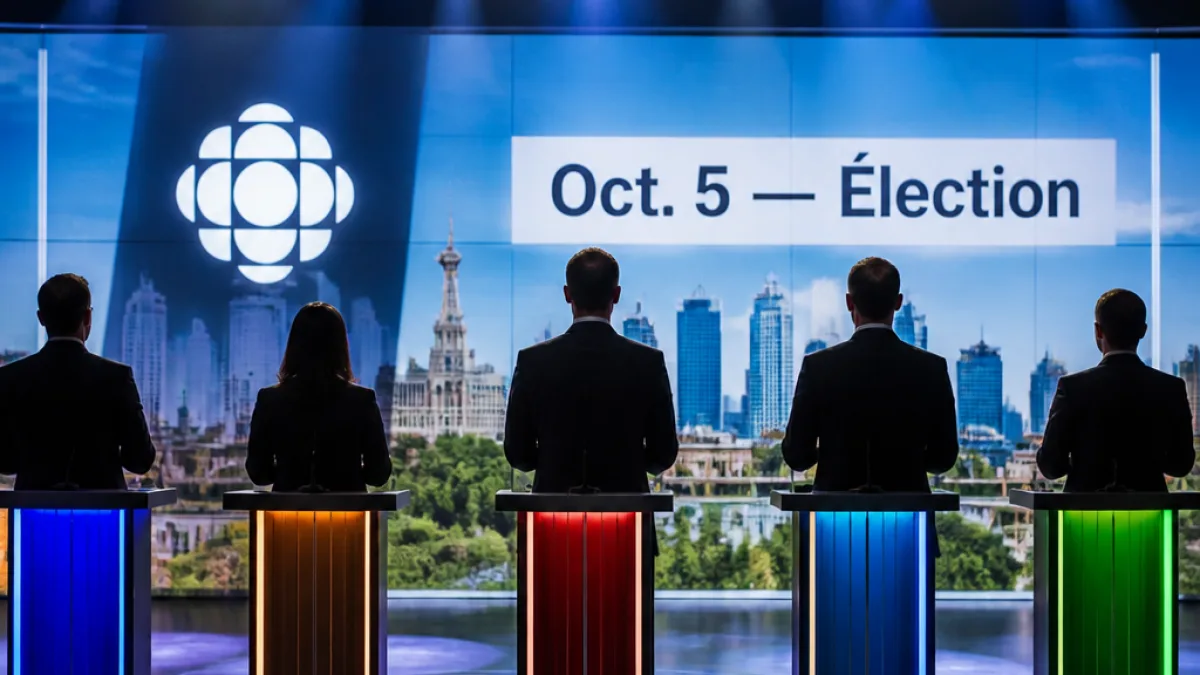
MONTREAL — Candidates representing Quebec’s five principal political parties met in an evening debate hosted by Radio‑Canada on Thursday to present competing visions for the province’s economy, with provincial voters returning to the polls on Oct. 5.
Focus on tariffs, inflation and energy
The session, moderated by Radio‑Canada host Gérald Fillion, concentrated on trade friction with the United States, measures to relieve household budgets, the energy transition and the management of public accounts. Party leaders did not take part in the event; they are scheduled to appear together in a third televised leaders’ debate on Sept. 23.
Organizers said the debate was designed to give voters a clearer sense of how each party would handle economic pressures that have been central to the campaign. Issues under scrutiny included the possible effects of American tariffs, strategies to curb the rising cost of living, plans to manage Quebec’s energy resources and proposals to stabilise provincial finances.
Wide representation, targeted scrutiny
Candidates from the Coalition Avenir Québec, the Parti Québécois, the Quebec Liberal Party, Québec solidaire and the Conservative Party of Quebec took part. With leaders absent, the session provided a platform for local and regional campaigners to spell out policy details and to press their opponents on implementation and affordability.
Earlier in the week, party leaders engaged in two debates that set a sharper national tone; Thursday’s event was meant to bring the discussion down to the municipal and regional impacts of provincial economic policy, organisers said.
- Trade and tariffs: Panelists were asked how they would respond to potential or actual American tariffs affecting Quebec exporters.
- Cost of living: Candidates outlined approaches to housing, food costs and household energy bills.
- Energy policy: The debate examined the balance between hydroelectric production, energy prices and transition plans.
- Public finances: Participants faced questions about deficit reduction, taxation and spending priorities.
Context and consequences
The debate comes at a time when many Quebec households continue to feel the strain of higher prices and when exporters are attentive to international trade shifts. Voters in manufacturing regions and in urban centres alike were expected to follow the discussion closely, particularly as it touches on jobs, transportation costs and regional investment.
While party leaders have dominated media attention throughout the campaign, the candidates’ debate offered a chance for less prominent figures to present concrete proposals and to test them against competing platforms. For many voters, the session served as a practical guide to how party promises might translate into action in local communities.
How this fits into the campaign calendar
With the leaders’ showdown set for Sept. 23, the campaign is entering its final fortnight of direct voter engagement. The televised exchanges are expected to shape media coverage and voter perceptions heading into advance polling and Election Day on Oct. 5.
| Party | Participation in Thursday debate |
|---|---|
| Coalition Avenir Québec | Candidate participants |
| Parti Québécois | Candidate participants |
| Quebec Liberal Party | Candidate participants |
| Québec solidaire | Candidate participants |
| Conservative Party of Quebec | Candidate participants |
Each party was represented by candidates rather than their leaders, underlining a campaign phase in which local credibility and specific policy detail can influence undecided voters.
What voters should watch for next
The leaders’ debate on Sept. 23 will be the next major televised event and could be decisive in framing the final days of the campaign. Observers will look for how party leaders respond to the themes debated on Thursday — particularly tariff mitigation, affordability measures and plans for Quebec’s energy future — and whether they offer new costed commitments or sharper contrasts with rivals.
For Quebecers weighing their choices, the coming two weeks will feature intensified scrutiny of platforms and promises, with a mix of provincial and local consequences. The economic debate was one of the last opportunities before the leaders’ face‑off for candidates to make the case directly in a provincewide broadcast.
Reporting from Montreal.