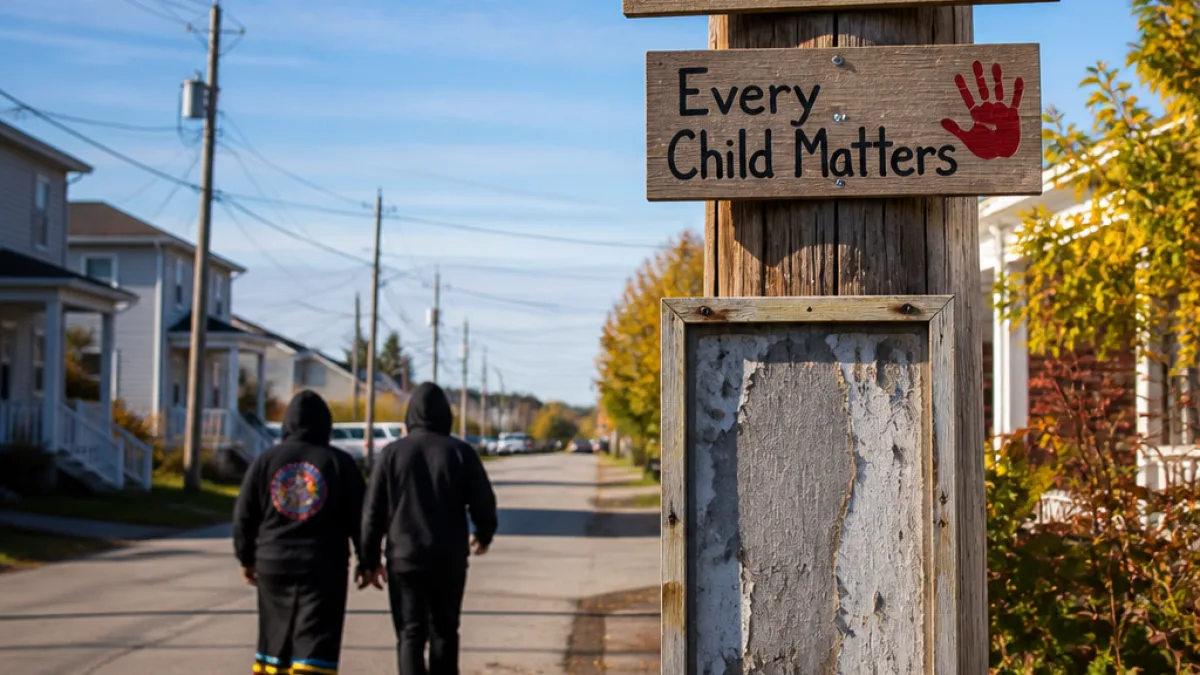
As Quebec prepares for a provincial election, the suburban streets of the Mohawk community of Kahnawake, just across the Saint Lawrence from Montreal, offer a telling visual: signs that mark land and memory—"Every Child Matters," "This is Mohawk Land," and placards in Kanien'kéha—are common. Campaign posters for provincial parties are not.
Election posters removed, community keeps its distance
Local leaders say political advertising is actively discouraged. Mohawk Council of Kahnawake Grand Chief Cody Diabo said the community does not want the provincial campaign to be “in our face” and that any posters that do appear are quickly taken down.
“We don’t want to participate or be involved in (the elections) in any way, nor do we want it to be right in our face,”
The removal of campaign material has been captured on video and shared online: footage circulating recently shows someone using a sledgehammer to pull down a Parti Québécois sign placed at the edge of a highway near Kahnawake.
Turnout gap between Indigenous communities and provincewide average
Provincial election data compiled by Élections Québec reveals a striking disparity: over the last two decades, the average voter turnout in Indigenous communities has been roughly 19 per cent, compared with about 68 per cent across Quebec.
Those averages mask large differences between communities. For example, in the Quebec City region’s Indigenous community of Wendake, turnout in 2022 was significantly higher: 1,012 ballots were cast out of 1,691 registered voters. By contrast, turnout in parts of Akwesasne was effectively nonexistent in 2022 despite a large number of registrants.
| Measure | Figure |
|---|---|
| Average Indigenous communities turnout (since 2007) | ~19% |
| Quebec provincewide average turnout | ~68% |
| Wendake (2022) | 1,012 / 1,691 registered voters cast ballots |
Why the disengagement?
Local leaders and community members point to multiple, often overlapping reasons for low participation in provincial elections. Central among them is a sovereignty and jurisdictional perspective: many residents view provincial and federal governments as operating on territory they consider outside those governments’ authority.
Other factors include a history of colonial relationships, persistent concerns about provincial policies affecting Indigenous self-determination, and the sense that provincial ballots will not address community priorities. In some communities, logistical barriers and questions about the value of voting also play roles.
- Jurisdictional and sovereignty concerns: elections seen as foreign to band governance.
- Historical distrust of provincial and federal institutions rooted in colonial policies.
- Local enforcement against campaign presence, limiting exposure to provincial parties.
Local enforcement and community norms
The active removal of party posters in Kahnawake speaks to local norms that deter visible provincial campaigning. For candidates and parties, the lack of visible outreach in such communities is both a cause and an effect of low engagement: without canvassing, debates or visible platforms tailored to community concerns, voters may feel further removed from provincial politics.
At the same time, communities that do participate — such as Wendake in 2022 — show that turnout is not uniform. Those variations suggest local leadership, outreach and community politics influence whether voters step into provincial polling stations.
Implications for provincial politics
For Quebec’s political parties, low Indigenous turnout raises questions about representation and legitimacy. Legislators elected on votes that exclude large swathes of Indigenous populations may face harder questions about how their mandates intersect with Indigenous rights and claims.
For Indigenous communities, maintaining distance can be an assertion of political autonomy and a strategy to prioritise self-determination. But it also means decisions at the provincial level can be made with limited direct electoral input from those communities.
As the election approaches, the dynamic between Indigenous communities and provincial political actors remains a critical element of Quebec’s democratic landscape. Understanding it requires attention to history, local governance and the everyday choices communities make to protect space for their own political processes.
Contact: Reporting from Kahnawake and Montreal.