Project reaches halfway point in design
Design work on a proposed gondola linking Production Way-University Station with Simon Fraser University’s main campus has reached roughly 50 per cent, but the project remains dependent on financial support from senior governments before construction and ongoing service can proceed.
TransLink CEO Kevin Quinn provided the update during an annual address to the Greater Vancouver Board of Trade on Nov. 20, 2026. His remarks placed the Burnaby Mountain project within a wider discussion of the region’s transit system, including the pressure on the existing bus network and the potential effect of shifting university trips to a fixed-link service.
“It’s a great project. The great benefit of the gondola is we get buses back into our system, right?”
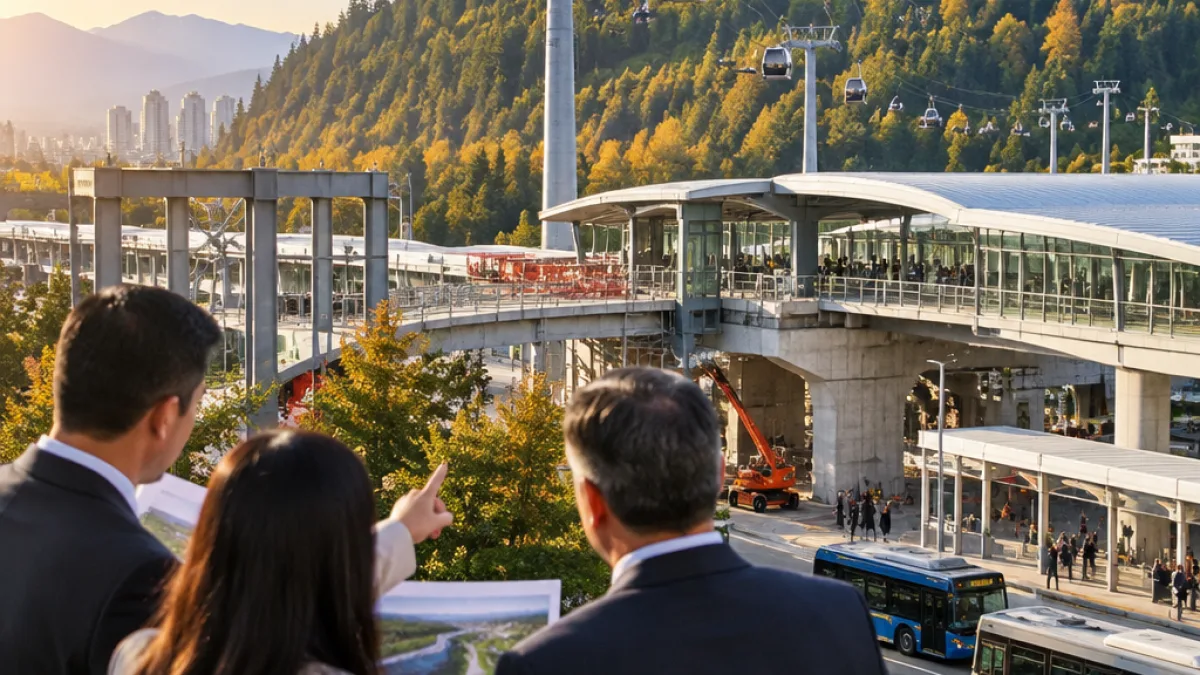
The proposed line would travel in a straight line for 2.7 kilometres, rising up Burnaby Mountain to the SFU campus. It is planned as a heavy-duty transit gondola, with cabins designed to carry about 30 passengers. TransLink has compared the cabin concept with the Peak to Peak gondola at Whistler Blackcomb, although the proposed Burnaby service would function as part of the public-transit network rather than as a recreational link.
A connection designed to reshape bus service
The project’s effect would extend beyond the cable line itself. Once the gondola opened, TransLink would substantially reorganize bus service serving the campus, including discontinuing the major No. 145 route between Production Way-University Station and SFU. That change would make the gondola the principal connection between the SkyTrain station and the university on Burnaby Mountain.
Quinn said the change could release buses for use elsewhere in Metro Vancouver at a time when TransLink’s depots are operating under considerable pressure. The agency’s case for the gondola therefore rests on two linked outcomes: creating a faster, higher-capacity trip to the university and allowing buses now concentrated on the mountain connection to return to other parts of the system.
- Route length: 2.7 kilometres
- Peak capacity: 3,000 passengers per hour in each direction
- Estimated end-to-end trip: seven minutes
- Mountain elevation: about 370 metres above sea level
Funding remains the central condition
The proposed capacity would be about 66 per cent higher than the peak-period capacity of Metro Vancouver’s busiest bus route, the 99 B-Line. The gondola could potentially run at maximum frequencies of less than one minute, according to the project description. Those figures describe the intended operating model, however, rather than a service that has been built or placed into operation.
| Feature | Proposed detail |
|---|---|
| Lower connection | Production Way-University Station |
| Upper connection | SFU’s main campus |
| Cabin size | About 30 passengers |
| Peak direction capacity | 3,000 passengers per hour |
TransLink still requires commitments from both the provincial and federal governments to help pay for construction and to support the service after it opens. Quinn also indicated that a private partner could be suitable for helping achieve the project. The remarks point to a financing and operating model that is not yet settled, even as design work continues.
At the proposed lower terminal, earlier conceptual renderings show a large indoor concourse intended to create a transfer hub between the gondola and the SkyTrain station. For Burnaby residents, students and staff, that interchange would be the project’s most visible point on the ground: a new meeting place between rapid transit arriving from the region and a direct climb toward the university. For the broader system, the unresolved question is whether the promised capacity and bus relief can move from design drawings to a funded, operating service.