Water allocations across the Western Cape will be reduced after two consecutive below-average rainfall seasons pushed the province’s main supply system below its preferred operating level and increased the risk of shortages from 2027.
Water and Sanitation Minister Pemmy Majodina announced on Monday that allocations for domestic and industrial users would be cut by 7%, while irrigation allocations would decrease by 15%. The measures apply across the Western Cape water supply system, which serves Cape Town, parts of the West Coast and Winelands, as well as agricultural users.
The reductions are expected to remove about 56.8 million cubic metres from annual allocations, equivalent to roughly 11% of the system’s total allocations. Irrigation users will account for 29.6 million cubic metres of the reduction, while domestic and industrial users will have 27.2 million cubic metres less available.
Storage has fallen below the preferred threshold
According to the department’s annual operating analysis for the 2026/27 hydrological year, the system remains operationally stable and is currently able to meet demand. That position, however, is being tested by declining storage and weaker rainfall, with the department warning that future supply risks are increasing.
| Measure | Latest position |
|---|---|
| Combined dam storage on 2 November | 72.5%, or 646.5 million cubic metres |
| Storage during the same period in 2025 | 84.4%, or 694 million cubic metres |
| Preferred operational threshold | 80% |
| Ten-year average | 84.49% |
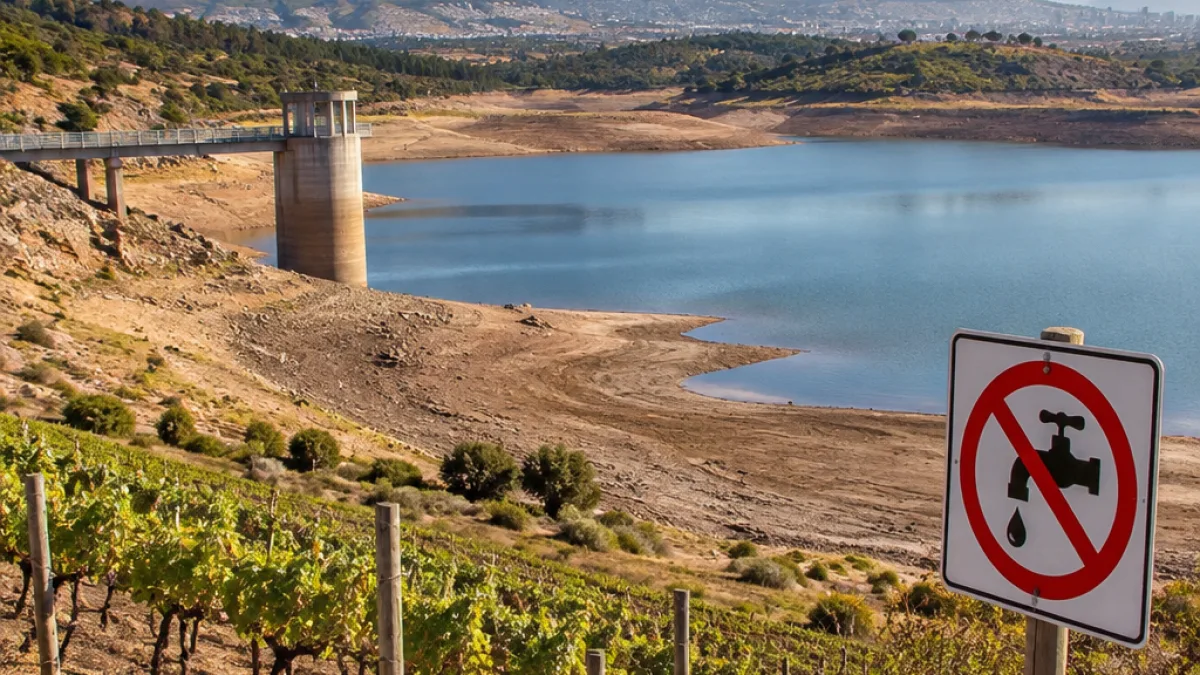
The combined storage level of 72.5% was recorded on 2 November. That was 11.9 percentage points below the system’s 10-year average of 84.49% and below the preferred operating threshold of 80%.
The decline matters because the Western Cape relies heavily on a network of interconnected dams to balance supply between urban areas, industry and farming. The system includes Theewaterskloof, Berg River, Wemmershoek, Voëlvlei, and the Upper and Lower Steenbras dams.
Rainfall deficit raises longer-term concerns
Rainfall during the 2024/25 and 2025/26 periods reached 722.7 millimetres and 752.8mm respectively. Both totals were well below the long-term average of 964mm, according to the department.
The current decision is therefore not presented as a response to an immediate failure of the supply system. Rather, it is an intervention intended to reduce the rate at which water is drawn down and to protect supplies as uncertainty grows. Government modelling found that continuing to use full allocations would substantially increase the likelihood of shortages and mandatory restrictions from 2027 onwards.
For households and businesses, the announcement does not by itself set out a new province-wide schedule of restrictions. It does, however, signal that the margin between available supply and demand is narrowing. The effect on individual users will depend on how the allocation reductions are implemented within the broader supply system and by the authorities responsible for different areas.
Irrigation faces the largest percentage cut
Agriculture will carry the larger percentage reduction, with irrigation allocations falling by 15%. This is significant in a province where farming and export-oriented crops share the same water resources as cities and industrial users. The department’s figures show that the irrigation cut will remove more water in absolute terms than the reduction affecting domestic and industrial users.
The decision places the competing needs of the province’s urban and rural economies in sharper focus. Cape Town and surrounding municipalities require reliable water for residents and businesses, while agricultural users depend on allocations for production. Cutting both categories reflects an attempt to manage the system as a whole rather than treating one sector as the sole source of reduced demand.
- Domestic and industrial allocations: reduced by 7%.
- Irrigation allocations: reduced by 15%.
- Total annual reduction: about 56.8 million cubic metres.
- Projected risk: shortages and mandatory restrictions become more likely from 2027 if full allocations continue.
El Niño adds another layer of uncertainty
The department has also warned that a forecast of a strong to extreme El Niño could further complicate the outlook. The weather pattern can bring higher temperatures, increased evaporation and reduced runoff into dams, all of which would place additional pressure on stored water.
El Niño is a naturally occurring climate phenomenon and is not directly caused by fossil-fuel-driven climate change. Scientists nevertheless note that warmer ocean temperatures, associated with a warming planet, can intensify its effects. For the Western Cape, where rainfall is strongly seasonal, a weaker winter rainfall season can have consequences well beyond the immediate months in which it occurs.
The supply system serves a broad area that includes Cape Town, the West Coast, Stellenbosch, Paarl, Franschhoek and Wellington, alongside agricultural users throughout the region. Its condition will therefore remain relevant to municipal planning, farming operations, industrial activity and household water security.
For now, the department says the system can meet existing demand. The allocation cuts are a warning that this position cannot be assumed indefinitely. With storage already below its preferred level and rainfall below average for two successive periods, the choices made before 2027 will determine whether the province can avoid more severe and compulsory restrictions later.