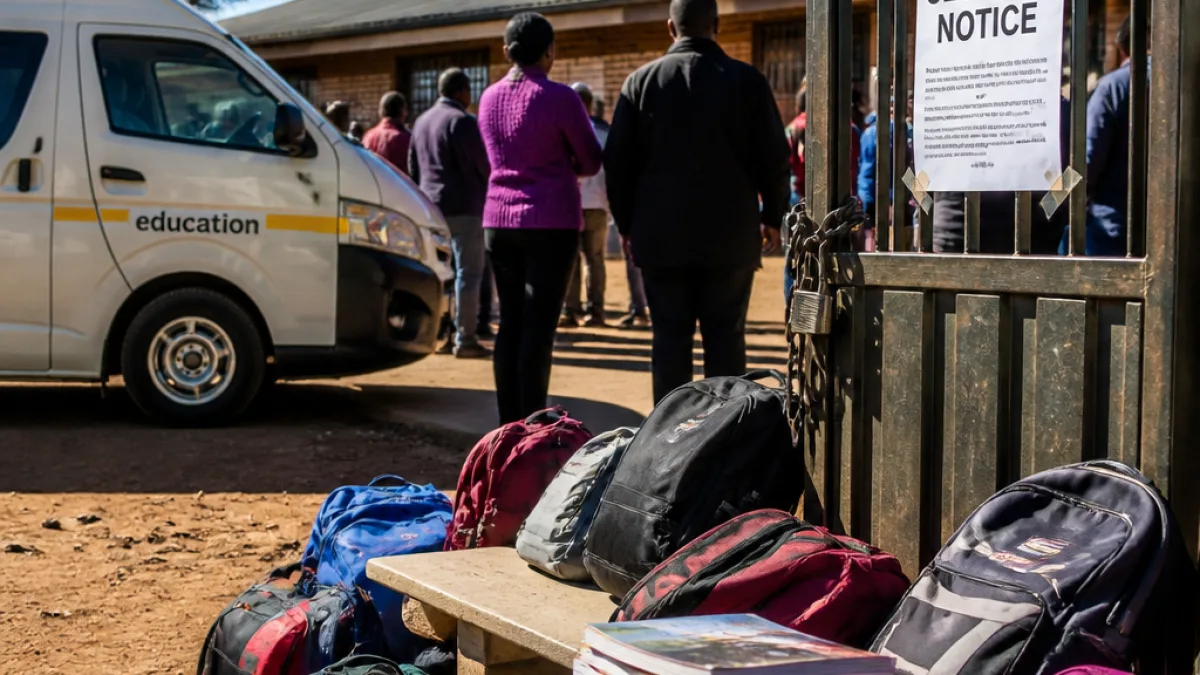
Gauteng’s education department has stepped up enforcement against unauthorised learning centres, investigating 61 schools suspected of operating illegally since January and issuing closure letters to 32 institutions, the province’s MEC for education, Lebogang Maile, said at a media briefing.
Action follows tip-offs and on-the-ground visits
Officials moved on schools after receiving information from parents, community members and other government entities. Teams visited the institutions to verify registration and compliance documents and instructed those found to be operating unlawfully to stop.
Where closures occurred, the department emphasised that action does not end with shutting a premises. District offices are required to work with parents to place affected learners in lawful schools to ensure continuity of education.
“Where an institution is found to be operating unlawfully, it is instructed to cease operating and the relevant closure process is followed,”
Maile said that of the cases dealt with so far in 2026, seven schools had ceased operating and four had applied for registration. Two school directors were arrested during the department’s interventions.
Context: growing independent sector and provincial subsidies
Gauteng now has 1 083 operational independent schools registered across the province, up from 961 in 2021. The crackdown on unlawful institutions runs alongside planned financial support for legitimate private providers: the department intends to allocate approximately R1.13 billion in subsidies to qualifying independent schools in the 2026/27 financial year.
| Allocation | Phase |
|---|---|
| R621 million | Primary phase |
| R508 million | Secondary phase |
The MEC also noted broader transfers and subsidies previously allocated to the sector, with the department having distributed around R4.3 billion in transfers and subsidies over recent periods, signalling continued financial support for compliant independent schools.
What this means for learners and parents
Officials made clear that closing an illegal school does not absolve the department of responsibility for learners. District offices are accountable for placing affected children in registered schools to prevent disruption to their education.
- Parents who suspect an unregistered school should report concerns to their local district office.
- Learners displaced by closures will be assisted to enrol at lawful schools by the relevant district.
- Schools operating without registration can be instructed to stop and face legal processes; operators may be prosecuted and directors arrested.
Community members in several suburbs have raised alarm in recent months about small private establishments advertising quick-fee structures and irregular class hours; the department said these initial reports formed part of the information prompting inspections.
Enforcement and registration: the department’s next steps
The department’s inspections check for required compliance documents and registration with provincial authorities. Institutions found wanting are instructed to cease operations and are guided through the formal closure process where necessary.
For those wishing to operate legitimately, the department said it would process registration applications and consider subsidy eligibility, provided schools meet the prescribed regulatory and quality standards.
The recent moves aim to protect learners from substandard provision and to ensure that state support is targeted at verified, accountable institutions. As the registration drive continues, parents and community representatives in Gauteng will be watching how quickly displaced learners are absorbed into the registered system.
Reporting from Johannesburg.