
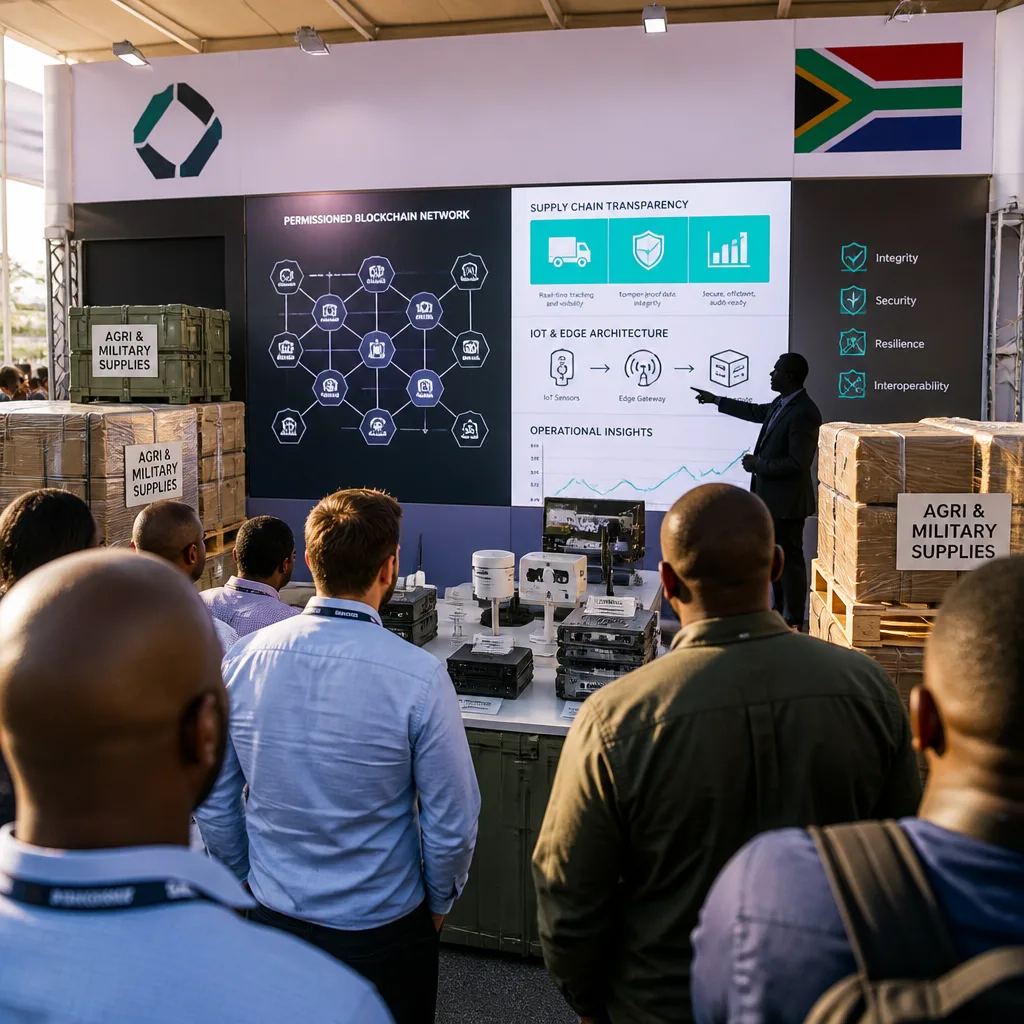
The South African Defence Group (SADG) will present a paper at Africa Aerospace and Defence (AAD) 2026 that argues sovereign digital infrastructure designed for commodity tracking can be adapted to meet military logistics and accountability needs, according to DefenceWeb.
From agricultural commodities to ammunition lots
The presentation, delivered by Dr Mthobisi Zondi, Executive Chair of SADG, centres on the Integrated Commodity Tracing and Authentication System (ICTAS). Originally created for tracking agricultural and mineral commodities in a SADC country, ICTAS combines several technologies – including a permissioned blockchain (Hyperledger Fabric), unique digital identities, IoT sensor networks, edge computing and automated compliance engines – to provide immutable, end‑to‑end traceability.
“In constrained budget environments, the ability to extract dual dividends from a single sovereign platform provides strategic advantage,” said Dr Zondi.
According to the reporting, each commodity batch in ICTAS receives a verifiable digital identity and an immutable record of quality certificates, chain‑of‑custody events and warehouse receipts. Real‑time GPS and condition monitoring give continuous visibility of consignments.
How civil systems map to defence needs
SADG’s argument is that the ICTAS architecture maps directly onto a range of defence logistics requirements. The reported applications include:
- unique digital identity and provenance tracking for ammunition lots and critical components;
- real‑time fleet and convoy tracking for military logistics;
- depot and ammunition accounting with environmental monitoring;
- automated support for end‑user certificates and Arms Trade Treaty reporting; and
- SADC‑wide logistics interoperability for joint and Standby Force operations.
The paper frames these capabilities as particularly valuable where budgets are constrained: one sovereign platform can deliver benefits across civil and defence spheres, strengthen oversight and support exportable industrial capacity.
Technology components and defence functions
Breaking down the architecture helps clarify how a commodity system can be repurposed for military logistics. According to the DefenceWeb summary, the primary components and their mapped defence uses are:
| ICTAS component | Defence application |
|---|---|
| Permissioned blockchain (Hyperledger Fabric) | Immutable records for provenance, accounting and treaty reporting |
| Commodity Tracking ID (unique digital identity) | Serialised tracking of ammunition lots and parts |
| IoT sensor networks & GPS | Real‑time convoy/fleet tracking and environmental monitoring in depots |
| Edge computing & automated compliance engines | Local processing for resilience and automated regulatory reporting |
That combination is presented as enabling continuous visibility of assets and reducing opportunities for loss, mis‑accounting or fraud — all persistent concerns in logistics chains for both civil and defence sectors.
Policy and procurement implications
The SADG paper touches on several policy questions that are increasingly relevant to South Africa’s technology and defence planners. Foremost is the idea of investing in sovereign platforms that can be reused across sectors to multiply return on investment. The approach also raises practical questions about certification, security, interoperability and governance when civilian systems are adapted for military use.
Adopting permissioned blockchains and distributed digital identities implies a need for agreed standards — technical, legal and operational — particularly where cross‑border interoperability with SADC partners is envisioned. It also places emphasis on resilient local supply chains for sensors, communications and edge devices so systems remain operational in austere environments.
For technology teams operating on tight data and budget constraints, the appeal is clear: a shared platform reduces duplication while delivering traceability and accountability. For defence planners, the potential upside is better visibility of arms, ammunition and logistics without entirely separate and costly bespoke systems.
As Air Force Base Waterkloof hosts AAD 2026, the SADG contribution underscores a wider trend: civil technologies, when built with sovereignty and security in mind, are being reframed as national capability multipliers. The next steps will test whether governments and procurement agencies can translate that potential into interoperable, secure and sustainable deployments across both civil and defence domains.