
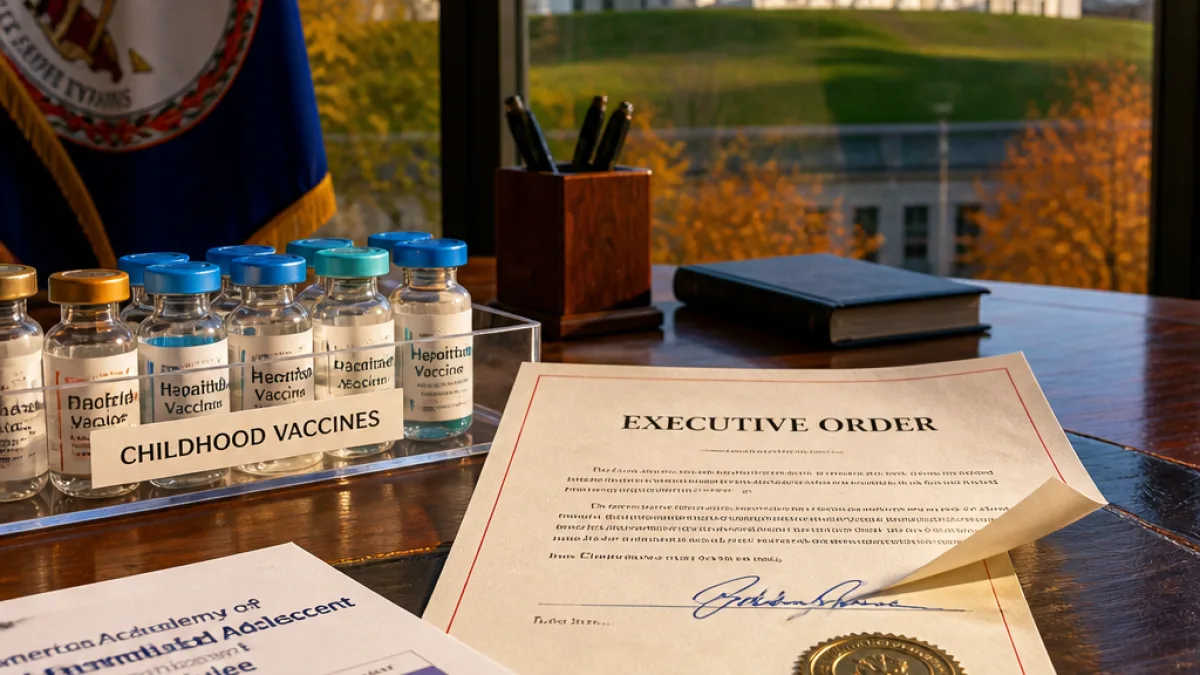
Virginia’s Department of Health on Tuesday said the commonwealth will not change its existing childhood immunization requirements after President Donald Trump signed an executive order that alters federal vaccine guidance.
State to follow established science, officials say
VDH Commissioner Dr. Cameron Webb emphasized that Virginia families should rely on the state’s long-standing approach to vaccination, which the department said is grounded in the latest available science. The department reaffirmed its support for the immunization timeline endorsed by the American Academy of Pediatrics as an effective strategy to protect children from serious, preventable illnesses.
“The evidence supporting the (American Academy of Pediatrics) immunization schedule is extensive, and we remain confident that following it is one of the best ways to protect children from serious, preventable diseases,” Dr. Webb said.
The White House order, signed Monday alongside Health and Human Services Secretary Robert F. Kennedy Jr., recommends that all children receive vaccinations for 11 specific diseases and suggests that additional vaccines be targeted to high-risk groups. The order also classifies some vaccines, including influenza and COVID-19 shots, under a rubric of "shared clinical decision-making."
What the federal order lists
The presidential order specifies a set of routine childhood immunizations and mentions several others for particular populations. Because the order represents federal guidance rather than direct changes to state law, Virginia officials said the commonwealth’s current mandates remain in effect.
| Vaccines the order recommends for all children |
|---|
| Measles, mumps and rubella |
| Diphtheria |
| Tetanus |
| Pertussis (whooping cough) |
| Polio |
| Haemophilus influenzae type B |
| Pneumococcal disease |
| Human papillomavirus (HPV) |
| Varicella (chickenpox) |
The order also references vaccines or prophylactic antibodies for high-risk groups, including respiratory syncytial virus monoclonal antibodies, hepatitis A and B, meningococcal B, meningococcal ACWY and dengue. It characterizes influenza and COVID-19 vaccines as decisions to be made jointly by clinicians and patients.
Single-disease MMR proposal draws scrutiny
In an unusual provision, the executive order called for the measles, mumps and rubella vaccine — commonly given as a combined MMR shot — to be separated into three single-disease products administered at different times. White House officials acknowledged during a media call that such single-disease formulations are not currently available in the United States but suggested private-sector development could change that in the future.
Virginia’s Department of Health did not indicate any plan to pursue or adopt single-disease alternatives. The department’s public comments focused on preserving the current schedule and maintaining high immunization coverage, particularly as measles cases have increased in the commonwealth this year.
Local context: measles increase and vaccine hesitancy
State health officials noted that measles activity has risen in Virginia in recent months, with the majority of cases occurring in young children. The department said this uptick highlights the importance of adhering to recommended vaccine schedules.
Health authorities have for years battled waves of vaccine skepticism and misinformation that periodically gain traction among some parents. Officials said continued reliance on robust, science-based recommendations is essential to protecting children and the public at large.
- State stance: Maintain existing vaccine requirements and follow AAP schedule.
- Federal action: Executive order recommends vaccines for 11 diseases, suggests others for high-risk groups.
- Notable proposal: Splitting the combined MMR into separate shots, though single-disease versions are not available in the U.S.
What families and providers should know
Because the executive order does not change Virginia law, parents and clinicians in the commonwealth should continue to follow state rules on school-entry immunizations and the immunization timelines generally promoted by pediatric and public-health organizations. Health care providers and school officials remain responsible for enforcing state requirements, and parents seeking exemptions should consult current state guidance for eligibility and procedures.
Public health leaders reiterated the protective value of high vaccine coverage for preventing outbreaks of highly contagious diseases like measles, particularly in communities with young children. The department said it will continue outreach and education efforts to encourage up-to-date vaccinations across the state.
This article will be updated if the Virginia Department of Health issues further guidance or if state lawmakers take action to modify existing immunization law.
Nathaniel Okafor is a state correspondent covering health and public policy for WE NEWS.
















